How do you calculate wind speed using the Doppler effect?

Click For Summary
The discussion focuses on calculating wind speed using the Doppler effect, specifically in the context of a weather monitoring station using a 625 MHz Doppler radar system. The measured frequency shift of 325 Hz indicates that the Doppler effect occurs twice: once when the radar pulse hits the raindrops and again when the reflected pulse returns to the radar. To find the wind speed, the frequency shift should be halved, leading to a shift of 162.5 Hz for each Doppler effect occurrence. The correct approach involves using the relativistic Doppler shift formula to account for these two shifts. Understanding this concept is crucial for accurately determining wind speeds in storm systems.
Vivman
Messages
2
Reaction score
0
Homework Statement
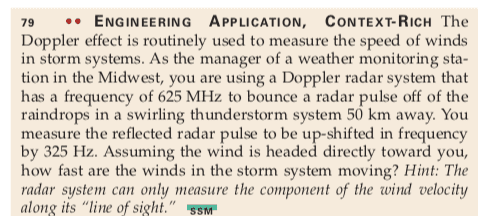
The Doppler effect is routinely used to measure the speed of winds in storm systems. As the manager of a weather monitoring sta- tion in the Midwest, you are using a Doppler radar system that has a frequency of 625 MHz to bounce a radar pulse off of the raindrops in a swirling thunderstorm system 50 km away. You measure the reflected radar pulse to be up-shifted in frequency by 325 Hz. Assuming the wind is headed directly toward you, how fast are the winds in the storm system moving?
Relevant Equations
Doppler effect equation from Serway: f'(observer frequency) = (c + v)/c * f(source frequency)
Problem Statement: The Doppler effect is routinely used to measure the speed of winds in storm systems. As the manager of a weather monitoring sta- tion in the Midwest, you are using a Doppler radar system that has a frequency of 625 MHz to bounce a radar pulse off of the raindrops in a swirling thunderstorm system 50 km away. You measure the reflected radar pulse to be up-shifted in frequency by 325 Hz. Assuming the wind is headed directly toward you, how fast are the winds in the storm system moving?
Relevant Equations: Doppler effect equation from Serway: f'(observer frequency) = (c + v)/c * f(source frequency)

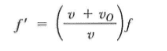
Attempt at solution was solving for v in the Doppler effect equation. Doing so seems wrong. Is this the correct way of doing it?
Skjermbilde 2019-04-28 kl. 16.46.35.png
Skjermbilde 2019-04-28 kl. 16.43.32.png
 
Physics news on Phys.org
In Doppler radar, the Doppler effect happens twice because of the reflection. The object receives the beam at the shifted frequency, and so the beam that reflects back is transmitted at a shifted frequency. And when received back at the source, it's shifted again because of the relative motion.

All that means that frequency shift is doubled. There's a factor of 2 in your equation. Or for f' use a frequency which is only shifted by half as much.
 
Vivman said:
Attempt at solution was solving for v in the Doppler effect equation. Doing so seems wrong. Is this the correct way of doing it?
Because the problem involves radar, which uses electromagnetic waves, you should be using the relativistic Doppler shift formula. As RPinPA noted, you have two Doppler shifts in this problem.
 
I see thank you very much. As RPinPA noted that half of the speed I get from the first frequency equation is correct. Why is that?
 
I already explained that. Because 325 Hz is the frequency shift after being shifted twice. So the frequency with which it arrives at the raindrops is 325/2 = 162.5 Hz. That's the Doppler shift caused due to the relative motion of the radar and the raindrops.

The other 162.5 Hz is because the raindrops send a reflected beam back to the source. The frequency of that beam is 625 MHz + 162.5 Hz in the drops frame of reference. When that gets Doppler shifted back at the radar, its frequency is 625 Mhz + 325 Hz.

Imagine there's a time delay instead of a direct reflection. Suppose we had a spaceship moving toward us and we send a 625 MHz radio signal to it. It receives the signal and records it. Because of the Doppler effect, the signal they receive is not at 625 MHz but something higher. An hour later they transmit the recorded signal back to the radar station, but what they're sending out is at more than 625 MHz. And at the radar station it is higher still, because of the Doppler shift.

Do you see now why there are two Doppler shifts and that 325 Hz is 2 times the frequency shift caused by relative motion of speed v?
 
The book claims the answer is that all the magnitudes are the same because "the gravitational force on the penguin is the same". I'm having trouble understanding this. I thought the buoyant force was equal to the weight of the fluid displaced. Weight depends on mass which depends on density. Therefore, due to the differing densities the buoyant force will be different in each case? Is this incorrect?

Similar threads

  • · Replies 8 ·
Replies
8
Views
825
  • · Replies 1 ·
Replies
1
Views
2K
  • · Replies 1 ·
Replies
1
Views
1K
  • · Replies 7 ·
Replies
7
Views
3K
  • · Replies 16 ·
Replies
16
Views
2K
  • · Replies 1 ·
Replies
1
Views
3K
  • · Replies 4 ·
Replies
4
Views
2K
  • · Replies 5 ·
Replies
5
Views
4K
  • · Replies 2 ·
Replies
2
Views
2K
  • · Replies 2 ·
Replies
2
Views
2K