How Do You Derive Transverse Comoving Distance?

  • Context: Undergrad 
  • Thread starter Thread starter S0uris
  • Start date Start date
  • Tags Tags
    Transverse
Join the discussion
Registration is free. Ask a follow-up in this thread, or start your own.
4 replies · 3K views
S0uris
Messages
2
Reaction score
0
Hi, i need derive the comoving distance (transverse)

im working with https://arxiv.org/pdf/astro-ph/9905116.pdf

I've had trouble starting, please help :)
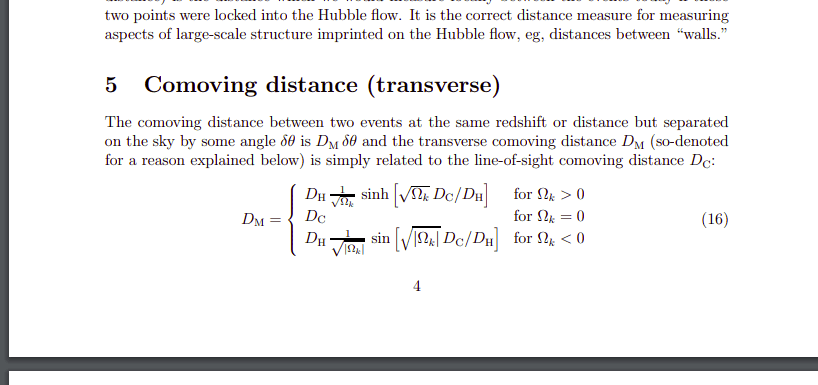
Captura de pantalla de 2020-06-03 19-12-29.png
 
Last edited:
Astronomy news on Phys.org
Could you go into more details? You cannot expect the readers read the entire paper.
 
ok :) i just need this form, i don't know how to start.

Captura de pantalla de 2020-06-03 19-12-29.png
 
S0uris said:
i need derive the comoving distance (transverse)

What do you mean by "derive" and what information that you need to do so isn't in the paper you linked to?
 
S0uris said:
Hi, i need derive the comoving distance (transverse)

im working with https://arxiv.org/pdf/astro-ph/9905116.pdf

I've had trouble starting, please help :)

View attachment 264089

I think you need to read up on the Friedmann-Robertson-Walker metric. If you do you will know those trigonometric terms come from the coordinate transformation to hyperspherical coordinates. This is done because the FRW metric (which is really the metric of a 3-sphere in spacetime) has a coordinate singularity when the curvature of the universe is non-zero.

The second point is that transverse comoving distance is related to angular diameter distance via the scale factor and in fact in the current time the scale factor is equal to one.

This explanation is terrible I know, but It's difficult to explain without actually deriving everything. If you are familiar with Einstein notation, then pages 3 to 6 inclusive of this document might help.
 
Last edited: