How Do You Design a JK Flip-Flop Synchronous Up/Down Counter?

  • Thread starter Thread starter Mark200
  • Start date Start date
  • Tags Tags
    Counter
Click For Summary
SUMMARY

The discussion focuses on designing a synchronous up/down counter using J-K flip-flops that counts through specific sequences based on the input switch UP. The required sequences are 1, 2, 6, 3, 5, 7 when UP is 1, and 7, 2, 1, 5, 3, 6 when UP is 0. A key recommendation is to create a next state Karnaugh map table using variables s, y0, y1, and y2 to derive the J and K inputs, which simplifies the design process and eliminates trial and error.

PREREQUISITES
  • Understanding of J-K flip-flops and their operation
  • Familiarity with synchronous counters and state machines
  • Knowledge of Karnaugh maps for simplifying logic expressions
  • Basic digital logic design principles
NEXT STEPS
  • Study the design of synchronous counters using J-K flip-flops
  • Learn how to construct and utilize Karnaugh maps for logic simplification
  • Explore the implementation of state machines in digital circuits
  • Review examples of up/down counters to understand their design variations
USEFUL FOR

Students preparing for exams in digital electronics, engineers designing digital circuits, and hobbyists interested in building synchronous counters using J-K flip-flops.

Mark200
Messages
2
Reaction score
0
Exam question:

Use J-K flip-flops to design the logic for a synchronous up/down counter that counts "up" through the sequence 1 2 6 3 5 7 f the input switch UP is 1, and "down" through the sequence 7 2 1 5 3 6 if UP is 0. Verify that the counter is self-starting.


What I know so far:

Ok so in my book I've found a similar circuit, except it's to count through the sequence 1 2 3 4 and so on. And I'm not sure at all how I'd go about changing the circuit to work for the question above. The circuit I have is:
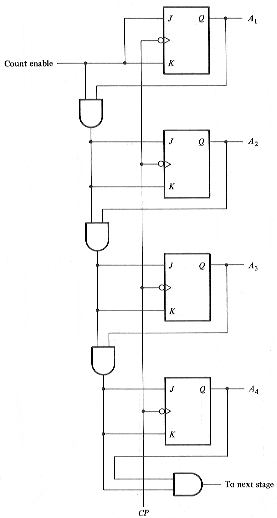
article1.sync_bin_c.gif


Any ideas?
 
Physics news on Phys.org
Hi Mark200, welcome to PF!

Hmmm...so it looks like you'll need three bits. And you want to go through the sequence:

001
010
110
011
101
111

It looks like the circuit you have makes great use of the fact that setting J = K = 1 toggles Q to change state, and setting J = Q = 0 keeps it the same. So I would expect that what would change would be which output of which AND gate goes where. That's all I've got though, short of actually trying to draw out different circuits.
 
Ok I'm afraid I'm going to need to ask for more help on this question! I failed my exam and I have to do a repeat exam, and it's tomorrow hah. And this question came up on the original exam!

I've been trying to figure out how to do it. I found a way, but it involves having about three logic gates for every single input and it's extremely messy. There must be an easier way. I tried to scan my work so far in but my scanner isn't working! I've thought about changing where the outputs go but I don't think that'll work.

Any ideas?? As much help as possible would be great! Even if it doesn't come up on the exam tomorrow it'd just be a relief to finally know how to do this question
 
Mark200 said:
Exam question:

Use J-K flip-flops to design the logic for a synchronous up/down counter that counts "up" through the sequence 1 2 6 3 5 7 f the input switch UP is 1, and "down" through the sequence 7 2 1 5 3 6 if UP is 0. Verify that the counter is self-starting.


What I know so far:

Ok so in my book I've found a similar circuit, except it's to count through the sequence 1 2 3 4 and so on. And I'm not sure at all how I'd go about changing the circuit to work for the question above. The circuit I have is:

article1.sync_bin_c.gif


Any ideas?

Mark200 said:
Ok I'm afraid I'm going to need to ask for more help on this question! I failed my exam and I have to do a repeat exam, and it's tomorrow hah. And this question came up on the original exam!

I've been trying to figure out how to do it. I found a way, but it involves having about three logic gates for every single input and it's extremely messy. There must be an easier way. I tried to scan my work so far in but my scanner isn't working! I've thought about changing where the outputs go but I don't think that'll work.

Any ideas?? As much help as possible would be great! Even if it doesn't come up on the exam tomorrow it'd just be a relief to finally know how to do this question

I'm sure it's a bit late for your exam. But instead of trying to find some ad-hoc jerry-rig that works, why don't you make a next state karnaugh map table with variables s, y0,y1,y2 from which you can solve for the J and K inputs? Takes a little time but also removes all the trial and error guesswork.
 

Similar threads

  • · Replies 3 ·
Replies
3
Views
2K
Replies
20
Views
4K
Replies
1
Views
3K
  • · Replies 4 ·
Replies
4
Views
3K
  • · Replies 1 ·
Replies
1
Views
4K
  • · Replies 1 ·
Replies
1
Views
2K
  • · Replies 2 ·
Replies
2
Views
6K
  • · Replies 1 ·
Replies
1
Views
2K
  • · Replies 5 ·
Replies
5
Views
4K
  • · Replies 2 ·
Replies
2
Views
2K