How Do You Estimate Sums Using the Euler-Mascheroni Constant?

  • Topic:
  • Thread starter ognik
  • Start date
  • Tags Tags
    Series
1 reply · 2K views · last reply
ognik
Messages
626
Reaction score
2
Hi, question asks to set upper and lower bounds on $$\sum_{n=1}^{1,000,000} \frac{1}{n}$$ assuming (a) the Euler-Mascheroni constant is known and (b) not known.

$\gamma = \lim_{{n}\to{\infty\left( \sum_{m=1}^{n} \frac{1}{m} \right)}} = 0.57721566$ and I found (a) easily (14.39272...), but no idea how to approach part b, a hint please?

This is similar to another problem, a pocket calculator gives $ \sum_{1}^{100} \frac{1}{{n}^{-3}}= 1.202 $, find upper and lower limits? Probably the hint will cover both :-)
 
ognik said:
Hi, question asks to set upper and lower bounds on $$\sum_{n=1}^{1,000,000} \frac{1}{n}$$ assuming (a) the Euler-Mascheroni constant is known and (b) not known.

$\gamma = \lim_{{n}\to{\infty\left( \sum_{m=1}^{n} \frac{1}{m} \right)}} = 0.57721566$ and I found (a) easily (14.39272...), but no idea how to approach part b, a hint please?

This is similar to another problem, a pocket calculator gives $ \sum_{1}^{100} \frac{1}{{n}^{-3}}= 1.202 $, find upper and lower limits? Probably the hint will cover both :-)
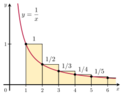
Hint: Use upper and lower Riemann sums for the integral of the function $1/x$, as in this picture:
 
Attachments
  • Graph of y = 1/x for x from 1 to 6, with rectangles of width 1 under the curve from x = 1 to 6 labelled with heights 1, 1/2, 1/3, 1/4 and 1/5.
    250px-Integral_Test.svg.png
    2.4 KB · Views: 153