How Do You Find the Measure of ∠BAC in Degrees?

  • Context: MHB 
  • Thread starter Thread starter CGuthrie91
  • Start date Start date
  • Tags Tags
    Measure
Click For Summary
SUMMARY

The measure of angle $\angle BAC$ is calculated as $\angle BAC = 34^{\circ} - 8^{\circ}$, resulting in $\angle BAC = 26^{\circ}$. This calculation is based on the angle of elevation at point A, which is $34^{\circ}$, and the angle formed by the slope of the ground, which is $8^{\circ}$. The sum of the angles in triangle ABC must equal $180^{\circ}$, allowing for further calculations of other angles such as $\angle ABC$.

PREREQUISITES
  • Understanding of basic trigonometry concepts
  • Familiarity with angle measures in degrees
  • Knowledge of the properties of triangles
  • Ability to set up and solve equations
NEXT STEPS
  • Study the properties of triangles and the sum of angles in a triangle
  • Learn how to calculate angles of elevation and depression
  • Explore trigonometric functions and their applications in solving for unknown angles
  • Practice solving equations involving angles in geometric figures
USEFUL FOR

Students studying geometry, educators teaching trigonometry, and anyone interested in understanding angle calculations in triangles.

CGuthrie91
Messages
9
Reaction score
0
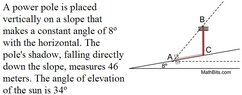
View attachment 2416

Find the measure of angle $\angle BAC$.
 

Attachments

  • question.jpg
    question.jpg
    31.6 KB · Views: 121
Last edited by a moderator:
Mathematics news on Phys.org
Re: Find the measure <BAC

Surely $\displaystyle \begin{align*} \angle BAC = 34^{\circ} - 8^{\circ} \end{align*}$. Can you see why?
 
Re: Find the measure <BAC

Prove It said:
Surely $\displaystyle \begin{align*} \angle BAC = 34^{\circ} - 8^{\circ} \end{align*}$. Can you see why?

not really
 
What about the measure of <ABC?
 
CGuthrie91 said:
What about the measure of <ABC?

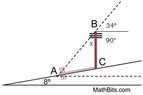
View attachment 2417

What must the sum of the three angles I have labeled be?
 

Attachments

  • questio2.jpg
    questio2.jpg
    6.9 KB · Views: 107
Re: Find the measure <BAC

CGuthrie91 said:
not really

The angle of elevation is $\displaystyle \begin{align*} 34^{\circ} \end{align*}$. This is the angle at point A that the segment AB makes with the horizontal.

The angle at A that is made from the slope of the ground with the horizontal is $\displaystyle \begin{align*} 8^{\circ} \end{align*}$. This combined with $\displaystyle \begin{align*} \angle BAC \end{align*}$ gives the angle of elevation.

So $\displaystyle \begin{align*} \angle BAC + 8^{\circ} = 34^{\circ} \end{align*}$, or equivalently, $\displaystyle \begin{align*} \angle BAC = 34^{\circ} - 8^{\circ} \end{align*}$.
 
MarkFL said:
https://www.physicsforums.com/attachments/2417

What must the sum of the three angles I have labeled be?
180?
 
CGuthrie91 said:
180?

Yes, in degrees. So, can you set up an equation, and then solve for the unknown $x$, representing $\angle ABC$?
 

Similar threads

  • · Replies 2 ·
Replies
2
Views
1K
  • · Replies 5 ·
Replies
5
Views
2K
Replies
1
Views
2K
  • · Replies 1 ·
Replies
1
Views
2K
  • · Replies 6 ·
Replies
6
Views
3K
  • · Replies 3 ·
Replies
3
Views
8K
  • · Replies 6 ·
Replies
6
Views
2K
  • · Replies 21 ·
Replies
21
Views
5K
  • · Replies 4 ·
Replies
4
Views
2K
  • · Replies 2 ·
Replies
2
Views
1K