How Do You Set Up Double Integrals for Different Orders of Integration?

  • Context: MHB 
  • Thread starter Thread starter harpazo
  • Start date Start date
  • Tags Tags
    Set
Click For Summary
SUMMARY

This discussion focuses on setting up double integrals for the function \( \frac{y}{1 + x^2} \) over a specified region \( R \), bounded by \( y = 0 \), \( y = \sqrt{x} \), and \( x = 4 \). Two orders of integration are established: first using vertical strips, resulting in the integral \( I = \int_0^4 \frac{1}{x^2+1} \int_0^{\sqrt{x}} y \, dy \, dx \), and second using horizontal strips, yielding \( I = \int_0^2 y \int_{y^2}^4 \frac{1}{x^2+1} \, dx \, dy \). Both setups lead to the same evaluation result of \( \frac{1}{4} \ln(17) \), confirming the consistency of the integration process.

PREREQUISITES
  • Understanding of double integrals and their applications
  • Familiarity with the concepts of integration order
  • Knowledge of the functions \( y = \sqrt{x} \) and \( y = 0 \)
  • Basic skills in evaluating integrals involving \( \frac{1}{x^2+1} \)
NEXT STEPS
  • Study the properties of double integrals in different coordinate systems
  • Learn about changing the order of integration in double integrals
  • Explore the evaluation of integrals involving trigonometric functions, specifically \( \arctan \)
  • Practice setting up double integrals for various bounded regions
USEFUL FOR

Students and professionals in mathematics, particularly those focusing on calculus, integration techniques, and anyone seeking to deepen their understanding of double integrals and their applications in different contexts.

harpazo
Messages
208
Reaction score
16
Set up an integral for both orders of integration.
DO NOT EVALUATE THE INTEGRAL.

Let S S = double integrals

Let R = region

S S y/(1 + x^2) dA

R: region bounded by y = 0, y = sqrt{x}, x = 4

I can graph the region but have no idea how to proceed from there. I need solution steps.
 
Physics news on Phys.org
Harpazo said:
Set up an integral for both orders of integration.
DO NOT EVALUATE THE INTEGRAL.

Let S S = double integrals

Let R = region

S S y/(1 + x^2) dA

R: region bounded by y = 0, y = sqrt{x}, x = 4

I can graph the region but have no idea how to proceed from there. I need solution steps.

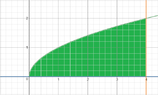
First we should note that the functions intersect at (0, 0), so if we use vertical strips we see that they will go from x = 0 to x = 4. The bottom of each strip is bounded by the x-axis (y = 0) and the top of each strip is bounded by the function $\displaystyle \begin{align*} y = \sqrt{x} \end{align*}$. So that means our region of integration is

$\displaystyle \begin{align*} 0 \leq y \leq \sqrt{x} \end{align*}$ with $\displaystyle \begin{align*} 0 \leq x \leq 4 \end{align*}$
 
Harpazo said:
Set up an integral for both orders of integration.
DO NOT EVALUATE THE INTEGRAL.

Let S S = double integrals

Let R = region

S S y/(1 + x^2) dA

R: region bounded by y = 0, y = sqrt{x}, x = 4

I can graph the region but have no idea how to proceed from there. I need solution steps.
Have you considered that if you post these one at a time you might be able to solve some on your own? You have posted five threads with pretty much the exact same question.

-Dan
 
Thank you everyone.
 
Harpazo said:
Set up an integral for both orders of integration.
DO NOT EVALUATE THE INTEGRAL.

Let S S = double integrals

Let R = region

S S y/(1 + x^2) dA

R: region bounded by y = 0, y = sqrt{x}, x = 4

I can graph the region but have no idea how to proceed from there. I need solution steps.

Let's first look at the region $D$ over which we are directed to integrate:

View attachment 6551

Now if we use horizontal strips, then we see they are bound on the left by $x=y^2$ and on the right by $x=4$. We also see that these horizontal strips run from $y=0 $to $y=2$. And so we may write the integral as:

$$I=\int_0^2 y\int_{y^2}^4 \frac{1}{x^2+1}\,dx\,dy$$

Evaluating (I know you asked not to evaluate, but I figure enough time has gone by, and I wish to check to be sure we get the same result regardless of integration order), we obtain:

$$I=\int_0^2 y\arctan(4)-y\arctan\left(y^2\right)\,dy=\frac{1}{4}\ln(17)$$

Now, if we set this up with vertical strips, we see that they are bound on the bottom by $y=0$ and on the top by $y=\sqrt{x}$, and that these strips run from $x=0$ to $x=4$. And so we may write the integral as:

$$I=\int_0^4 \frac{1}{x^2+1}\int_0^{\sqrt{x}} y\,dy\,dx$$

Evaluating, we obtain:

$$I=\frac{1}{4}\int_0^4\frac{2x}{x^2+1}\,dx=\frac{1}{4}\ln(17)$$

I found this method simpler to integrate. :D
 

Attachments

  • di_region_3.png
    di_region_3.png
    4 KB · Views: 127
MarkFL said:
Let's first look at the region $D$ over which we are directed to integrate:
Now if we use horizontal strips, then we see they are bound on the left by $x=y^2$ and on the right by $x=4$. We also see that these horizontal strips run from $y=0 $to $y=2$. And so we may write the integral as:

$$I=\int_0^2 y\int_{y^2}^4 \frac{1}{x^2+1}\,dx\,dy$$

Evaluating (I know you asked not to evaluate, but I figure enough time has gone by, and I wish to check to be sure we get the same result regardless of integration order), we obtain:

$$I=\int_0^2 y\arctan(4)-y\arctan\left(y^2\right)\,dy=\frac{1}{4}\ln(17)$$

Now, if we set this up with vertical strips, we see that they are bound on the bottom by $y=0$ and on the top by $y=\sqrt{x}$, and that these strips run from $x=0$ to $x=4$. And so we may write the integral as:

$$I=\int_0^4 \frac{1}{x^2+1}\int_0^{\sqrt{x}} y\,dy\,dx$$

Evaluating, we obtain:

$$I=\frac{1}{4}\int_0^4\frac{2x}{x^2+1}\,dx=\frac{1}{4}\ln(17)$$

I found this method simpler to integrate. :D

Wonderfully done!
 

Similar threads

Replies
4
Views
2K
  • · Replies 10 ·
Replies
10
Views
3K
  • · Replies 6 ·
Replies
6
Views
2K
  • · Replies 5 ·
Replies
5
Views
2K
  • · Replies 2 ·
Replies
2
Views
2K
  • · Replies 8 ·
Replies
8
Views
2K
  • · Replies 20 ·
Replies
20
Views
4K
  • · Replies 7 ·
Replies
7
Views
3K
  • · Replies 2 ·
Replies
2
Views
3K
  • · Replies 4 ·
Replies
4
Views
2K