How Do You Solve a Vector Tension Problem with Three Ropes?

  • Thread starter Thread starter elfmotat
  • Start date Start date
  • Tags Tags
    Tension Vector
Click For Summary

Homework Help Overview

The problem involves analyzing the tension in three ropes supporting two weights of 20 N and 10 N. The original poster attempts to establish equations based on the forces acting on the system, but expresses uncertainty about the correctness of their equations and the need for a third equation.

Discussion Character

  • Exploratory, Assumption checking, Mathematical reasoning

Approaches and Questions Raised

  • Participants discuss separating forces into x and y components and suggest focusing on vertical forces for each weight. There is a mention of using force diagrams to aid in forming equations. Some participants question the original poster's understanding of component separation in a multi-weight system.

Discussion Status

The discussion is ongoing, with participants providing guidance on how to approach the problem by suggesting the use of force diagrams and equations. There is recognition of the need for clarity in separating forces, but no consensus has been reached on the correct approach or equations.

Contextual Notes

There is a mention of having four equations available for analysis, but the original poster struggles with the application of these in a system involving multiple weights. The discussion reflects a learning process where assumptions and methods are being examined without definitive conclusions.

elfmotat
Messages
260
Reaction score
2
Homework Statement

2 weights of 20 N and 10 N are hung from 3 ropes. Find the tension of T1, T2, and T3:
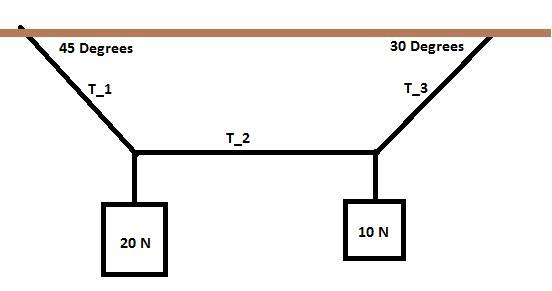
vector.jpg


The attempt at a solution

If I designate one of the points as the origin, I get:

[tex]T_1sin45+T_2sin0+T_3sin30=30 N[/tex]

and

[tex]T_2cos0+T_3cos30-T_1sin45=0[/tex]

I'm having trouble finding a third equation... if those two are even right in the first place.
 
Physics news on Phys.org
Try and stick to separating the forces into x and y components, at least mentally.

If you think about the forces that only act in the vertical direction for each weight separately you should be able to pretty much read off the values for T1 and T3, just use one of those to get you on to the shared tension.

You have four equations at your disposal, both axes for both weights.
 
Kabbotta said:
Try and stick to separating the forces into x and y components, at least mentally.

If you think about the forces that only act in the vertical direction for each weight separately you should be able to pretty much read off the values for T1 and T3, just use one of those to get you on to the shared tension.

You have four equations at your disposal, both axes for both weights.

Sorry... I don't understand what you're saying. I don't know how to separate it into components with a system with more than one weight.
 
Sorry I thought that might be the problem,

At each junction of wires you can draw a little force diagram like this.

You can create four equations by focusing on only one axis at a time.

First one, this is only the force that acts parallel to the y-axis w/ the left knot at it's center.

[tex]\sum F_{y} = T_{1}Sin(45) -20 N. = 0[/tex]
 

Attachments

  • ForceDiagram.png
    ForceDiagram.png
    739 bytes · Views: 468

Similar threads

  • · Replies 5 ·
Replies
5
Views
3K
Replies
2
Views
1K
  • · Replies 1 ·
Replies
1
Views
2K
  • · Replies 2 ·
Replies
2
Views
2K
  • · Replies 10 ·
Replies
10
Views
2K
Replies
5
Views
8K
Replies
11
Views
3K
  • · Replies 13 ·
Replies
13
Views
3K
Replies
8
Views
1K
  • · Replies 13 ·
Replies
13
Views
2K