How Do You Solve Complex Number Equations in Quadratics and Exponentials?

Click For Summary

Homework Help Overview

The discussion revolves around solving complex number equations within the context of quadratic and exponential functions. Participants explore various problems involving complex roots, modulus, and distinct roots of complex numbers.

Discussion Character

  • Exploratory, Conceptual clarification, Mathematical reasoning, Problem interpretation, Assumption checking

Approaches and Questions Raised

  • Participants attempt to understand the implications of complex roots in quadratic equations and the relationship between complex numbers and their modulus. Questions arise regarding the nature of arguments in exponential forms and how to identify distinct roots in sets of complex numbers.

Discussion Status

The discussion is ongoing, with participants providing hints and guidance on how to approach the problems. Some participants are exploring different interpretations of the questions, while others are clarifying concepts related to complex numbers and their properties.

Contextual Notes

Some participants express confusion over the requirements of the problems, particularly regarding assumptions about real and imaginary components in equations. There are indications of missing information or unclear definitions that are being addressed through dialogue.

jisbon
Messages
475
Reaction score
30
Homework Statement
NIL
Relevant Equations
NIL
Hello all!
Thanks for helping me out so far :) Really appreciate it.
I don't seem to understand some of the questions presented to me, so if anyone has an idea on how to start the questions, please do render your assistance :)
1)
Suppose
(a+bi)(c+di)(e+fi)=4+8i(a+bi)(c+di)(e+fi)=4+8i
Find the value of
(a2+b2)(c2+d2)(e2+f2)(a2+b2)(c2+d2)(e2+f2)
Not sure what I'm suppose to do here, expanding is probably out of the question, does squaring (a+bi)(c+di)(e+fi)(a+bi)(c+di)(e+fi) helps to find out (a2+b2)(c2+d2)(e2+f2)(a2+b2)(c2+d2)(e2+f2)?

2)
Let
S=(cos(π/5)+isin(π/5))n,nϵNS=(cos(π/5)+isin(π/5))n,nϵN
What I understand here is that I'm supposed to find the amount of distinct roots in this equation? How do I even start?

5)
Let ∣z1∣=∣z2∣=7∣z1∣=∣z2∣=7
If ∣z1+z2∣=2∣z1+z2∣=2,solve ∣1/z1+1/z2∣
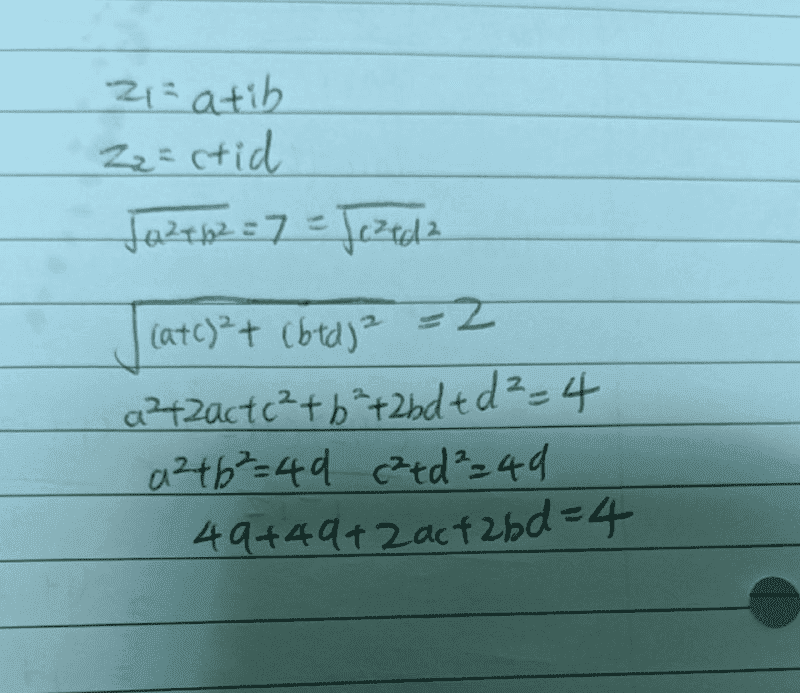
1567165455919.png


How do I even proceed from here?

3)
Let z be complex number that allows:
z+7¯¯¯z=∣¯¯¯z+4∣∣z+7z¯=∣z¯+4∣
Find z.
My working:
a+bi+7(a−bi)=∣(a+4)+bi∣a+bi+7(a−bi)=∣(a+4)+bi∣
8a−6bi=√(a+4)2+b28a−6bi=√(a+4)2+b2
64a2−96abi−36b2=a2+8a+16+b264a2−96abi−36b2=a2+8a+16+b2
Not sure where to proceed from here.
4)
Take ##3+7i## is a solution of ##3x^2+Ax+B=0##
Since ##3+7i## is a solution, I can only gather :
##(z−(3+7i))(...)=3x2+Ax+B##
Not sure on how to go from here.
EDIT: I got A =18 and B=174, is this correct?
I recognized that since there's a 3, this means the other root must be a conjugate, hence
##(z-(3+7i))(z-(3-7i))##
##(z-3)^2-(7i)^2 =0##
##z^2+6z+58=0##
##3z^2+18z+174=0##

6)
Suppose ##z=2e^{ikπ}##and
##z^{n}=2^5 e^{iπ/8}##
Find k such that z has smallest positive argument
I don't understand this question :/ For z to have smallest positive principal argument, what does it entail/mean?
EDIT: Tried again. Got the following:
##z^{n}=2^n e^{inkπ} = 2^5 e^{iπ/8}##
## nk = 1/8##
##5k =1/8##
##k = 1/40##?7)
Let
##\sum_{k=0}^9 x^k = 0##
Find smallest positive argument. Same thing as previous question, but I guess I can expand to
z+z2+z3+...+z9=0z+z2+z3+...+z9=0
##z=re^iθ##
##rei^θ+re^2iθ+re^3iθ+...##
What do I do to proceed on?
Cheers
 
Last edited:
Physics news on Phys.org
You need to take these one at a time. Let's start with 1):

What's the relationship between ##a + bi## and ##a^2 + b^2##?
 
PeroK said:
You need to take these one at a time. Let's start with 1):

What's the relationship between ##a + bi## and ##a^2 + b^2##?
Okay :)
##a^2 + b^2## = ##(a + bi)(a-bi)##
 
jisbon said:
Okay :)
##a^2 + b^2## = ##(a + bi)(a-bi)##

And what does that represent?
 
PeroK said:
And what does that represent?
Not sure what you mean there. But I do get that the solution will be
##(4+8i)(a-bi)(c-di)(e-fi)##?
 
jisbon said:
Not sure what you mean there. But I do get that the solution will be
##(4+8i)(a-bi)(c-di)(e-fi)##?

Have you ever heard of the "modulus" of a complex number?
 
PeroK said:
Have you ever heard of the "modulus" of a complex number?
Oh yes, "modulus" of a complex number will be ##a^2+b^2##
But how does it help me ?
 
jisbon said:
Oh yes, "modulus" of a complex number will be ##a^2+b^2##
But how does it help me ?

Actually, that's the modulus squared.

What properties does the modulus have?
 
PeroK said:
Actually, that's the modulus squared.

What properties does the modulus have?
Is the answer ## 80##? :)
EDIT: 80 I mean
 
  • #10
jisbon said:
Is the answer ## 80##? :)
EDIT: 80 I mean

Yes.
 
  • #11
PeroK said:
Yes.
Thanks :) Any clues for the next question :>
 
  • #12
jisbon said:
2)
Let
##S=\{(cos(π/5)+isin(π/5))^n \ ,nϵN \}##
What I understand here is that I'm supposed to find the amount of distinct roots in this equation? How do I even start?

For number 2), your original statement was better. I've tidied it up. ##S## is a set. On the face of it, ##S## has an infinite numbers of elements. But, are some of the elements the same? If so, how many distinct elements does it have?
 
  • #13
PeroK said:
For number 2), your original statement was better. I've tidied it up. ##S## is a set. On the face of it, ##S## has an infinite numbers of elements. But, are some of the elements the same? If so, how many distinct elements does it have?
So from what you state, I should probably start listing down all the possible elements?
Since ##\theta## can only go from ##-\pi## to ##\pi##
If I make it to :
##re^{i\frac{\pi}{5}}##
Then there will be:
##re^{i\frac{2\pi}{5}}##
##re^{i\frac{3\pi}{5}}##
##re^{i\frac{4\pi}{5}}##
##re^{i\frac{5\pi}{5}}##
and the negative.
So total 10?
 
  • #14
jisbon said:
So from what you state, I should probably start listing down all the possible elements?
Since ##\theta## can only go from ##-\pi## to ##\pi##
If I make it to :
##re^{i\frac{\pi}{5}}##
Then there will be:
##re^{i\frac{2\pi}{5}}##
##re^{i\frac{3\pi}{5}}##
##re^{i\frac{4\pi}{5}}##
##re^{i\frac{5\pi}{5}}##
and the negative.
So total 10?

You could do a better job of explaining that, but ##10## is correct.
 
  • #15
PeroK said:
You could do a better job of explaining that, but ##10## is correct.
Oopsie haha, ok at least I kind of understood what it means.
How about 3? I'm kind of confused because I only have 1 equation when I need to solve for both a and b :(
 
  • #16
jisbon said:
Oopsie haha, ok at least I kind of understood what it means.
How about 3? I'm kind of confused because I only have 1 equation when I need to solve for both a and b :(

For number 3, does anything look strange about that equation? You need to think out of the box a little.
 
  • #17
PeroK said:
For number 3, does anything look strange about that equation? You need to think out of the box a little.
There seems to be no imaginary number on the right hand side, does it necessary mean ##-96ab = 0##?
 
  • #18
jisbon said:
There seems to be no imaginary number on the right hand side, does it necessary mean ##-96ab = 0##?

Yes, the RHS is a non-negative real number. What does that say about ##z##? Hint: start again.
 
  • #19
PeroK said:
Yes, the RHS is a non-negative real number. What does that say about ##z##? Hint: start again.
This means that z is solely a real number, is it?
Also not sure what you meant by 'starting' again. Is it rewriting the equations without ##ib## involved?
 
  • #20
jisbon said:
This means that z is solely a real number, is it?
Also not sure what you meant by 'starting' again. Is it rewriting the equations without ##ib## involved?

Yes, you either see directly that ##z## is real, or set ##z = a + ib## and show that ##b = 0##.
 
  • #21
PeroK said:
Yes, you either see directly that ##z## is real, or set ##z = a + ib## and show that ##b = 0##.

PS what you did wasn't wrong, but it got too complicated, which was a clue that you'd missed something. In these cases, it's usually better to start again than to continue with your complicated equations.
 
  • #22
PeroK said:
Yes, you either see directly that ##z## is real, or set ##z = a + ib## and show that ##b = 0##.
Restarting the equation without ##ib## involved gives me:
##a+7a = a^2+8a+16##
##a^2 +16 =0##
##a = -4i##?
Now it seems to be a problem :/

PS: Nevermind, I think I got a mistake. Is ##a = 4/7## ? Hence ## z= 4/7 + 0i##
 
  • #23
jisbon said:
Restarting the equation without ##ib## involved gives me:
##a+7a = a^2+8a+16##
##a^2 +16 =0##
##a = -4i##?
Now it seems to be a problem :/

PS: Nevermind, I think I got a mistake. Is ##a = 4/7## ? Hence ## z= 4/7 + 0i##
Did you try that in the original equation?
 
  • #24
PeroK said:
Did you try that in the original equation?
I think I messed up my equation.
Is it supposed to be:
##a+7a = a+4## now? Since I square and square root the RHS, giving me back ##a+4##?
 
  • #25
jisbon said:
I think I messed up my equation.
Is it supposed to be:
##a+7a = a+4## now? Since I square and square root the RHS, giving me back ##a+4##?

You don't have to square the equation. In any case, you should check whether ##z = 4/7## is a solution by direct substitution into the original equation.
 
  • #26
for 5, instead of doing it the hard way (by replacing ##z_1=a+bi, z_2=c+di## e.t.c) use properties of the modulus and algebra in the set of complex numbers. Properties of modulus are pretty much like the properties of absolute value in real numbers and algebra in C is pretty much the same as algebra in R so for example
##\frac{1}{z_1}+\frac{1}{z_2}=\frac{z_1+z_2}{z_1z_2}##
 
  • Like
Likes   Reactions: PeroK
  • #27
PeroK said:
You don't have to square the equation. In any case, you should check whether ##z = 4/7## is a solution by direct substitution into the original equation.
Assuming b =0, it does
 
  • #28
Delta2 said:
for 5, instead of doing it the hard way (by replacing ##z_1=a+bi, z_2=c+di## e.t.c) use properties of the modulus and algebra in the set of complex numbers. Properties of modulus are pretty much like the properties of absolute value in real numbers and algebra in C is pretty much the same as algebra in R so for example
##\frac{1}{z_1}+\frac{1}{z_2}=\frac{z_1+z_2}{z_1z_2}##
So for question 5, answer will be 2/49?
Thanks for the tip :)
 
  • #29
jisbon said:
Assuming b =0, it does
You don't have to assume ##b = 0##. You should be able to show that ##b = 0## and ##a \ge 0##.
 
  • #30
jisbon said:
So for question 5, answer will be 2/49?
Thanks for the tip :)
Yes that's correct.
 

Similar threads

Replies
27
Views
5K
  • · Replies 7 ·
Replies
7
Views
3K
  • · Replies 14 ·
Replies
14
Views
3K
  • · Replies 18 ·
Replies
18
Views
3K
Replies
3
Views
2K
Replies
18
Views
3K
  • · Replies 2 ·
Replies
2
Views
2K
  • · Replies 2 ·
Replies
2
Views
8K
Replies
18
Views
7K
  • · Replies 4 ·
Replies
4
Views
2K