How do you solve for the area bounded by two curves using integration?

  • Context: MHB 
  • Thread starter Thread starter paulmdrdo1
  • Start date Start date
  • Tags Tags
    Area Integration
Click For Summary
SUMMARY

The discussion focuses on calculating the area bounded by curves using integration techniques. Specifically, it addresses three problems: finding the area between the polynomial function \(y=x^3-3x^2-x+3\) and the x-axis from \(x=-1\) to \(x=2\), the area between \(y=x^3\) and \(y=\sqrt[3]{x}\) in the first quadrant, and the area between \(x=y^2\) and \(y=x-2\). Key steps include determining the roots of the polynomial, analyzing the sign of the function across intervals, and applying the definite integral to compute the area. The final answers for the areas are confirmed as 5.75, 0.5, and 4.5 square units respectively.

PREREQUISITES
  • Understanding of polynomial functions and their roots
  • Knowledge of definite integrals and integration techniques
  • Familiarity with the concept of area between curves
  • Basic calculus concepts, including the Fundamental Theorem of Calculus
NEXT STEPS
  • Study the application of the Fundamental Theorem of Calculus in area calculations
  • Learn about numerical integration methods such as the Trapezoidal Rule
  • Explore the concept of improper integrals for unbounded regions
  • Investigate the use of graphing utilities to visualize functions and their intersections
USEFUL FOR

Students learning calculus, educators teaching integration techniques, and anyone interested in applying integration to solve real-world problems involving areas between curves.

paulmdrdo1
Messages
382
Reaction score
0
1. find the area bounded by:
a. $\displaystyle y=x^3-3x^2-x+3$ and the x-axis for x = -1 to x = 2.

b. $y=x^3$ and $\displaystyle y=\sqrt[3]{x}$ in the first quadrant

c. $x=y^2$ and $y=x-2$

what are the steps in solving these? please help! thanks!
 
Physics news on Phys.org
Re: area using integration

a) I would begin by finding the roots of the given polynomial (it factors nicely) to determine the intervals for which it is positive and for which it is negative. Why do we need to know this?
 
Re: area using integration

if we factor the polynomial we will get $(x-3)(x^2-1)$ so the roots of the polynomial are $x = 3$, $x=\sqrt{1}$. but i don't know the answer to your question "Why do we need to know this?" I'm hoping that you can help me. I'm just beginning to learn calculus by the way.
 
Re: area using integration

If we fully factor the polynomial, we find:

$$f(x)=x^3-3x^2-x+3=x^2(x-3)-(x-3)=\left(x^2-1 \right)(x-3)=(x+1)(x-1)(x-3)$$

Hence we see the roots are:

$$x=-1,1,3$$

Because the roots are all of multiplicity 1, which simply means they are not repeated, we know the sign of $f(x)$ will alternate across the roots, so it suffices to test one interval, so let's choose $x=0$ from the interval $(-1,1)$ and we find $f(0)=3>0$.

So, we may conclude the polynomial is negative on $(-\infty,-1)$, positive on $(-1,1)$, negative on $(1,3)$ and positive on $(3,\infty)$.

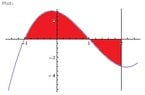
Next, let's sketch the area to be found:

View attachment 1304

Do you see now that the area under the $x$-axis will require us to integrate the negative of $f(x)$ on that interval?

When we are computing the area between two curves (and this is what we are doing if we observe that the $x$-axis is $y=0$), then we need to use as our integrand the magnitude of the difference between the two curves:

$$A=\int_a^b \left|f(x)-g(x) \right|\,dx$$

So, we need to know on what intervals $f(x)>g(x)$, since by definition:

$$|u|=u$$ when $0\le u$ and $|u|=-u$ when $u<0$.

So, we see that on $(-1,1)$ we have $0<f(x)$ and on $(1,2)$ we have $f(x)<0$, hence the area can be found with:

$$A=\int_{-1}^2\left|f(x)-0 \right|\,dx=\int_{-1}^2\left|f(x) \right|\,dx=\int_{-1}^1 f(x)\,dx+\int_1^2 -f(x)\,dx=\int_{-1}^1 f(x)\,dx-\int_1^2 f(x)\,dx$$
 

Attachments

  • paulmdrdo1.jpg
    paulmdrdo1.jpg
    5.6 KB · Views: 107
Re: area using integration

thanks mark. but I'm still struggling to understand the entirety of your answer. how did you know the graph of that function. did you just punch it in a graphing calculator? i want to know how to draw that without using graphing calculator. what do you mean by "the sign of f(x) will alternate across the roots? thanks!
 
Re: area using integration

While I did use a graphing utility to obtain the plot of the function, it was not necessary, only easier to use to generate an image I could then attach. We really only need to know the sign of the function, so we know on which interval(s) to use the function itself as the integrand and on which interval(s) to use the negative of the function as the integrand.

When I say the sign of the function will alternate across its roots, this simply means that the sign of the function will change across each root.
 
Re: area using integration

why do we need to know the intervals which the function is positive and negative?
 
Re: area using integration

Because on those intervals in which the function is negative, integrating will return a negative value. so we need to negate the function on those intervals to return a positive value. If we simply integrate the given function over the entire interval, then we will get the area above the $x$-axis minus the area below. But, we want to add the two areas to get the total area.
 
Re: area using integration

how do we know that the sign of f(x) will alternate across each roots without looking at the graph? and also how can we determine that there would be an "alternating of the sign situation" of the f(x) in the problem?
 
Last edited:
  • #10
Re: area using integration

paulmdrdo said:
how do we know that the sign of f(x) will alternate across each roots without looking at the graph?
You don't need to... Let's say f(x) has a root at x= -2. Then simply calculate f(x) for x+z and x-z for a very small z. You will then find that, if f(x) changes sign around the root x=-2, then f(x+z) and f(x-z) will also have different sign... ;)
 
  • #11
Re: area using integration

my answer to a would be 5.75 sq. units is it correct?
 
  • #12
Re: area using integration

paulmdrdo said:
how do we know that the sign of f(x) will alternate across each roots without looking at the graph? and also how can we determine that there would be an "alternating of the sign situation" of the f(x) in the problem?

When a root is of odd multiplicity, then we know the function will change sign across this root. Think of the graphs of $y=x^{2n}$ vs. $y=x^{2n+1}$ where $n\in\mathbb{N}$ as an example.

paulmdrdo said:
my answer to a would be 5.75 sq. units is it correct?

Yes, that is correct. For part b) I would begin by determining the limits of integration and which function is greater on that interval. What do you find?
 
  • #13
Re: area using integration

to determine the limits of integration i would set both function equal to one another.

$\displaystyle x^3=\sqrt[3]{x}$ then we will have $\sqrt[3]{x}(\sqrt[3]{x^2}-1)$

the limits of integration would be x=0;x=1

but i don't know how to determine which function is greater.
 
  • #14
Re: area using integration

One way is to pick a test value for $x$ on the interval $(0,1)$. I would try $$x=\frac{1}{2}$$.
 
  • #15
Re: area using integration

MarkFL said:
One way is to pick a test value for $x$ on the interval $(0,1)$. I would try $$x=\frac{1}{2}$$.

where will I plug that test value?
 
  • #16
Re: area using integration

paulmdrdo said:
where will I plug that test value?

Into both of the bounding functions. Whichever returns the greater value will be the greater function on that interval.
 
  • #17
Re: area using integration

$\sqrt[3]{x}$ is greater.

calculating

$\displaystyle \int_{0}^1{\sqrt[3]{x}-x^3}dx$

my answer would be 1/2 or .50 sq. units did i get it right?

 
  • #18
Re: area using integration

Yes, that's correct. For part c) I recommend switching the variables...
 
  • #19
Re: area using integration

MarkFL said:
Yes, that's correct. For part c) I recommend switching the variables...

what do you mean by switching the variables?
 
  • #20
Re: area using integration

Let $x$ become $y$ and $y$ become $x$ so that you have:

$$y=x^2$$

$$y=x+2$$ (this one has been rearranged from $$x=y-2$$)

You don't have to switch them like this, but you can and it may make it easier for you to determine the area.
 
  • #21
Re: area using integration

the limits of integration are x=2;x=-1

we now have

$\displaystyle\int_{-1}^2{(x+2-x^2)dx}$

then arranging the integrand we have

$\displaystyle\int_{-1}^2{(-x^2+x+2)dx}$

the answer is 6.5 sq units?

for educational purposes, can we solve this using other method? can you show me how would that work?
 
  • #22
Re: area using integration

No, 6.5 is not correct. Can you show your work?

Another way would be:

$$A=\int_{-1}^2 (1+x)(2-x)\,dx$$

Use the substitution:

$$u=1+x\,\therefore\,du=dx$$

and we have:

$$A=\int_0^3 u(3-u)\,du=\int_0^3 3u-u^2\,du$$

This is easier to evaluate because the lower limit is $0$.
 
  • #23
Re: area using integration

this is how i solve part c)


$\displaystyle\int_{-1}^2 (-x^2+x+2)dx$

taking the definite integral of the terms individually

$\displaystyle\int_{-1}^2 -x^2dx+\int_{-1}^2 xdx +\int_{-1}^2 2dx$

i will have 9/2 sq. units. is this correct? in your solution above why did change the limits of integration?

 
Last edited:
  • #24
Re: area using integration

paulmdrdo said:
this is how i solve part c)


$\displaystyle\int_{-1}^2 (-x^2+x+2)dx$

taking the definite integral of the terms individually

$\displaystyle\int_{-1}^2 -x^2dx+\int_{-1}^2 xdx +\int_{-1}^2 2dx$

i will have 9/2 sq. units. is this correct? in your solution above why did change the limits of integration?

Yes, 9/2 is correct.

When you are evaluating a definite integral, and you change the variable, you have to also change the limits so that they are in terms of the new variable. I used:

$$u=1+x$$

The original lower limit was -1, and so:

$$u(-1)=1+(-1)=0$$

So the new lower limit is 0.

The original upper limit was 2, and so:

$$u(2)=1+(2)=3$$

So the new upper limit is 3.
 

Similar threads

  • · Replies 3 ·
Replies
3
Views
3K
  • · Replies 2 ·
Replies
2
Views
2K
  • · Replies 3 ·
Replies
3
Views
3K
  • · Replies 4 ·
Replies
4
Views
2K
  • · Replies 2 ·
Replies
2
Views
3K
  • · Replies 11 ·
Replies
11
Views
2K
  • · Replies 20 ·
Replies
20
Views
4K
  • · Replies 2 ·
Replies
2
Views
3K
  • · Replies 1 ·
Replies
1
Views
2K
Replies
5
Views
2K