Saladsamurai
- 3,009
- 7
I am having some trouble deciphering what the input and output of a 2D Rotation Matrix actually represent.
All example online have the vectors oriented at the origin. I know you can move them anywhere so long as you maintain their length and orientation, but here is my question:
Let's say I have a vector that is not located at the origin. Call its initial point (x0, y0) and its terminal point (x1, y1)
Now let's say that it has rotated through the positive angle of Phi. It's initial point is clearly still (x0, y0) and its new terminal point is (x2, y2).
Using only (x0, y0) and angle Phi, how can I find the coordinate (x0, y0) ?
I know that the Rotation Vector is defined as:
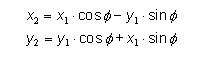
My issue is that since they chose the origin, x1 and y1 in their example could be either the coordinates OR the components.
So, for the general 2D case: Do I plug in the coordiantes or components? And are the results the coordinates or components?
I am under the impression that it is the latter in both cases. And so in order to obtain the actual coordinates of my new vectors endpoint, I must add the resulting components to the initial coordinate (x0, y0)
Does that sound right?
All example online have the vectors oriented at the origin. I know you can move them anywhere so long as you maintain their length and orientation, but here is my question:
Let's say I have a vector that is not located at the origin. Call its initial point (x0, y0) and its terminal point (x1, y1)
Now let's say that it has rotated through the positive angle of Phi. It's initial point is clearly still (x0, y0) and its new terminal point is (x2, y2).
Using only (x0, y0) and angle Phi, how can I find the coordinate (x0, y0) ?
I know that the Rotation Vector is defined as:
My issue is that since they chose the origin, x1 and y1 in their example could be either the coordinates OR the components.
So, for the general 2D case: Do I plug in the coordiantes or components? And are the results the coordinates or components?
I am under the impression that it is the latter in both cases. And so in order to obtain the actual coordinates of my new vectors endpoint, I must add the resulting components to the initial coordinate (x0, y0)
Does that sound right?
Last edited: