How does 12 + j16 become 20 ∠53.1° in impedance calculations?

  • Topic:
  • Thread starter Thread starter portcharlotte
  • Start date Start date
  • Tags Tags
    Impedance
Join the discussion
Registration is free. Start your own thread to ask a follow-up.
2 replies · 3K views
portcharlotte
Messages
2
Reaction score
0
Good morning,

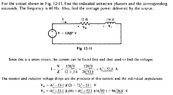
I was reviewing a problem in my book regarding Impedance. I have a question. For the impedance -Z they got 20 ∠53.1° degrees How did they go from 12 + j16 to 20 ∠53.1°. Thanks

View attachment 8827
 
Attachments
  • 12.11 Text Book Need Help.JPG
    12.11 Text Book Need Help.JPG
    50.8 KB · Views: 160
Mathematics news on Phys.org
portcharlotte said:
Good morning,

I was reviewing a problem in my book regarding Impedance. I have a question. For the impedance -Z they got 20 ∠53.1° degrees How did they go from 12 + j16 to 20 ∠53.1°. Thanks

Hi portcharlotte, welcome to MHB! ;)

Every imaginary number has a cartesian representation and a polar representation.
The relation between $x+jy$ and $r∠\theta$ is given by $r=\sqrt{x^2+y^2}$ and $\theta=\arctan\frac yx$.
That is, unless $x\le 0$ in which case we have to select the appropriate $\theta$ in the unit circle, as it is out of range of $\arctan$.

In this case we have $x=12$ and $y=16$. Therefore $r=\sqrt{12^2+16^2}=20$ and $\theta=\arctan\frac{16}{12}\approx 53.1°$