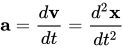
How does calculus relate to dimensions?

  • Context: High School 
  • Thread starter Thread starter paulo84
  • Start date Start date
  • Tags Tags
    Calculus Dimensions
Click For Summary

Discussion Overview

The discussion revolves around the relationship between calculus, dimensions, and the visualization of mathematical concepts such as time squared and velocity squared, particularly in the context of physics. Participants explore how these concepts relate to acceleration, energy, and the mathematical operations involved, including the dot product and the implications of vectors and scalars.

Discussion Character

  • Exploratory
  • Technical explanation
  • Conceptual clarification
  • Debate/contested
  • Mathematical reasoning

Main Points Raised

  • Some participants express confusion about visualizing time squared and velocity squared, suggesting a possible connection to matrices.
  • One participant suggests thinking of acceleration as meters per second per second rather than meters per second squared for easier understanding.
  • Another participant argues that visualizing the velocity squared term in the kinetic energy equation is not feasible, emphasizing the importance of understanding the derivation of equations instead.
  • There is a discussion about the meaning of squaring a number, with some participants asserting that it does not necessarily refer to a geometric shape.
  • One participant explains that the square of velocity can be understood through the dot product, relating it to the components of velocity in three dimensions.
  • Another participant questions whether the number obtained from squaring is known because of its geometric interpretation.
  • There is a debate about the importance of mathematical visualization in physics, with some arguing it is not crucial while others counter that it is significant in physics literature.
  • Some participants discuss the components of velocity, including speed and direction, and how this relates to dimensionality and potential representation as a matrix.
  • One participant reflects on their personal challenges with grasping physics concepts, suggesting a need for a three-dimensional perspective to better understand the material.

Areas of Agreement / Disagreement

Participants express a range of views on the visualization of mathematical concepts in physics, with no clear consensus on the importance or feasibility of such visualizations. There are competing perspectives on the interpretation of squared terms and their geometric implications.

Contextual Notes

Some discussions involve assumptions about the understanding of vectors and scalars, as well as the mathematical operations that relate them. The conversation also touches on the complexity of visualizing physical concepts in a mathematical context, which remains unresolved.

paulo84
Messages
112
Reaction score
7
1760b1620e8d07692ecfb879abb37fad5a34f238


82c6f8ceda1650271df82f27287811c32c629a68


I am trying to understand what time^2 and velocity^2 mean in terms of how to visualize them? This wasn't explained in Physics or Mechanics (Further Mathematics) in high school, unfortunately. It seems likely it relates to matrices, maybe?

Appreciate any replies! :)
 
Physics news on Phys.org
For acceleration, you're better to think of it as metres per second per second rather than metres per second squared. For example: In freefall, your speed increases at a rate of 9.8 m/s per second. Mathematically, this is the same thing as 9.8 m/s2, but it's a little easier to wrap your head around.
 
PetSounds said:
For acceleration, you're better to think of it as metres per second per second rather than metres per second squared. For example: In freefall, your speed increases at a rate of 9.8 m/s per second. Mathematically, this is the same thing as 9.8 m/s2, but it's a little easier to wrap your head around.

Thanks. It's just... a square is a shape? Or not necessarily?
 
There isn't any way to "visualize" why there is a velocity squared term in the kinetic energy equation. Most equations in physics are in a mathematically simplified form that doesn't reveal the laws and principles that were used to derive them. Moral: Understanding how the equation is derived is more valuable than trying to "visualize" its individual terms.
 
  • Like
Likes   Reactions: russ_watters
paulo84 said:
Thanks. It's just... a square is a shape? Or not necessarily?
To square a number means to multiply a number by itself. It doesn't always refer to a geometric shape.
 
PetSounds said:
To square a number means to multiply a number by itself. It doesn't always refer to a geometric shape.

But isn't the number we get from squaring only known because of that shape? Or not?

Matthew314159271828 said:
There isn't any way to "visualize" why there is a velocity squared term in the kinetic energy equation. Most equations in physics are in a mathematically simplified form that doesn't reveal the laws and principles that were used to derive them. Moral: Understanding how the equation is derived is more valuable than trying to "visualize" its individual terms.

OK...I'm visualizing hidden squares! Folded back on themselves...I appreciate your point about the important part to understand, but do you think that would be correct??
 
paulo84 said:
82c6f8ceda1650271df82f27287811c32c629a68


I am trying to understand what time^2 and velocity^2 mean in terms of how to visualize them? )
I am assuming that you know the difference between vectors and scalars. Energy is a scalar and velocity is a vector, so if you want an energy which is related to velocity then you need some operation which takes a vector and returns a scalar.

That operation is known as the dot product. So ##v^2## is shorthand for ##v \cdot v = v_x^2 + v_y^2 + v_z^2##. This is the square of the speed.

As far as visualization, it means that if the x-axis is speed and the y-axis is energy then the graph is a parabola with the vertex at the origin
 
  • Like
Likes   Reactions: paulo84
Dale said:
I am assuming that you know the difference between vectors and scalars. Energy is a scalar and velocity is a vector, so if you want an energy which is related to velocity then you need some operation which takes a vector and returns a scalar.

That operation is known as the dot product. So ##v^2## is shorthand for ##v \cdot v = v_x^2 + v_y^2 + v_z^2##. This is the square of the speed.

As far as visualization, it means that if the x-axis is speed and the y-axis is energy then the graph is a parabola with the vertex at the origin

Wow, thanks, that's awesome! Now I have some reading to do.
 
Look, there is no way to visualize what the equation is conveying in a physical sense. The mathematical visualization in terms of a graph is not important to the physicist.
 
  • #10
paulo84 said:
But isn't the number we get from squaring only known because of that shape? Or not?

Why? You can multiply 3 × 3 without involving geometry.
 
  • #11
Matthew314159271828 said:
Look, there is no way to visualize what the equation is conveying in a physical sense. The mathematical visualization in terms of a graph is not important to the physicist.

Oh sorry, I should have asked the question in the Maths subforum.
 
  • #12
Matthew314159271828 said:
The mathematical visualization in terms of a graph is not important to the physicist.
I wouldn’t go that far. If graphs and visualizations weren’t important to physicists then there wouldn’t be so many of them in physics papers and textbooks.
 
  • #13
You're absolutely right
 
  • #14
Dale said:
I am assuming that you know the difference between vectors and scalars. Energy is a scalar and velocity is a vector, so if you want an energy which is related to velocity then you need some operation which takes a vector and returns a scalar.

That operation is known as the dot product. So ##v^2## is shorthand for ##v \cdot v = v_x^2 + v_y^2 + v_z^2##. This is the square of the speed.

As far as visualization, it means that if the x-axis is speed and the y-axis is energy then the graph is a parabola with the vertex at the origin

Dale - I came back to your post. So the vector velocity is the sum of the speed along each of x, y and z axes?

Relative to acceleration, is there an implication that you're dealing with 2 dimensions of time, or not?
 
  • #15
Sorry, mixing up my concepts. The square of velocity is the sum of the square of the speed along each of x, y and z axes?
 
  • #16
And likewise velocity is essentially speed in 3 dimensions, which can be expressed as a matrix?
 
  • #17
paulo84 said:
And likewise velocity is essentially speed in 3 dimensions, which can be expressed as a matrix?
Look my dude, you're overcomplicating this in your head. Let's start from the bottom. Position is where you are. The rate at which you change position is velocity. The rate at which you change velocity is acceleration. Change in position is distance per second. We can denote that as meters per second, or meters/seconds. Acceleration as the rate at which your velocity changes. This could be denoted as velocity per second, or velocity/seconds. If you sub in the definition of meters per second into that you get meters/(second^2).
 
  • #18
Jayalk97 said:
Look my dude, you're overcomplicating this in your head. Let's start from the bottom. Position is where you are. The rate at which you change position is velocity. The rate at which you change velocity is acceleration. Change in position is distance per second. We can denote that as meters per second, or meters/seconds. Acceleration as the rate at which your velocity changes. This could be denoted as velocity per second, or velocity/seconds. If you sub in the definition of meters per second into that you get meters/(second^2).
I should also include that velocity has two components, speed and direction. Depending on the number of physical spatial dimension you are working with this, the direction part can have multiple components, one for every direction you're able to move in.
 
Last edited by a moderator:
  • #19
Jayalk97 said:
Look my dude, you're overcomplicating this in your head. Let's start from the bottom. Position is where you are. The rate at which you change position is velocity. The rate at which you change velocity is acceleration. Change in position is distance per second. We can denote that as meters per second, or meters/seconds. Acceleration as the rate at which your velocity changes. This could be denoted as velocity per second, or velocity/seconds. If you sub in the definition of meters per second into that you get meters/(second^2).

Thanks. I need to look at it in 3D to understand it! I was told in school I was a natural mathematician and a natural chemist but not a natural physicist. I only made it through the Mechanics paper because I could work out the inbetween maths, I sometimes have trouble grasping concepts which seem simple to others...
 
  • #20
Jayalk97 said:
I should also include that velocity gas two components, speed and direction. Depending on the number of physical spatial dimension you are working with this, the direction part can have multiple components, one for every direction you're able to move in.

Tensors?
 
  • #21
paulo84 said:
Tensors?
Not really quite sure what you mean by that but velocity is often represented as a vector, with a direction (where the arrow literally points) and the speed represented by magnitude (how long the arrow is). Sorry if I sound patronizing I don't really know where you are in your physics education so I want to spell everything out to make sure I'm clear.
 
  • #22
Jayalk97 said:
Not really quite sure what you mean by that but velocity is often represented as a vector, with a direction (where the arrow literally points) and the speed represented by magnitude (how long the arrow is). Sorry if I sound patronizing I don't really know where you are in your physics education so I want to spell everything out to make sure I'm clear.

You don't sound patronizing...https://www.physicsforums.com/threads/vectors-and-matrices.936357/
 
  • #23
paulo84 said:
Good lol. But as for matrices, everything relates to matrices. They're just a way to display information. If you could find a way to put some set of information into a matrix, you could then easily manipulate that information to achieve a desired result. Matrices and linear algebra as a whole are used everywhere. For instance as an electrical engineering student I use them to solve for current and voltages in certain circuits. By storing the information I get from a circuit into a matrix I could often literally plug it all into a calculator and get answer that might take me 10 minutes of algebra otherwise.
 
  • #24
Jayalk97 said:
Good lol. But as for matrices, everything relates to matrices. They're just a way to display information. If you could find a way to put some set of information into a matrix, you could then easily manipulate that information to achieve a desired result. Matrices and linear algebra as a whole are used everywhere. For instance as an electrical engineering student I use them to solve for current and voltages in certain circuits. By storing the information I get from a circuit into a matrix I could often literally plug it all into a calculator and get answer that might take me 10 minutes of algebra otherwise.

The problem is it gets really really complicated when you have to put in inverse values into tensors and you can't just use '1's but have to work out the square root of everything. Well, maybe it's not that complicated?
 
  • #25
paulo84 said:
The problem is it gets really really complicated when you have to put in inverse values into tensors and you can't just use '1's but have to work out the square root of everything. Well, maybe it's not that complicated?
Not my area of expertise haha. By the look of it you're taking some sort of solid mechanics class? If it doesn't require you to actively use linear algebra I'd just throw it all into a calculator and save time.
 
  • #26
Jayalk97 said:
Not my area of expertise haha. By the look of it you're taking some sort of solid mechanics class? If it doesn't require you to actively use linear algebra I'd just throw it all into a calculator and save time.

I meant cube roots. I'm not taking any class... :X
 
  • #27
paulo84 said:
So the vector velocity is the sum of the speed along each of x, y and z axes?
Are you familiar with vectors? This question looks like you have never used vectors.

If not, then this is absolutely priority number 1! Vectors are necessary for physics at all levels

paulo84 said:
Relative to acceleration, is there an implication that you're dealing with 2 dimensions of time, or not?
Definitely not
 
  • #28
Dale said:
Are you familiar with vectors? This question looks like you have never used vectors.

If not, then this is absolutely priority number 1! Vectors are necessary for physics at all levels

Definitely not

I'm 33 and haven't dealt with vectors in maths since I was 17, unfortunately. Until very recently, that is...
 
  • #29
My recommendation is to go back and review both vectors and basic differential and integral calculus. You can’t do any physics without vectors, you can do a little with just vectors and algebra, but most of what you are asking requires vectors and calculus too.
 
  • #30
Dale said:
Are you familiar with vectors? This question looks like you have never used vectors.

If not, then this is absolutely priority number 1! Vectors are necessary for physics at all levels

Definitely not

Can you tell me why 'definitely not'?
 

Similar threads

  • · Replies 6 ·
Replies
6
Views
1K
  • · Replies 3 ·
Replies
3
Views
3K
  • · Replies 5 ·
Replies
5
Views
2K
  • · Replies 4 ·
Replies
4
Views
1K
  • · Replies 7 ·
Replies
7
Views
6K
  • · Replies 43 ·
2
Replies
43
Views
10K
  • · Replies 57 ·
2
Replies
57
Views
2K
  • · Replies 42 ·
2
Replies
42
Views
3K
  • · Replies 16 ·
Replies
16
Views
3K
  • · Replies 1 ·
Replies
1
Views
3K