Sal915
- 1
- 0
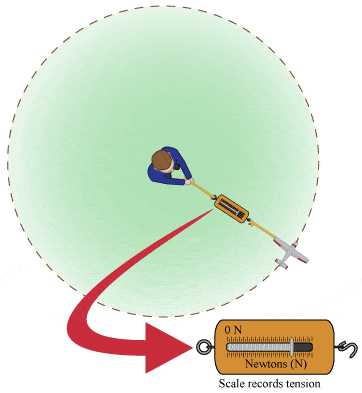
A toy plane with a mass of 1.04 kg is tied to a string and made to travel at a speed of 23 m/s in a horizontal circle with a 17-m radius. The person holding the string pulls the plane in, increasing the tension in the string, increasing the speed of the plane and decreasing the radius of the plane's orbit. What is the net work done on the plane if the tension in the string increases by a factor of four and the radius decreases to 8 m.
 2.
2.
A light spring obeys Hooke's Law. It takes
30.7 J of work to stretch this spring from an elongation of 4.34 cm to an elongation of 5.34 cm.
(a) Is the amount of work required to increase the elongation of the spring from 5.34 cm to 6.34 cm greater than, less than, or equal to 30.7 J?
greater than
less than
equal to - this is what i chose but got it wrong, chose this because both have a difference of 1.00
(b) Verify your answer to part (a) by calculating the required work.
_____ J i put 30.7 J here but got it wrong because i thought it would be equal..
A light spring obeys Hooke's Law. It takes
30.7 J of work to stretch this spring from an elongation of 4.34 cm to an elongation of 5.34 cm.
(a) Is the amount of work required to increase the elongation of the spring from 5.34 cm to 6.34 cm greater than, less than, or equal to 30.7 J?
greater than
less than
equal to - this is what i chose but got it wrong, chose this because both have a difference of 1.00
(b) Verify your answer to part (a) by calculating the required work.
_____ J i put 30.7 J here but got it wrong because i thought it would be equal..