How Does Adding Masses Affect the Angular Velocity of a Rotating Cylinder?

Click For Summary

Homework Help Overview

The discussion revolves around the effects of adding small masses to a rotating cylinder on its angular velocity. The original poster presents a scenario involving a cylinder with a specified mass and radius, rotating at a certain angular velocity, and questions how the addition of two small masses affects the new angular velocity.

Discussion Character

  • Conceptual clarification, Assumption checking, Mixed

Approaches and Questions Raised

  • Participants explore the implications of moment of inertia changes due to the added masses, question the assumptions regarding angular momentum, and discuss the definitions of point masses versus small masses in relation to the cylinder's rotation.

Discussion Status

The discussion is active, with participants offering various perspectives on the moment of inertia and its impact on angular velocity. Some suggest that the additional masses do not decrease the moment of inertia, while others question the assumptions about what remains constant during the rotation.

Contextual Notes

There is a lack of clarity regarding the assumptions that should be made about the system, such as whether angular momentum is conserved or if other factors are held constant. The definitions and contributions of the added masses to the moment of inertia are also under scrutiny.

brotherbobby
Messages
777
Reaction score
172
Problem :

A cylinder of mass ##M## and radius ##R## rotates with an angular velocity ##\omega_1## about an axis passing through its centre of symmetry. Two small masses each of mass ##m## (small in comparison to the radius of the cylinder) are glued to either of the two circular faces of the cylinder right on its axis of rotation. The cylinder-mass system now rotates with an angular velocity ##\omega_2##.
Is ##\omega_2## greater than, less than or equal to ##\omega_1##?
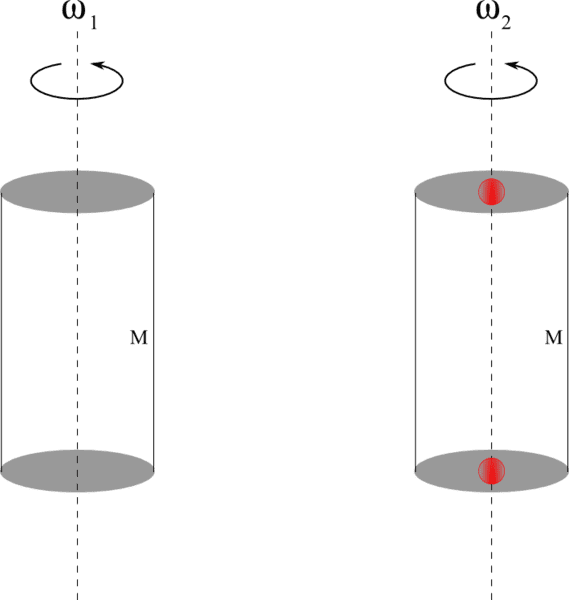
rotating cylinder.png

Relevant equations :

The moment of inertia of the solid cyliner is ##\frac{1}{2} MR^2##. My attempt :

The two small masses do not increase the moment of inertia of the cylinder, being point masses. Hence ##\omega_2## = ##\omega_1##
 

Attachments

  • rotating cylinder.png
    rotating cylinder.png
    6.3 KB · Views: 923
Physics news on Phys.org
Your problem is ill defined. What else is given in the problem? Obviously you can rotate either setup with whatever angular velocity you want, it just depends on how much angular momentum you put into the system. You need to specify what other assumptions should be taken, such as same angular momentum.
 
The exercise is incomplete: they don't tell you what remains constant. However small, the extra masses definitely do not decrease the moment of inertia and do contribute to it. There is a good argument to claim ##\omega_2 < \omega_1##.
 
Will the moment of inertia of the combined system be more than that of the bare cylinder?
 
Check the definition :rolleyes:
 
If the two masses lie along the axis of the cylinder, then they won't contribute to the moment of inertia (about that axis).
 
upload_2019-2-19_16-8-51.png
 

Attachments

  • upload_2019-2-19_16-8-51.png
    upload_2019-2-19_16-8-51.png
    10.1 KB · Views: 553
Yes, but these are point masses. They have no radius of their own. They are put along the axis of the cylinder.
 
point masses don't exist and a small mass is not a point mass :biggrin:
 
  • #10
brotherbobby said:
Yes, but these are point masses. They have no radius of their own. They are put along the axis of the cylinder.
Correct. They have a radius, but it is considered negligible compared to that of the cylinder.
brotherbobby said:
small in comparison to the radius of the cylinder
In this case, negligible means that ##MR^2 \gg mr^2##, so it is actually an issue of both mass and radius ...
 
  • #11
True, if you insist that the masses have a radius, they will contribute to I. But the question is about point masses.
 
  • #12
upload_2019-2-19_16-15-9.png
Then you won't need much glue :cool:
 

Attachments

  • upload_2019-2-19_16-15-9.png
    upload_2019-2-19_16-15-9.png
    1 KB · Views: 510
  • #13
It would be fair to call this entire argumentation ...(drumrolls please)... pointless ... :oldlaugh::oldlaugh::oldlaugh:

Anyway, I think it is clear from the formulation of the problem that the additional masses should be considered to give a negligible contribution to the moment of inertia. What is missing, as already stated, is the assumption about what is supposed to be considered constant.
 

Similar threads

  • · Replies 40 ·
2
Replies
40
Views
6K
Replies
335
Views
17K
Replies
2
Views
2K
  • · Replies 11 ·
Replies
11
Views
3K
Replies
13
Views
2K
  • · Replies 9 ·
Replies
9
Views
4K
  • · Replies 1 ·
Replies
1
Views
2K
Replies
67
Views
4K
  • · Replies 13 ·
Replies
13
Views
3K
Replies
24
Views
4K