How does field oriented control convert current references to voltage outputs?

  • Thread starter Physicslearner500039
  • Start date
  • Tags Tags
    Control Field
2 replies · 2K views · last reply
Physicslearner500039
Messages
124
Reaction score
6
I have seen in several documents on field oriented control for example in the below document. The inputs to the PI controller are phase currents but the outputs are voltages that is iSqref and iSdref is converted into Vsqref and VSdref. How the current signals are automatically converted to voltage signals I expected them to be current signals. Please help.
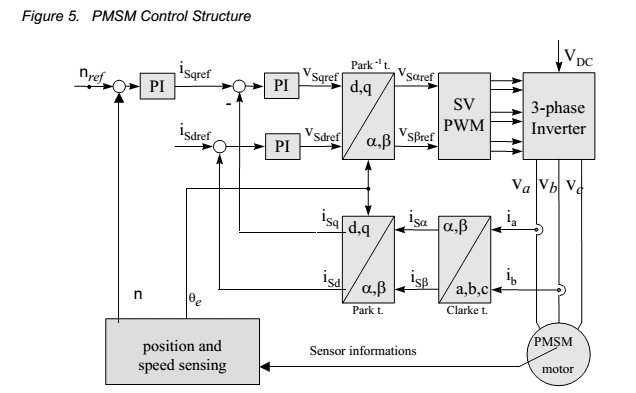
Block diagram of PMSM control structure: speed reference n_ref and PI controllers produce i_Sqref and i_Sdref, Park inverse transform outputs V_Sαref and V_Sβref to SV PWM and a 3-phase inverter fed by V_DC driving the PMSM motor, with Clarke and Park transforms on measured currents i_a and i_b and position and speed sensing feeding back.
 
Hi,
The controller is normally designed in such a way that it acts like a mirror image of the physical system it is going to control. In this case, the physical system i.e, the motor takes voltage as input and its response is measured as current. We know the mathematical model of the motor (transfer function between voltage and current). From this information, the controller (whether it is PI controller or some other type) can be designed to do exactly the opposite such that the reference quantity (in this case, the current) can be tracked.