How does gravity affect the path of light?

  • Thread starter Thread starter Ron777
  • Start date Start date
  • Tags Tags
    Light
Click For Summary
Gravity can bend the path of light, causing it to curve around massive objects like stars. When light approaches a star, it enters the star's gravitational field, which causes it to bend inward rather than being pulled directly into the star. The confusion arises from the alignment of light rays with reference grids in diagrams, as light can travel in various directions. Light rays from a distant source remain parallel until they interact with the gravitational field. This bending effect is a key aspect of gravitational lensing, illustrating how gravity influences light's trajectory.
Ron777
Messages
2
Reaction score
0
Question: If gravity can bend light toward it's source, or even hold it back so to speak (like a black hole), how does light bend around a star like photo attached? It seems if gravity pulls light toward it, the light shouldn't move out and around the star/sun but bend into it?
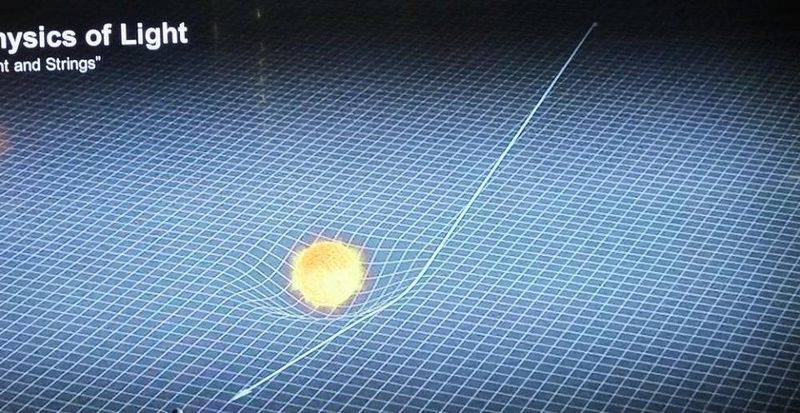
DSCF7398.jpg
 
Physics news on Phys.org
You are interpreting the picture wrong.

The pic is confusing because the light ray is not aligned with the grid. But light rays can go any which way they want. This one happens to be crossing the imaginary grid at an angle.

But rest assured: that light ray is coming directly - in a straight line - from its source.
 
Last edited:
Look what happens if we add more light rays. These rays are from a near point source, so they radiate outward from that point.
 

Attachments

  • lensing.jpg
    lensing.jpg
    79.8 KB · Views: 468
But this might make more sense. Here, the light rays are coming from a distant source, so they are all parallel.
They remain parallel until they enter the star's gravity well, then they bend inward.
 

Attachments

  • lensing2.jpg
    lensing2.jpg
    79 KB · Views: 450
Scratch that, now I see what your saying, your first pic shows it, their graphic (that I posted) is what threw me, yours is a better visual showing more light paths, thanks!
 
In an inertial frame of reference (IFR), there are two fixed points, A and B, which share an entangled state $$ \frac{1}{\sqrt{2}}(|0>_A|1>_B+|1>_A|0>_B) $$ At point A, a measurement is made. The state then collapses to $$ |a>_A|b>_B, \{a,b\}=\{0,1\} $$ We assume that A has the state ##|a>_A## and B has ##|b>_B## simultaneously, i.e., when their synchronized clocks both read time T However, in other inertial frames, due to the relativity of simultaneity, the moment when B has ##|b>_B##...

Similar threads

  • · Replies 30 ·
2
Replies
30
Views
3K
  • · Replies 20 ·
Replies
20
Views
2K
  • · Replies 28 ·
Replies
28
Views
1K
  • · Replies 10 ·
Replies
10
Views
2K
  • · Replies 49 ·
2
Replies
49
Views
6K
Replies
15
Views
2K
  • · Replies 7 ·
Replies
7
Views
2K
  • · Replies 41 ·
2
Replies
41
Views
5K
  • · Replies 15 ·
Replies
15
Views
2K
  • · Replies 8 ·
Replies
8
Views
2K