How does L from LU give us column space?

Click For Summary
SUMMARY

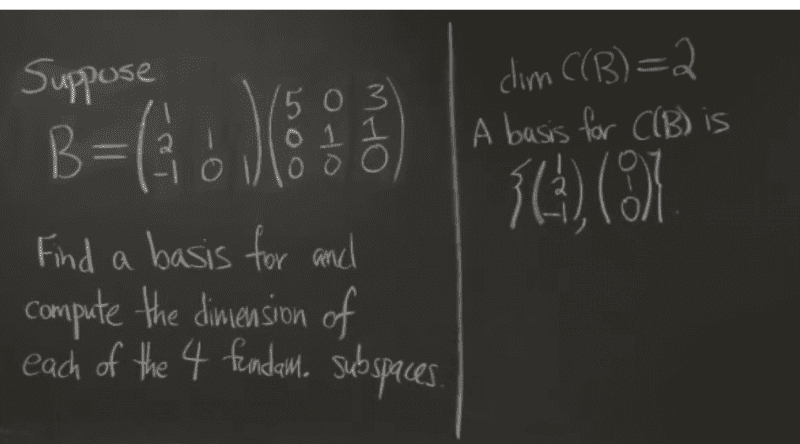
The discussion clarifies how the L matrix in the LU decomposition allows for the determination of the column space of matrix B. It establishes that the column space of B, denoted as C(B), is a subspace of the column space of L, C(L). Given that L is invertible and has linearly independent columns, the dimension of C(B) is 2, while C(L) is 3. The specific columns of L that contribute to C(B) are (1,2,-1)T and (0,1,0)T, which form a basis for C(B).

PREREQUISITES
  • Understanding of LU decomposition
  • Familiarity with concepts of column space and linear independence
  • Knowledge of matrix rank and null space
  • Basic linear algebra, including vector spaces
NEXT STEPS
  • Study LU decomposition in-depth, focusing on its applications in solving linear systems
  • Learn about the properties of column spaces and their relationship to linear transformations
  • Explore the concepts of matrix rank and null space in various contexts
  • Investigate the implications of linear independence in higher-dimensional vector spaces
USEFUL FOR

Students and professionals in mathematics, particularly those studying linear algebra, as well as data scientists and engineers working with matrix computations and transformations.
LongApple
Messages
68
Reaction score
0
I see that the pivots in columns 1 and 2 help us decide which columns to take. But why does the L matrix of this B = LU let just to read off the column space?

upload_2015-2-2_3-31-50.png


2:18
 
Physics news on Phys.org
The column space of ##B## is the set of all ##Bx##, where each ##x## is a ##3 \times 1## vector whose elements are the coefficients of a particular linear combination of the columns of ##B##.

If ##B = LU##, then ##Bx = LUx = L(Ux) = Ly##, so any linear combination of the columns of ##B## is also a linear combination of the columns of ##L##. This means that ##C(B)## (the column space of ##B##) is a subspace of ##C(L)## (the column space of ##L##).

In this case, ##C(B)## is a proper subspace of ##C(L)##, which we can see by arguing as follows. By inspection, the columns of ##L## are linearly independent, so ##L## is invertible. This means that the null space of ##B## is the same as the null space of ##U##, because invertibility of ##L## implies that ##LUx = 0## if and only if ##Ux = 0##. Since ##U## has two linearly independent columns, ##U## has rank 2, so the dimension of ##N(U) = N(B)## is 1. Therefore ##C(B)## has dimension 2, whereas ##C(L)## has dimension 3.

Moreover, by examining ##U## we can see that ##C(U)## consists exactly of vectors of the form ##(a,b,0)^T##, since the third row of ##U## is zero. This means that only the first two columns of ##L##, namely ##(1,2,-1)^T## and ##(0,1,0)^T## contribute to the column space of ##B##. Since these two columns are linearly independent and ##C(B)## has dimension 2, they form a basis for ##C(B)##.
 
Last edited:
I am studying the mathematical formalism behind non-commutative geometry approach to quantum gravity. I was reading about Hopf algebras and their Drinfeld twist with a specific example of the Moyal-Weyl twist defined as F=exp(-iλ/2θ^(μν)∂_μ⊗∂_ν) where λ is a constant parametar and θ antisymmetric constant tensor. {∂_μ} is the basis of the tangent vector space over the underlying spacetime Now, from my understanding the enveloping algebra which appears in the definition of the Hopf algebra...

Similar threads

  • · Replies 4 ·
Replies
4
Views
2K
  • · Replies 14 ·
Replies
14
Views
3K
  • · Replies 4 ·
Replies
4
Views
2K
  • · Replies 8 ·
Replies
8
Views
3K
  • · Replies 14 ·
Replies
14
Views
3K
  • · Replies 4 ·
Replies
4
Views
2K
  • · Replies 14 ·
Replies
14
Views
3K
  • · Replies 4 ·
Replies
4
Views
3K
  • · Replies 4 ·
Replies
4
Views
7K
  • · Replies 3 ·
Replies
3
Views
2K