71GA
- 208
- 0
Lets say we have a tunelling problem in the picture, where ##W_p## is a finite potential step:
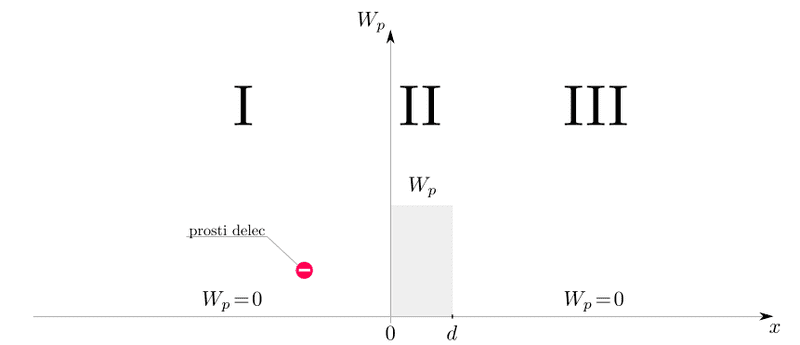
If particle is coming from the left a general solutions to the Schrödinger equations for sepparate intervals I, II and II are:
\begin{align}
\text{I:}& & \psi_1 &= \overbrace{A e^{i\mathcal L x}}^{\psi_{in}} + \overbrace{Be^{-i \mathcal L x}}^{\psi_{re}}& \mathcal L &= \sqrt{\tfrac{2mW}{\hbar^2}}\\
\text{II:}& & \psi_2 &= C e^{\mathcal K x} + De^{-\mathcal K x}& \mathcal K &= \sqrt{-\tfrac{2m(W-W_p)}{\hbar^2}}\\
\text{III:}& & \psi_3 &= \underbrace{E e^{i \mathcal L x}}_{\psi_{tr}}& &\\
\end{align}
Where ##\psi_{in}## is an incomming wave, ##\psi_{re}## is a reflected wave and ##\psi_{tr}## is transmitted wave. I used the boundary conditions and got a system of 4 equations:
\begin{align}
{\tiny\text{boundary}}&{\tiny\text{conditions at x=0:}} & {\tiny\text{boundary conditions}}&{\tiny\text{at x=d:}}\\
A + B &= C + D & Ce^{\mathcal K d} + De^{-\mathcal K d} &= E e^{i \mathcal L d}\\
i \mathcal L A - i \mathcal L B &= \mathcal KC - \mathcal K D & \mathcal K C e^{\mathcal K d} - \mathcal K D e^{-\mathcal K d}&= i \mathcal L E e^{i \mathcal L d}
\end{align}
So now i decided to calculate coefficient of transmission ##T##:
\begin{align}
T &= \dfrac{|j_{tr}|}{|j_{in}|} \!=\! \Bigg|\dfrac{\dfrac{\hbar }{2mi}\! \left( \dfrac{d\overline{\psi}_{tr}}{dx}\, \psi_{tr} - \dfrac{d \psi_{tr}}{dx}\, \overline{\psi}_{tr} \right)}{\dfrac{\hbar}{2mi} \!\left( \dfrac{d\overline{\psi}_{in}}{dx}\, \psi_{in} - \dfrac{d\psi_{in}}{dx}\, \overline{\psi}_{in} \right) }\Bigg| \!=\! \Bigg|\dfrac{\frac{d}{dx}\big(\overbrace{Ee^{-i\mathcal L x}}^{\text{konjug.}}\big) Ee^{i\mathcal L x} - \frac{d}{dx} \left( Ee^{i\mathcal L x}\right)\! \overbrace{Ee^{-i\mathcal L x}}^{\text{konjug.}}}{ \frac{d}{dx}\big(\underbrace{Ae^{-i\mathcal L x}}_{\text{konjug.}}\big) Ae^{i\mathcal L x} - \frac{d}{dx} \left( Ae^{i\mathcal L x}\right)\! \underbrace{Ae^{-i\mathcal L x}}_{\text{konjug.}}}\Bigg|\! = \nonumber\\
&=\Bigg|\dfrac{-i\mathcal L Ee^{-i\mathcal L x} E e^{i \mathcal L x} - i\mathcal L E e^{i \mathcal L x} Ee^{-i \mathcal L x}}{-i \mathcal L A e^{-i\mathcal L x} Ae^{i \mathcal L x} - i \mathcal L A e^{i \mathcal L x}Ae^{-i \mathcal L x} }\Bigg|=\Bigg|\dfrac{-i\mathcal L E^2 - i\mathcal L E^2}{-i \mathcal L A^2 - i \mathcal L A^2}\Bigg|=\Bigg|\dfrac{-2 i \mathcal L E^2}{-2i\mathcal L A^2}\Bigg| = \frac{|E|^2}{|A|^2}
\end{align}
It accured to me that if out of 4 system equations i can get amplitude ratio ##E/A##, i can calculate ##T## quite easy. Could anyone show me how do i get this ratio?
If particle is coming from the left a general solutions to the Schrödinger equations for sepparate intervals I, II and II are:
\begin{align}
\text{I:}& & \psi_1 &= \overbrace{A e^{i\mathcal L x}}^{\psi_{in}} + \overbrace{Be^{-i \mathcal L x}}^{\psi_{re}}& \mathcal L &= \sqrt{\tfrac{2mW}{\hbar^2}}\\
\text{II:}& & \psi_2 &= C e^{\mathcal K x} + De^{-\mathcal K x}& \mathcal K &= \sqrt{-\tfrac{2m(W-W_p)}{\hbar^2}}\\
\text{III:}& & \psi_3 &= \underbrace{E e^{i \mathcal L x}}_{\psi_{tr}}& &\\
\end{align}
Where ##\psi_{in}## is an incomming wave, ##\psi_{re}## is a reflected wave and ##\psi_{tr}## is transmitted wave. I used the boundary conditions and got a system of 4 equations:
\begin{align}
{\tiny\text{boundary}}&{\tiny\text{conditions at x=0:}} & {\tiny\text{boundary conditions}}&{\tiny\text{at x=d:}}\\
A + B &= C + D & Ce^{\mathcal K d} + De^{-\mathcal K d} &= E e^{i \mathcal L d}\\
i \mathcal L A - i \mathcal L B &= \mathcal KC - \mathcal K D & \mathcal K C e^{\mathcal K d} - \mathcal K D e^{-\mathcal K d}&= i \mathcal L E e^{i \mathcal L d}
\end{align}
So now i decided to calculate coefficient of transmission ##T##:
\begin{align}
T &= \dfrac{|j_{tr}|}{|j_{in}|} \!=\! \Bigg|\dfrac{\dfrac{\hbar }{2mi}\! \left( \dfrac{d\overline{\psi}_{tr}}{dx}\, \psi_{tr} - \dfrac{d \psi_{tr}}{dx}\, \overline{\psi}_{tr} \right)}{\dfrac{\hbar}{2mi} \!\left( \dfrac{d\overline{\psi}_{in}}{dx}\, \psi_{in} - \dfrac{d\psi_{in}}{dx}\, \overline{\psi}_{in} \right) }\Bigg| \!=\! \Bigg|\dfrac{\frac{d}{dx}\big(\overbrace{Ee^{-i\mathcal L x}}^{\text{konjug.}}\big) Ee^{i\mathcal L x} - \frac{d}{dx} \left( Ee^{i\mathcal L x}\right)\! \overbrace{Ee^{-i\mathcal L x}}^{\text{konjug.}}}{ \frac{d}{dx}\big(\underbrace{Ae^{-i\mathcal L x}}_{\text{konjug.}}\big) Ae^{i\mathcal L x} - \frac{d}{dx} \left( Ae^{i\mathcal L x}\right)\! \underbrace{Ae^{-i\mathcal L x}}_{\text{konjug.}}}\Bigg|\! = \nonumber\\
&=\Bigg|\dfrac{-i\mathcal L Ee^{-i\mathcal L x} E e^{i \mathcal L x} - i\mathcal L E e^{i \mathcal L x} Ee^{-i \mathcal L x}}{-i \mathcal L A e^{-i\mathcal L x} Ae^{i \mathcal L x} - i \mathcal L A e^{i \mathcal L x}Ae^{-i \mathcal L x} }\Bigg|=\Bigg|\dfrac{-i\mathcal L E^2 - i\mathcal L E^2}{-i \mathcal L A^2 - i \mathcal L A^2}\Bigg|=\Bigg|\dfrac{-2 i \mathcal L E^2}{-2i\mathcal L A^2}\Bigg| = \frac{|E|^2}{|A|^2}
\end{align}
It accured to me that if out of 4 system equations i can get amplitude ratio ##E/A##, i can calculate ##T## quite easy. Could anyone show me how do i get this ratio?
Last edited: