How does rotating a magnet affect the magnetic field?

Click For Summary
Rotating a rare Earth magnet affects the magnetic field by causing the magnetic field pattern to rotate as well, leading to a time-varying magnetic induction. According to Faraday's law, this variation induces current in the solenoid coil, which can be explained through the presence of an electric field. The experiment resembles the principles of electric motor design, where the interaction between magnetic fields and electric currents is fundamental. Understanding these dynamics can provide insights into the voltage generated in the coil based on the speed of rotation. The relationship between rotation speed and induced voltage is a key focus of the experiment.
kvyn
Messages
1
Reaction score
0
I'm doing an experiment on the effect of the speed of rotation of a rare Earth magnet on the voltage generated in a solenoid coil. I was wondering, how does rotating the magnet affect the magnetic field?

The experiment setup is similar to the one below:
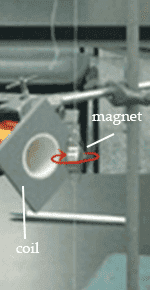
Untitled_4.png
 
Physics news on Phys.org
kvyn said:
I'm doing an experiment on the effect of the speed of rotation of a rare Earth magnet on the voltage generated in a solenoid coil. I was wondering, how does rotating the magnet affect the magnetic field?

The experiment setup is similar to the one below:
Untitled_4.png

The magnetic field pattern will rotate with the magnet, thus making the magnetic induction variable in time. From Faraday's law, we expect current to be induced in the coil. We explain this current as due to electric field. So we think of variable magnetic field to be necessarily accompanied with electric field.
 
Your experiment sounds like a form of electric motor. Analyses of electric motor design should be adaptable to describe your experiment.
 
I'm working through something and want to make sure I understand the physics. In a system with three wave components at 120° phase separation, the total energy calculation depends on how we treat them: If coherent (add amplitudes first, then square): E = (A₁ + A₂ + A₃)² = 0 If independent (square each, then add): E = A₁² + A₂² + A₃² = 3/2 = constant In three-phase electrical systems, we treat the phases as independent — total power is sum of individual powers. In light interference...

Similar threads

  • · Replies 5 ·
Replies
5
Views
1K
  • · Replies 5 ·
Replies
5
Views
525
  • · Replies 7 ·
Replies
7
Views
3K
  • · Replies 6 ·
Replies
6
Views
2K
  • · Replies 42 ·
2
Replies
42
Views
3K
  • · Replies 14 ·
Replies
14
Views
2K
  • · Replies 7 ·
Replies
7
Views
2K
  • · Replies 21 ·
Replies
21
Views
4K
  • · Replies 5 ·
Replies
5
Views
3K
  • · Replies 1 ·
Replies
1
Views
1K