How does the addition of a lift affect the forces on a space elevator?

Click For Summary

Discussion Overview

The discussion centers on the forces acting on a space elevator, particularly how the addition of a lift affects the forces on the countermass and its tether. Participants explore the implications of placing a lift below geostationary orbit and the resulting force dynamics, including centripetal force and tension in the cable.

Discussion Character

  • Technical explanation
  • Debate/contested
  • Mathematical reasoning

Main Points Raised

  • Some participants propose that the total forces acting on the countermass, when a lift is added, exceed the centripetal force required to maintain its orbit, raising questions about why the countermass does not fall.
  • Others argue that from an inertial frame, the countermass is always falling, but its high horizontal velocity prevents it from getting closer to Earth.
  • A participant mentions that there is a safety factor in the mass and position of the counterweight, suggesting that constant tension in the cable is maintained regardless of the lift's position.
  • Some participants express uncertainty about how the forces balance when additional mass is placed on the tether, questioning whether the tensions above the weight increase as a result.
  • There is a discussion about whether the cable can maintain its tension if external factors, such as the moon's position, change.
  • One participant clarifies that adding mass does not affect the tension in the upper part of the elevator, as the mass is supported by reduced tension below it.

Areas of Agreement / Disagreement

Participants express differing views on how the forces interact when a lift is added to the cable. There is no consensus on the implications of these forces, and the discussion remains unresolved regarding the exact mechanics involved.

Contextual Notes

Participants mention various assumptions about the forces involved, including the role of tension and the effects of adding mass to the cable. The discussion highlights the complexity of the force dynamics without reaching a definitive conclusion.

sander2798
Messages
8
Reaction score
0
Hello everyone,

I am trying to find out how space elevators work, but there is one think I can't figure out.

Normally, the forces on the countermass and it's tether will be as following, assuming you neglect the gravity on the tether.
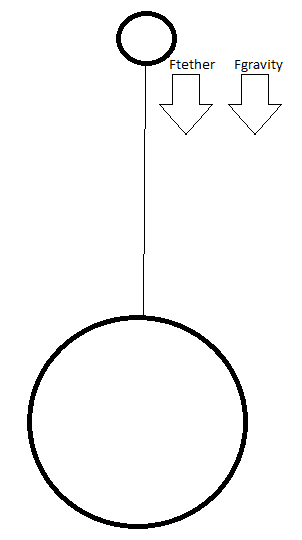
d44801c9b82e92c43d7183cc28e6e340.png


But now, I put the lift somewhere on the cable (below geostationary orbit), like this.
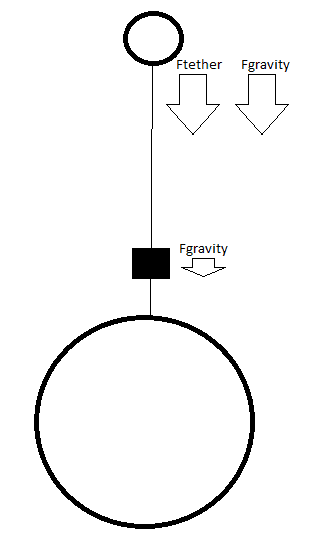
46f57766c734dd1478b757aed4a177a3.png


The total forces added up are more than the centripetal force needed to keep the counter mass in orbit, right? So how is it that the countermass doesn't come falling down?

Thanks in advance,
Sander.
 
Physics news on Phys.org
sander2798 said:
So how is it that the countermass doesn't come falling down?
Analyzed from an inertial frame it is falling down. Always. It is just going sideways very fast too, which keeps the distance from decreasing despite the fact that it is being pulled strongly down.

This may be easier to understand in the rotating reference frame. In that frame it is kept up by the centrifugal force.
 
Last edited by a moderator:
sander2798 said:
The total forces added up are more than the centripetal force needed to keep the counter mass in orbit, right?
There is some safety factor included in the mass and position of the counterweight: there is constant tension. Imagine a permanent load attached to the cable on the ground. Moving a part of this load up doesn't change the force balance. It just reduces tension below the weight.
 
  • Like
Likes   Reactions: sander2798
DaleSpam said:
Analyzed from an inertial frame it is falling down. Always. It is just going sideways very fast too, which keeps the distance from decreasing despite the fact that it is being pulled strongly down.

This !ay be easier to understand in the rotating reference frame. In that frame it is kept up by the centrifugal force.
With "falling down" I actually meant "getting closer to the earth", so I still don't understand it, but thanks for your response. :P
 
mfb said:
There is some safety factor included in the mass and position of the counterweight: there is constant tension. Imagine a permanent load attached to the cable on the ground. Moving a part of this load up doesn't change the force balance.

Yes, but assume you don't have any mass on the cable. The tension is a constant force, right? Adding the gravity of the counterweight to this should be equal to the centripetal force. So if you'd put a mass on this tether, the total forces pulling the countermass towards the Earth will be bigger than the needed centripetal force for a circular movement. As far as I know the result of this will be that the countermass will start coming closer to the Earth and start falling as soon as it passes geostationary orbit.

mfb said:
It just reduces tension below the weight.
It indeed reduces the tensions below the weight, but don't the tensions above the weight become bigger as a result of that?

Thanks a lot for your response!
 
sander2798 said:
With "falling down" I actually meant "getting closer to the earth", so I still don't understand it, but thanks for your response. :P
Well, your first diagram shows two forces, both pulling in the same direction. You mention the centripetal force but you didn't show it.

That said, in your second diagram, the magnitudes of the forces don't seem to have changed. So the anchor's disposition hasn't changed.

I think perhaps if you make your diagram more detailed it will become clearer.
 
Last edited by a moderator:
  • Like
Likes   Reactions: sander2798
sander2798 said:
Yes, but assume you don't have any mass on the cable. The tension is a constant force, right? Adding the gravity of the counterweight to this should be equal to the centripetal force. So if you'd put a mass on this tether, the total forces pulling the countermass towards the Earth will be bigger than the needed centripetal force for a circular movement. As far as I know the result of this will be that the countermass will start coming closer to the Earth and start falling as soon as it passes geostationary orbit.
Can the cable maintain its tension if the moon moves closer to earth? And from the other way: if, for example, you decide to add some more centripetal force, what does the cable do?
 
  • Like
Likes   Reactions: sander2798
sander2798 said:
It indeed reduces the tensions below the weight, but don't the tensions above the weight become bigger as a result of that?

Only if you overload the elevator. This would happen if the additional weight exceeds the initial tension. Within the safe range of operation the additional weight and the reduced tension cancel each other out.
 
sander2798 said:
Yes, but assume you don't have any mass on the cable. The tension is a constant force, right? Adding the gravity of the counterweight to this should be equal to the centripetal force.
It is.
sander2798 said:
So if you'd put a mass on this tether, the total forces pulling the countermass towards the Earth will be bigger than the needed centripetal force for a circular movement.
No, adding a mass does not change the upper part of the elevator at all. Tension there stays the same. The mass is "supported" by the reduced tension in the cable below the mass. The difference in tension (purely from the reduction below) balances the mass.
 
  • Like
Likes   Reactions: sander2798
  • #10
mfb said:
It is.No, adding a mass does not change the upper part of the elevator at all. Tension there stays the same. The mass is "supported" by the reduced tension in the cable below the mass. The difference in tension (purely from the reduction below) balances the mass.
That was exactly what I didnt understand. Good explanation, thanks a lot!
 

Similar threads

  • · Replies 6 ·
Replies
6
Views
3K
  • · Replies 5 ·
Replies
5
Views
4K
  • · Replies 14 ·
Replies
14
Views
22K
Replies
1
Views
4K
  • · Replies 11 ·
Replies
11
Views
2K
  • · Replies 2 ·
Replies
2
Views
3K
  • · Replies 1 ·
Replies
1
Views
2K
  • · Replies 10 ·
Replies
10
Views
2K
  • · Replies 18 ·
Replies
18
Views
4K
  • · Replies 11 ·
Replies
11
Views
2K