How Does the Euler-Lagrange Equation Apply to Parametric Solutions?

  • Thread starter Thread starter Another
  • Start date Start date
  • Tags Tags
    Euler-lagrange
Click For Summary
SUMMARY

The discussion focuses on the application of the Euler-Lagrange equation to parametric solutions, specifically addressing the differential equation defined as ##y_x = (\frac{b+y}{a-y})^{1/2}##. The solution is expressed in parametric form using the relationship ##y = \frac{1}{2} (a-b) - \frac{1}{2} (a+b) \cos \theta##, where ##\theta## serves as a parameter. The participants clarify that the exponent in the equation should be 1/2 rather than 2, emphasizing the importance of correct notation in mathematical definitions.

PREREQUISITES
  • Understanding of differential equations and their solutions
  • Familiarity with the Euler-Lagrange equation
  • Knowledge of parametric equations and substitutions
  • Basic proficiency in calculus and mathematical notation
NEXT STEPS
  • Study the derivation and applications of the Euler-Lagrange equation
  • Explore parametric equations and their graphical representations
  • Investigate the implications of substitutions in solving differential equations
  • Learn about the properties of functions and their definitions in calculus
USEFUL FOR

Mathematicians, physics students, and anyone interested in advanced calculus, particularly those studying differential equations and their applications in physics and engineering.

Another
Messages
104
Reaction score
5
Homework Statement
I am wondering about definition of a function
Relevant Equations
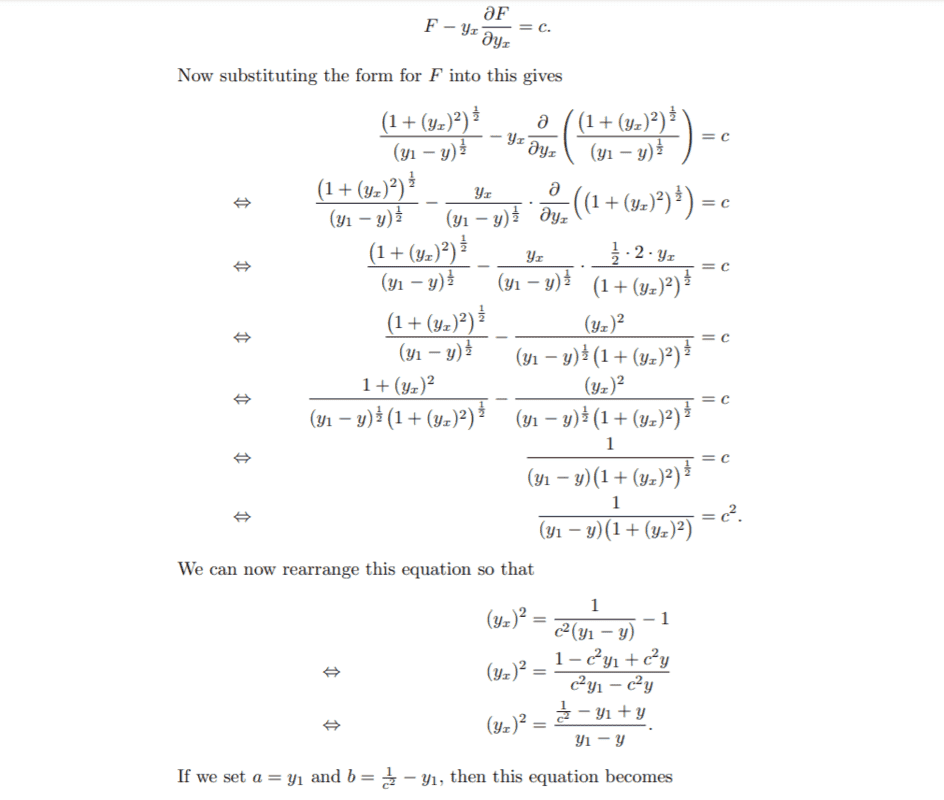
## F = \frac{(1+(y_x)^2)^{\frac{1}{2}}}{(y_1-y)^{\frac{1}{2}}}##
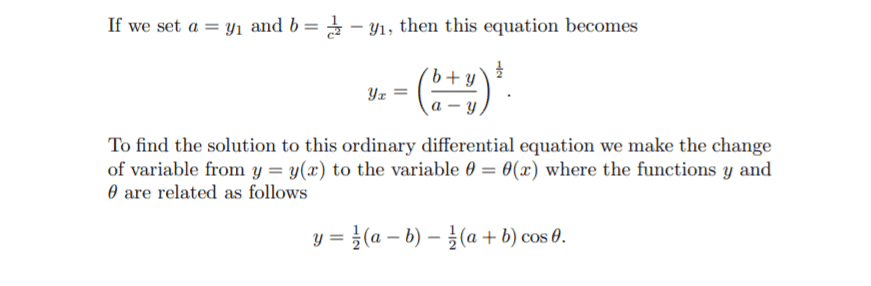
My question : I am wondering about definition of a function. when ##y_x = (\frac{b+y}{a-y})^2##

Why in this book is defined solution ##y = y(x)## in from ## y = y(θ(x))## . And have a relationship in the form

## y = \frac{1}{2} (a-b) - \frac{1}{2} (a+b) cosθ ## ?

_____________________________________________________________________________________________________________________________________
In this book is defined ## F = \frac{(1+(y_x)^2)^{\frac{1}{2}}}{(y_1-y)^{\frac{1}{2}}}##

The E-L equation in case F = ##F(y,y_x)## ===> ##F - y_x \frac{∂F}{∂y_x} = c## when c is constant.
qqwqwqw.png


aasdd.png
 
Physics news on Phys.org
Another said:
My question : I am wondering about definition of a function. when ##y_x = (\frac{b+y}{a-y})^2##
The exponent should be 1/2 rather than 2.

Why in this book is defined solution ##y = y(x)## in from ## y = y(θ(x))## . And have a relationship in the form

## y = \frac{1}{2} (a-b) - \frac{1}{2} (a+b) cosθ ## ?
This is just a very clever substitution that allows you to fairly easily find a solution of the differential equation, ##y_x = (\frac{b+y}{a-y})^{1/2}##. It yields a solution in parametric form: ##y(\theta)## ; ##x(\theta)##, where ##\theta## is a parameter.
 
TSny said:
The exponent should be 1/2 rather than 2.This is just a very clever substitution that allows you to fairly easily find a solution of the differential equation, ##y_x = (\frac{b+y}{a-y})^{1/2}##. It yields a solution in parametric form: ##y(\theta)## ; ##x(\theta)##, where ##\theta## is a parameter.
thank you very much
 

Similar threads

  • · Replies 5 ·
Replies
5
Views
2K
Replies
4
Views
4K
Replies
8
Views
2K
Replies
42
Views
4K
Replies
1
Views
1K
  • · Replies 15 ·
Replies
15
Views
7K
  • · Replies 11 ·
Replies
11
Views
2K
Replies
3
Views
1K
Replies
15
Views
2K