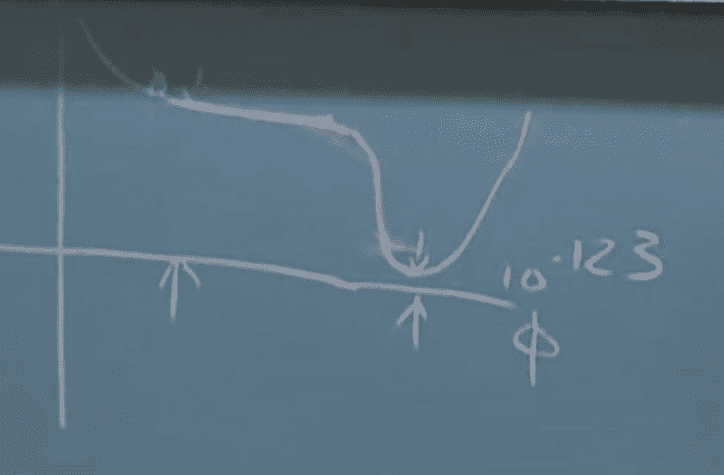
How does the graph of V(φ) support the concept of slow-roll inflation?

  • Context: Graduate 
  • Thread starter Thread starter robertjford80
  • Start date Start date
  • Tags Tags
    Expansion Universe
Click For Summary

Discussion Overview

The discussion centers around the implications of the graph of V(φ) in the context of slow-roll inflation, exploring how this graph supports the concept of inflation in cosmology. Participants examine the nature of inflation, the behavior of the potential, and the consequences for the universe's evolution, including the transition from inflation to the standard big bang expansion.

Discussion Character

  • Exploratory
  • Debate/contested
  • Technical explanation

Main Points Raised

  • Some participants note that the graph of V(φ) shows a gradual decline followed by a rapid descent, questioning how this is known given that inflation erases prior information.
  • Others argue that while inflation erases much of the pre-inflationary information, it leaves an imprint on the universe, suggesting that the graph serves as a heuristic model for understanding inflation.
  • A participant proposes that the current best-fit potential is V(φ) = αφ², indicating that many potentials resemble harmonic potentials near their minima, which may affect how inflation is observed.
  • Some participants challenge the notion that inflation ends instantaneously, suggesting that the slow-roll conditions must be broken gradually, as they involve continuous values that cannot change abruptly.
  • There is a discussion about the behavior of the oscillating inflaton, with some suggesting it behaves like regular matter and can decay into standard model particles, influencing the universe's heating and subsequent expansion.

Areas of Agreement / Disagreement

Participants express differing views on the nature of inflation's end and the implications of the potential's shape. There is no consensus on whether the end of inflation is instantaneous or gradual, and the discussion remains unresolved regarding the specifics of how the graph of V(φ) relates to these concepts.

Contextual Notes

Participants acknowledge that the discussion involves complex models of inflation and the conditions under which they operate, with some assumptions about the behavior of the inflaton and its interactions remaining unaddressed.
robertjford80
Messages
388
Reaction score
0
This is a screenshot from one of susskind's cosmology lectures.

Screenshot2012-06-18at90105PM.png


it shows a graph of V(φ). As you can see it slowly rules down then, bam, it rolls really fast down hill. I thought inflation erased all the information before it happened. So how does he know there is a gradual decline before a fast decline?
 
Space news on Phys.org
robertjford80 said:
This is a screenshot from one of susskind's cosmology lectures.

Screenshot2012-06-18at90105PM.png


it shows a graph of V(φ). As you can see it slowly rules down then, bam, it rolls really fast down hill. I thought inflation erased all the information before it happened. So how does he know there is a gradual decline before a fast decline?
Well, yes, inflation erases pretty much all information from before, but leaves its own imprint upon the resulting universe. That said, this is just a heuristic model of inflation used to explain the key concepts. There are many others. The current best-fit actually seems to be simply a potential given by:

[tex]V(\phi) = \alpha \phi^2[/tex].

Here [itex]\alpha[/itex] is a constant that gives the overall scale of the potential. This shouldn't be too much of a surprise since most any potential will look like a harmonic potential near its minimum, and it is pretty much only the behavior of the potential near the end of inflation that is detectable. So even if we had a complicated potential like the one shown in that graph, it might still come out just looking like a harmonic potential.
 
Chalnoth said:
Well, yes, inflation erases pretty much all information from before, but leaves its own imprint upon the resulting universe. That said, this is just a heuristic model of inflation used to explain the key concepts. There are many others. The current best-fit actually seems to be simply a potential given by:

[tex]V(\phi) = \alpha \phi^2[/tex].

Here [itex]\alpha[/itex] is a constant that gives the overall scale of the potential. This shouldn't be too much of a surprise since most any potential will look like a harmonic potential near its minimum, and it is pretty much only the behavior of the potential near the end of inflation that is detectable. So even if we had a complicated potential like the one shown in that graph, it might still come out just looking like a harmonic potential.

I don't think that's true -- although I'm not an expert in inflation so please educate me if I'm wrong. But in the usual models, doesn't inflation end right away when the slow roll conditions are broken? In a potential like that, after you start oscillating in the minimum, the slow roll conditions do not hold so the universe is no longer inflating. In fact, I seem to remember that the oscillating inflaton behaves like regular matter, satisfying [itex]\rho \sim a^{-3}[/itex]. If the oscillating inflaton is coupled to regular standard model particles, then it can decay into them, heating up the universe and starting the regular big bang expansion.
 
clamtrox said:
I don't think that's true -- although I'm not an expert in inflation so please educate me if I'm wrong. But in the usual models, doesn't inflation end right away when the slow roll conditions are broken? In a potential like that, after you start oscillating in the minimum, the slow roll conditions do not hold so the universe is no longer inflating. In fact, I seem to remember that the oscillating inflaton behaves like regular matter, satisfying [itex]\rho \sim a^{-3}[/itex]. If the oscillating inflaton is coupled to regular standard model particles, then it can decay into them, heating up the universe and starting the regular big bang expansion.
Right, but that end is never instantaneous, in any inflation model. The slow roll conditions are, after all, a statement that the change in the field value is very slow compared to the expansion. Such conditions cannot be broken instantaneously, because they involve one continuous value becoming significant in size compared to another. So inflation always has an at least somewhat gradual end.

I believe in realistic inflation models the end of inflation has to be fairly rapid, but it is never instantaneous.
 

Similar threads

  • · Replies 9 ·
Replies
9
Views
3K
  • · Replies 4 ·
Replies
4
Views
5K
Replies
39
Views
4K
Replies
25
Views
6K
  • · Replies 24 ·
Replies
24
Views
7K
  • · Replies 10 ·
Replies
10
Views
4K
  • · Replies 1 ·
Replies
1
Views
3K
  • · Replies 13 ·
Replies
13
Views
4K
  • · Replies 3 ·
Replies
3
Views
2K
  • · Replies 13 ·
Replies
13
Views
7K