Undergrad How Does the Ratio Test Determine Convergence in Power Series?

Click For Summary
SUMMARY

The discussion focuses on the application of the Ratio Test to determine the convergence of the power series $$\sum_{n=0}^{\infty} A_n (x-1)^n$$. The radius of convergence is established as $$R = \frac{3}{2}$$, indicating that the series converges for values of $$x$$ within the interval $$(-0.5, 2.5)$$. Specifically, when $$x = 2$$, the series converges since the limit of the ratio test is less than 1. The participants clarify that the series converges for $$x \geq 2$$ and $$x \leq 0$$, reinforcing the importance of evaluating specific values within the radius of convergence.

PREREQUISITES
  • Understanding of power series and convergence criteria
  • Familiarity with the Ratio Test for series convergence
  • Basic knowledge of limits and sequences in calculus
  • Ability to interpret mathematical notation and inequalities
NEXT STEPS
  • Explore the implications of the Ratio Test on different power series
  • Study the concept of radius of convergence in depth
  • Learn about alternative convergence tests, such as the Root Test
  • Investigate the behavior of series at the endpoints of the convergence interval
USEFUL FOR

Students and educators in mathematics, particularly those studying calculus and series convergence, as well as anyone interested in deepening their understanding of power series and convergence tests.

Leo Liu
Messages
353
Reaction score
156
TL;DR
{##A_n##} is a sequence of positive numbers. ##\sum_{n=0}^{\infty} A_n(x-1)^n## has a R of convergence ##R=\frac 3 2##. Does ##\sum_{n=0}^{\infty} A_n## converge or diverge?
I tried to use the ratio test, but I am stuck on finding the range of the limit.
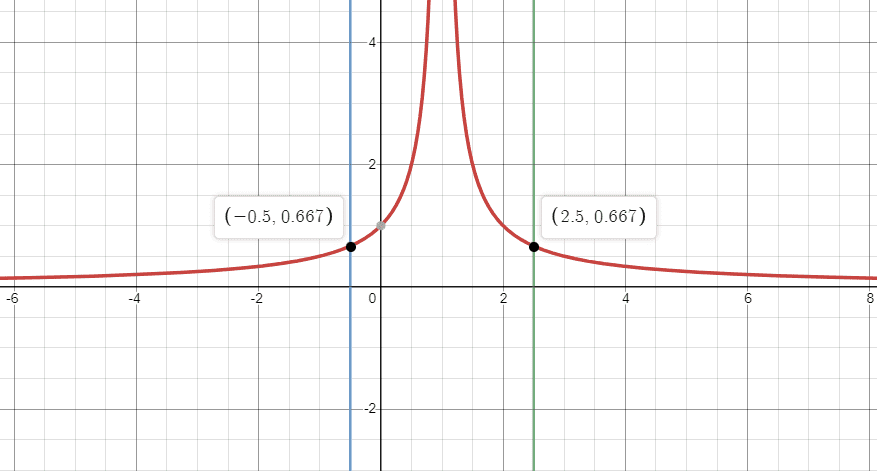
$$\because \left|x-1\right|<1.5=Radius$$
$$\therefore -0.5<x<2.5$$

$$\lim _{n \to \infty} \left| \frac{A_{n+1}(x-1)^{n+1}}{A_n(x-1)^n} \right|$$
$$\lim_{n \to \infty} \frac{A_{n+1} \left|x-1\right|}{A_n} <1$$
$$\lim_{n \to \infty} \left| \frac{A_{n+1}}{A_n} \right|< \frac 1 {\left| x-1 \right|}$$

Then I plotted the graph of 1/|x-1| and I found that the limit of A_n+1/A_n could vary from 2/3 (convergent) to infinity (divergent), as shown by the image below. What should I do next?
1593692590251.png
 
Last edited:
Physics news on Phys.org
What happens if you take ##x = 2##?
 
  • Like
Likes etotheipi
PeroK said:
What happens if you take ##x = 2##?
No conclusion?
 
Leo Liu said:
No conclusion?
What does that mean? Is ##2## inside or outside the radius?
 
PeroK said:
What does that mean? Is ##2## inside or outside the radius?
Does this show the radius of convergence ##R'## of the series A_n is 2?
 
Leo Liu said:
It means we have to use another method to test the convergence of the series. 2 is in the radius R.

Eh?

Leo Liu said:
Summary:: {##A_n##} is a sequence of positive numbers. ##\sum_{n=0}^{\infty} A_n(x-1)^n## has a R of convergence ##R=\frac 3 2##.
 
PeroK said:
Eh?
I think it is in the radius of convergence because ##-0.5<2<2.5##
 
Leo Liu said:
I think it is in the radius of convergence.
You're saying that you think ##2 < \frac 3 2##?
 
PeroK said:
You're saying that you think ##2 < \frac 3 2##?
No, but I am quite confused--we are talking about x, not ##\left| x-1 \right|##, right?
 
  • Like
Likes PeroK
  • #10
Leo Liu said:
No, but I am quite confused--we are talking about x, not ##\left| x-1 \right|##, right?
Yes, sorry, of course it's inside the radius of convergence. In any case, what does ##x = 2## tell you about ##A_n##?
 
  • Like
Likes Leo Liu
  • #11
PeroK said:
You're saying that you think ##2 < \frac 3 2##?
Can you please tell me what I should do next? This is not a homework question and I am doing it just for interest.
 
  • #12
Leo Liu said:
Can you please tell me what I should do next? This is not a homework question and I am doing it just for interest.
I've actually told you: put ##x = 2##.
 
  • #13
PeroK said:
Yes, sorry, of course it's inside the radius of convergence. In any case, what does ##x = 2## tell you about ##A_n##?
When ##x \geq 2 \: or \: x \leq 0##, the series converges.
 
  • #14
Leo Liu said:
When ##x>2 \: or \: x<0##, the series converges.
And what is the series when ##x = 2##?
 
  • #15
PeroK said:
And what is the series when ##x = 2##?
Converges at x=2?
 
  • #16
Leo Liu said:
Converges at x=2?
Write down the sequence for ##x = 2##.
 
  • Informative
Likes Leo Liu
  • #17
PeroK said:
Write down the sequence for ##x = 2##.
$$\sum_{n=0}^ \infty{A_n}$$
 
  • Like
Likes PeroK
  • #18
Leo Liu said:
$$\sum_{n=0}^ \infty{A_n}$$
That's what you should have done after post #2.
 
  • Like
Likes Leo Liu
  • #19
PeroK said:
That's what you should have done after post #2.
Oh, thank you! So it is actually convergent because the limit is less than 1 if we sub in x=2!
 
  • #20
Leo Liu said:
Oh, thank you! So it is actually convergent because the limit is less than 1 if we sub in x=2!
In general, the series:
$$\sum_{n = 0}^{\infty} A_n $$
converges, if and only if the power series:
$$\sum_{n = 0}^{\infty} A_n x^n$$
converges at ##x = 1##.

Those two properties are clearly equivalent.
 
  • Like
Likes Leo Liu

Similar threads

  • · Replies 3 ·
Replies
3
Views
3K
  • · Replies 6 ·
Replies
6
Views
4K
  • · Replies 5 ·
Replies
5
Views
3K
  • · Replies 3 ·
Replies
3
Views
2K
  • · Replies 2 ·
Replies
2
Views
2K
  • · Replies 2 ·
Replies
2
Views
2K
  • · Replies 2 ·
Replies
2
Views
2K
Replies
3
Views
2K
  • · Replies 8 ·
Replies
8
Views
2K
  • · Replies 12 ·
Replies
12
Views
3K