How Does Total Internal Reflection Occur in Salt Solutions?

  • Thread starter Thread starter Anton Alice
  • Start date Start date
Click For Summary
SUMMARY

Total internal reflection occurs in salt solutions due to the continuous change in refractive index as light travels through layers of varying density. The laser beam bends downwards at the peak of the curve because of this phenomenon, which is governed by Snell's Law. As the angle of incidence increases, transmission becomes more significant than reflection, particularly when the refractive index difference approaches zero. This results in a complex interplay between reflection and refraction, ultimately allowing the laser to bend back downwards.

PREREQUISITES
  • Understanding of Snell's Law
  • Knowledge of refractive index concepts
  • Familiarity with total internal reflection principles
  • Basic optics and light propagation
NEXT STEPS
  • Research the mathematical derivation of Snell's Law
  • Explore the principles of total internal reflection in optical fibers
  • Investigate the effects of varying refractive indices in layered media
  • Study the applications of laser technology in different refractive environments
USEFUL FOR

Students and professionals in optics, physicists, and anyone interested in the behavior of light in varying mediums, particularly in relation to total internal reflection and laser applications.

Anton Alice
Messages
68
Reaction score
1
Hello,

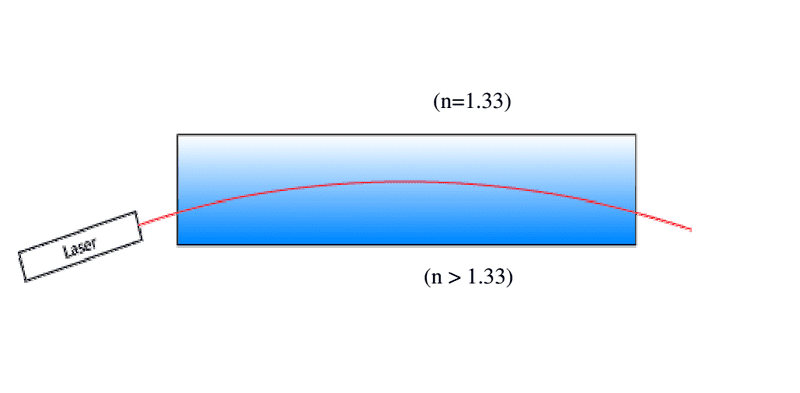
please take a look at the following picture:
laser.png


So we have a salt solution, with increasing refractive index, as you go down the solution.
The Laser is steadily refracted at the layers from high-to-low index and therefore bends in clockwise direction.
But how is it possible for the laser to bend down again? And also, shouldn't we also see reflections? Because at any point, there is a layer of high-to-low index transition. And at any such point there should also be a reflection. And as the angle of incidence get higher, as the laser path gets more horizontal, the reflection should dominate.

EDIT:

Does it bend down, because of total internal reflection at the peak of the curve?
 
Science news on Phys.org
Since the index of refraction changes continuously, you have to use Snell's law to describe the propagation one infinitesimal distance at a time. If you work it out, you can get a differential equation that will describe the trajectory of a beam of light. That it bends back downwards at the top is due to total internal reflection.

That being said, as the difference in index of refraction on two sides of an interface goes to zero, transmission dominates over reflection (the reflection coefficient becomes insignificant compared to the transmission coefficient). Though this would seem to contradict the idea of total internal reflection causing the backwards bend at the top, the beam near the top has a very shallow angle of incidence on either side of the peak, so that very small differences in refractive index can still amount to a change in the beam's trajectory.
 
  • Like
Likes Anton Alice
yes, thank you.
 

Similar threads

  • · Replies 17 ·
Replies
17
Views
2K
  • · Replies 2 ·
Replies
2
Views
2K
Replies
2
Views
1K
Replies
8
Views
4K
  • · Replies 7 ·
Replies
7
Views
2K
  • · Replies 8 ·
Replies
8
Views
3K
  • · Replies 1 ·
Replies
1
Views
3K
Replies
7
Views
4K
  • · Replies 4 ·
Replies
4
Views
2K
Replies
3
Views
2K