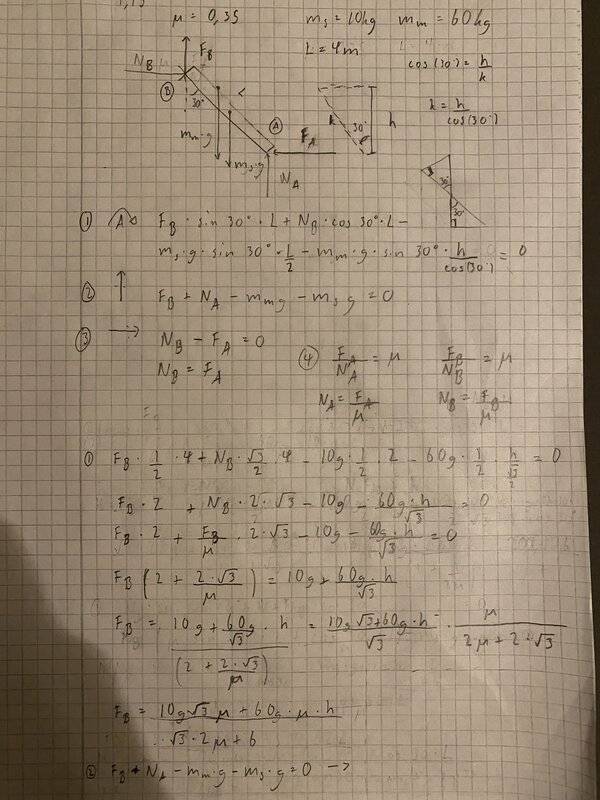
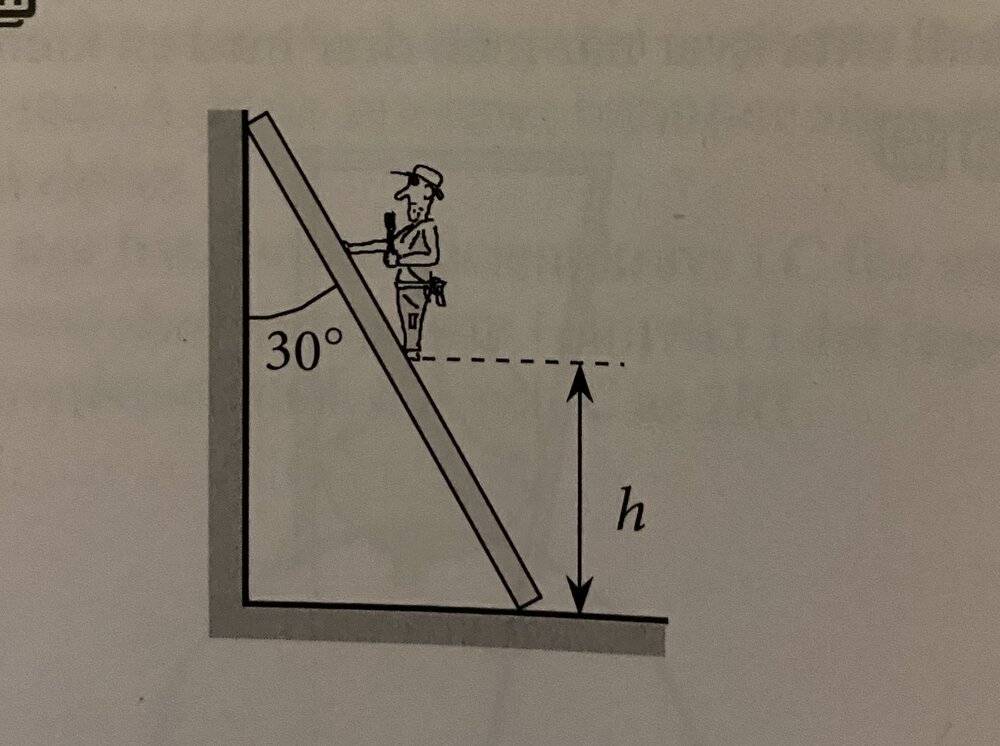
How far can the person climb up the ladder before it starts sliding?

Click For Summary

Homework Help Overview

The discussion revolves around a physics problem involving a ladder and the conditions under which it begins to slide. Participants are examining equations related to forces and moments acting on the ladder, with a focus on determining the height a person can climb before the ladder slips.

Discussion Character

  • Exploratory, Assumption checking, Mathematical reasoning

Approaches and Questions Raised

  • Participants discuss various equations and their simplifications, questioning the correctness of their calculations and the signs used in the equations. There is an exploration of different methods to solve the problem, including substituting values into specific equations and considering the elimination of unknowns.

Discussion Status

Some participants have provided guidance on identifying errors in the equations and suggested approaches for solving the problem. There is an ongoing exploration of methods, with no explicit consensus reached on a single approach. The discussion is active, with participants sharing their reasoning and clarifications.

Contextual Notes

Participants mention the difficulty of the problem and the time spent attempting to solve it. There are references to specific equations and variables, indicating a complex setup that may require careful consideration of assumptions and definitions.

ClearWhey
Messages
19
Reaction score
4
Homework Statement
A person climbs a ladder like in the picture, how far can he climb up before the ladder starts sliding?
Relevant Equations
Ladder length 4m
Person weight 60kg
Ladder weight 10kg
Ladders coeficient of friction on both contact points 0,35
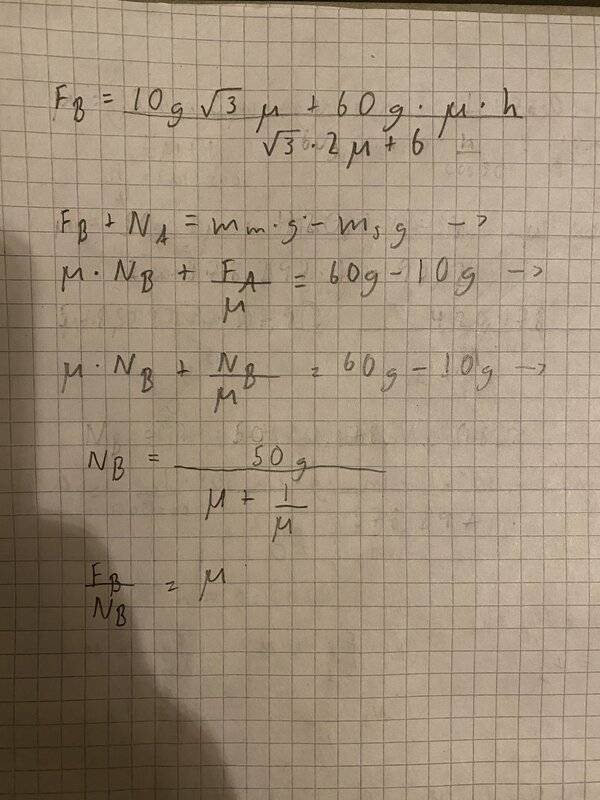
Look on picture two for my equations, I’m pretty sure my first three equations are correct as it’s the same on the answer paper I got. Answer paper only shows the three equations and correct answer so I have no idea how they got to it.

When I put the equations togheter And solve out ”h” i get like 1,5m something which is wrong. The answer is 2,34m. Can someone please look into this, did I simplify the equations wrong? Or is it something else. Have tried myself for like 2-3 hours and this is my last resort. Thanks in advance!
2CA7277E-7C95-47B5-A327-3749824A9885.jpeg
E0259D9F-C77C-4349-8FC7-7FE3930BBFC2.jpeg
2CE2C24B-1F32-43BF-9298-E8DB6A82019D.jpeg
 
Physics news on Phys.org
I found a sign error here:
1600398365731.png


I suggest that you start by using equations 2 through 4 to find ##N_B## and ##F_B##. Evaluatue these numerically and then substitute into equation 1 to find ##h##.
 
  • Like
Likes   Reactions: Lnewqban and ClearWhey
TSny said:
I found a sign error here:
View attachment 269629

I suggest that you start by using equations 2 through 4 to find ##N_B## and ##F_B##. Evaluatue these numerically and then substitute into equation 1 to find ##h##.

Changed that sign to + and now I got the correct answer! Thanks you so much.

I could only solve it with my method by placing in the equation for FB and NB into my last equation. But you wrote something about substituting into the first equation, how? Would it be easier to solve this kind of problem with another method?
 
  • Like
Likes   Reactions: TSny
ClearWhey said:
I could only solve it with my method by placing in the equation for FB and NB into my last equation. But you wrote something about substituting into the first equation, how? Would it be easier to solve this kind of problem with another method?
It is generally easier to start with the simplest equations that allow you to eliminate some unknowns. The most complicated equation doesn't use FA or NA, so eliminate those first.
##F_A=N_B##
##N_A=N_B/\mu##
##F_B=N_B\mu##
##F_B+N_A=N_B\mu+N_B/\mu=M_m+M_s##
##N_B=\frac{\mu(M_m+M_s)}{1+\mu^2}##
##F_B=\frac{\mu^2(M_m+M_s)}{1+\mu^2}##
Etc.
 
  • Like
Likes   Reactions: Lnewqban, ClearWhey and TSny
haruspex said:
It is generally easier to start with the simplest equations that allow you to eliminate some unknowns. The most complicated equation doesn't use FA or NA, so eliminate those first.
##F_A=N_B##
##N_A=N_B/\mu##
##F_B=N_B\mu##
##F_B+N_A=N_B\mu+N_B/\mu=M_m+M_s##
##N_B=\frac{\mu(M_m+M_s)}{1+\mu^2}##
##F_B=\frac{\mu^2(M_m+M_s)}{1+\mu^2}##
Etc.

Thanks for clarifying this, now this question seems a lot easier. By the way do you know if there is anyway you can mark this thread as complete or solved? Or do you just leave it be when the homework is solved?

And again thanks to you and TSny for helping me!
 
ClearWhey said:
if there is anyway you can mark this thread as complete or solved?
(@berkeman)
There had been requests for such a feature for quite a while, and finally it was implemented. Shortly afterwards, there was a major upgrade to the whole system and the feature disappeared.
Various other retrograde changes happened at the same time: subscript and superscript, except via Latex, was lost (now reinstated under the "..." pull down). But the most annoying is that clicking on Quote to some text in post #1 results in the whole of the Homework Statement and Relevant Equations sections being quoted as well as the selected text. Since I often want to quote several parts of post #1 and respond to them individually, I then have to go laboriously through deleting pages of duplication.
 
haruspex said:
But the most annoying is that clicking on Quote to some text in post #1 results in the whole of the Homework Statement and Relevant Equations sections being quoted as well as the selected text. Since I often want to quote several parts of post #1 and respond to them individually, I then have to go laboriously through deleting pages of duplication.

I found that if you highlight the text you want to quote, a little pop-up comes up with 'quote' and 'reply' options. If you hit 'reply', then it'll only copy that part into your text box, and not the whole post. One caveat is that it doesn't work for LateX. Do you have that feature too?
 
etotheipi said:
I found that if you highlight the text you want to quote, a little pop-up comes up with 'quote' and 'reply' options. If you hit 'reply', then it'll only copy that part into your text box, and not the whole post. One caveat is that it doesn't work for LateX. Do you have that feature too?
I just tried that and it did the same as Quote, just immediately instead of needing to click Insert Quotes.
Another behaviour I forgot to mention is that if you highlight a part of Homework Statement and Relevant Equations then you can do a Copy but there is no quote /reply option.
None of these have ever worked with Latex. There used to be another option, something about Mathjax?, which revealed the latex source in a popup and you could copy that. Reply of the whole post copies the latex ok, and I often do that just to get the latex, then delete all the rest.
 
  • Like
Likes   Reactions: etotheipi

Similar threads

  • · Replies 5 ·
Replies
5
Views
3K
  • · Replies 6 ·
Replies
6
Views
2K
  • · Replies 2 ·
Replies
2
Views
4K
Replies
9
Views
2K
  • · Replies 18 ·
Replies
18
Views
2K
  • · Replies 14 ·
Replies
14
Views
2K
  • · Replies 13 ·
Replies
13
Views
2K
  • · Replies 15 ·
Replies
15
Views
1K
  • · Replies 6 ·
Replies
6
Views
4K
  • · Replies 10 ·
Replies
10
Views
2K