How Far Must a Glider Travel to Achieve 14 Joules of Work with a 19N Weight?

  • Thread starter Thread starter lando45
  • Start date Start date
  • Tags Tags
    Air Track
Click For Summary

Homework Help Overview

The problem involves a glider on an air track being pulled by a hanging weight, with the goal of determining the distance it must travel to achieve a specific amount of work done. The subject area includes concepts from mechanics, specifically forces, tension, and work-energy principles.

Discussion Character

  • Exploratory, Assumption checking, Problem interpretation

Approaches and Questions Raised

  • Participants discuss the relationship between the tension in the string and the forces acting on both the glider and the hanging mass. There are attempts to apply Newton's second law and questions about whether the total force can be directly used to calculate distance using the work formula.

Discussion Status

The discussion is ongoing, with participants exploring different interpretations of the forces involved. Some guidance has been offered regarding the need to differentiate between tension and the weight of the hanging mass. There is no explicit consensus yet, as participants continue to question the assumptions made about the forces and the calculations involved.

Contextual Notes

Participants are grappling with the implications of the forces acting on the system, particularly the distinction between tension and weight. There is also confusion regarding the acceleration of the masses and how it relates to the tension in the string.

lando45
Messages
84
Reaction score
1
A 0.50 kg glider on an air track is pulled along frictionlessly by a tensile force arising from a hanging 19.0 N weight. Over what distance will it travel in order that 14.0 J of work be done on it?
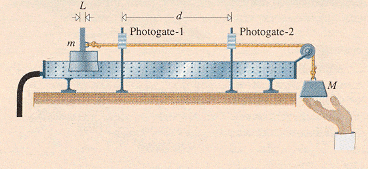
4-Q1.gif


I've been set this question by one of my Physics teachers and it's got me a little confused...I conducted some research, and I think that the tensile is the force used to accelerate both masses, not just the hanging one. So do I need to find the acceleration it produces? Then I can find the force on the 0.50kg mass, and could consequently find the distance traveled from the given work done...but I don't know if this is right, and if it is, how I go about doing it! Many thanks.
 
Physics news on Phys.org
The tensile strength is the tension in the string. That's the only net force acting on the glider, so it's the force doing the work on the glider. To solve for the tension, apply Newton's 2nd law to each mass.
 
OK... so the total net force is 19N as there are no other forces acting on either of the masses. So I can apply this to the second weight:
F = ma
19 = m_2 x 9.81
m_2 = 19/19.81
m_2 = 1.93kg
Now for calculating the force for the glider do I keep a as 9.81?
 
If 19.0N is the total force, why can I not just use W = Fd to work out the distance travelled?

W = Fd
14 = 19 x d
d = 14 / 19
d = 0.83m

?
 
You've calculated the mass of the hanging weight. Good. Now apply Newton's 2nd law to each mass, giving you two equations. You'll solve those equations to find the acceleration and the tension.
 
lando45 said:
If 19.0N is the total force, why can I not just use W = Fd to work out the distance travelled?
You need the force on the glider, which is the tension in the string. You need to solve for that tension. (It's not equal to the weight of the hanging mass!)
 
Doc Al said:
You need the force on the glider, which is the tension in the string. You need to solve for that tension. (It's not equal to the weight of the hanging mass!)
How is it not the same as the weight of the hanging mass? I think that's what's confusing me...if the hanging mass weighs 1.93kg, then the force it exerts on the rope (i.e. the tension force) is surely just 1.93 x 9.81 which brings you back to the original 19.0N?
 
OK so here's what I did next...

19.0N = 0.5kg x a
a_g = 38ms^-1

19.0N = 1.93kg x a
a_h = 9.81ms^-1

Does this seem OK? And where can I take it from here? It seems anything I try just brings me back to 19.0...
 
lando45 said:
How is it not the same as the weight of the hanging mass? I think that's what's confusing me...if the hanging mass weighs 1.93kg, then the force it exerts on the rope (i.e. the tension force) is surely just 1.93 x 9.81 which brings you back to the original 19.0N?
Not true. If the string tension equaled the weight of the hanging mass, then the mass would be in equilibrium and it wouldn't fall.

Instead, analyze the forces on both masses: On the hanging mass, tension pulls up, gravity pulls down. The net force leads to some downward acceleration. (Note that the acceleration is not 9.8 m/s^2 -- that's the acceleration of an object in free fall, where gravity is the only force acting.)
 

Similar threads

  • · Replies 14 ·
Replies
14
Views
5K
  • · Replies 3 ·
Replies
3
Views
1K
  • · Replies 3 ·
Replies
3
Views
2K
  • · Replies 8 ·
Replies
8
Views
16K
Replies
16
Views
8K
Replies
1
Views
11K
  • · Replies 2 ·
Replies
2
Views
3K
Replies
2
Views
5K
  • · Replies 3 ·
Replies
3
Views
8K
  • · Replies 4 ·
Replies
4
Views
14K