How fast do fundamental forces propagate?

Click For Summary
SUMMARY

The propagation speeds of fundamental forces vary based on their carrier particles. The electromagnetic force, carried by massless photons, propagates at the speed of light. In contrast, the weak and strong forces are mediated by massive bosons and gluons, which cannot travel at light speed. The discussion emphasizes that interactions can occur without physical particles moving between points, relying instead on field changes. Virtual particles, often misunderstood as real entities, serve primarily as mathematical tools for approximating interactions rather than representing physical reality.

PREREQUISITES
  • Understanding of electromagnetic force and photon behavior
  • Familiarity with weak and strong nuclear forces and their carrier particles
  • Knowledge of quantum field theory concepts
  • Basic grasp of virtual particles and their role in physics
NEXT STEPS
  • Research the role of virtual particles in quantum field theory
  • Study the implications of mass on particle propagation speeds
  • Explore the mathematical foundations of Hawking radiation
  • Investigate the Casimir effect and its relation to virtual particles
USEFUL FOR

Students of physics, quantum mechanics enthusiasts, and researchers interested in the nuances of fundamental forces and particle interactions.

GhostLoveScore
Messages
149
Reaction score
9
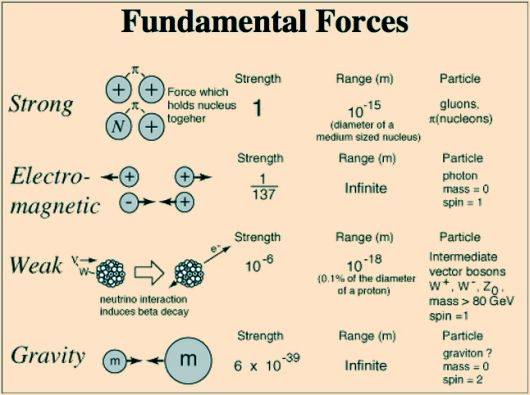
So, I've been looking at this chart
four-fundamental-forces-1.jpg


Only Electro-magnetic force is carried by massless particle - photon. And it propagates at the speed of light. Now take Weak and Strong force. They are carried by bosons and gluons. They have mass. So, what is the speed of propagation of Weak and Strong forces, if that question makes any sense. It seems that it can't propagate at the speed of light because you can't have mass traveling at the speed of light.
 
Physics news on Phys.org
Gluons are massless as well.

As far as it makes sense, the speed is still the speed of light, but especially for the weak interaction that concept is not really meaningful. You don't need a particle going from A to B to have an interaction - you need the fields at B change as a result of whatever happens at A. The fields are not particles.
 
  • Like
Likes   Reactions: GhostLoveScore
I have trouble understanding why we have force carrier particles. As you said, and I understood that, for electric force to act on something there has to be electric field. But I don't understand why do we have particles that carry weak and strong forces. Can't we also have some kind of field for each of those two forces, like we have electric and magnetic field for electric and magnetic forces?
 
Sometimes the exchange of particles is a good model. Sometimes it is not. Depends on the process.
 
Alright, what about electric force. If we have positive charge located at distance "d". There is an electric field going from positive charge. For an electron in that field there is a force F=E*q.
Now if we look at force carriers of the electric force - photons. How does electric force acts? Does positive charge produces photons and electron absorbs them? Can we see those photons?
 
GhostLoveScore said:
Does positive charge produces photons and electron absorbs them?
It is possible to model the interaction via the exchange of virtual photons, but they are just mathematical tools to approximate the field, because working with the field can be too challenging sometimes.
GhostLoveScore said:
Can we see those photons?
No, there are no real photons involved.
 
  • Like
Likes   Reactions: GhostLoveScore
mfb said:
It is possible to model the interaction via the exchange of virtual photons, but they are just mathematical tools to approximate the field, because working with the field can be too challenging sometimes.No, there are no real photons involved.
Disclaimer: I almost don't know anything about this.
I am very confused, because I always thought there was some physical reality to virtual particles.
That they are only a "mathematical tool" is completely new to me.
I heard that there were some interactions that could only really be explained through them.
For example Hawking radiation or the casimir effect.(both of which haven't been measured to my knowledge, but that's besides the point)

Am i somehow confusing virtual force carriers or gluons with other virtual particles ?:confused:
 
Physics is not about reality, but how real is something you cannot detect in any way, something that is present in approximations only and does not appear at all in more precise calculations?
Tazerfish said:
I heard that there were some interactions that could only really be explained through them.
Nothing needs the concept of virtual particles.
The Casimir effect can be derived using virtual particles, but they are not necessary.
The calculations for the Hawking radiation do not have virtual particles at all. The description with particle/antiparticle pairs sounds nice, but it is wrong.

Edit: weirdoguy was faster with the links.
 
  • #10
Thanks for clearing up that confusion, although i got to say it is a little shocking to me. :nb)
 
  • #11
Tazerfish said:
I heard that there were some interactions that could only really be explained through them.
For example Hawking radiation ...
Hawking said early on that the "virtual particle pair" explanation of Hawking Radiation is an ANALOGY, not an actual description of what happens. It was the only way he could think of to explain in English something that really can only be explained in the math.
 

Similar threads

  • · Replies 23 ·
Replies
23
Views
4K
  • · Replies 6 ·
Replies
6
Views
3K
  • · Replies 4 ·
Replies
4
Views
3K
  • · Replies 8 ·
Replies
8
Views
3K
  • · Replies 4 ·
Replies
4
Views
4K
  • · Replies 6 ·
Replies
6
Views
2K
  • · Replies 1 ·
Replies
1
Views
1K
  • · Replies 4 ·
Replies
4
Views
2K
  • · Replies 10 ·
Replies
10
Views
4K
  • · Replies 12 ·
Replies
12
Views
3K