Salmone
- 101
- 13
In an experiment of Dynamic Light Scattering, how is an autocorrelation like the one in the image computed?
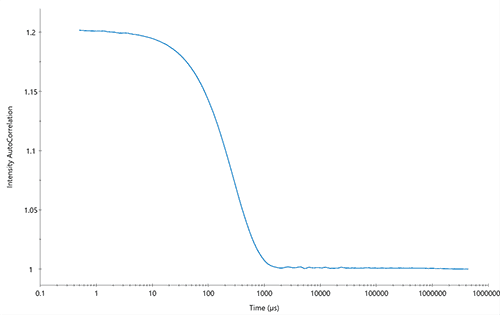
Mathematically a correlation function can be written as ##G(\tau)=\langle I(t)I(t+\tau) \rangle##, in an experiment like the one I mentioned the scattered intensity light is collected by a single detector, then the signal is sent to a digital correlator which computes the correlation function. How this process works? Once I have a signal from the detector, what does the correlator do? Does it multiply the intensity at time ##t## with the same intensity at time ##t+\tau## simply? How is the average implemented? By recording with the detector the same scattered intensity multiple times? Can you explain very generally how a digital correlator works?
Mathematically a correlation function can be written as ##G(\tau)=\langle I(t)I(t+\tau) \rangle##, in an experiment like the one I mentioned the scattered intensity light is collected by a single detector, then the signal is sent to a digital correlator which computes the correlation function. How this process works? Once I have a signal from the detector, what does the correlator do? Does it multiply the intensity at time ##t## with the same intensity at time ##t+\tau## simply? How is the average implemented? By recording with the detector the same scattered intensity multiple times? Can you explain very generally how a digital correlator works?