How Is Angular Momentum Calculated in Rotational Kinematics?

Click For Summary
Angular momentum in rotational kinematics is calculated using the equation L = (r)(p) + (1/12)mL^2(ω), where r is the position vector, p is momentum, m is mass, L is length, and ω is angular velocity. The first term represents the angular momentum of a particle or center of mass, while the second accounts for the object's moment of inertia. There was confusion regarding the vector nature of the terms, as the second term appeared scalar, but the direction of rotation clarified the result. A participant noted a discrepancy in their calculations, initially yielding a different answer, but resolved it by applying the right-hand rule. Understanding these concepts is crucial for mastering angular momentum calculations in physics.
Rheegeaux
Messages
6
Reaction score
0
[Note: Post moved to homework forum by mentor]

So I stumbled upon a reviewer for my physics exam tomorrow and I was wondering how the equation was formulated. Your help is very much appreciated :) ! Normally I would consult my professor for this but it's Sunday in my country today so I can't.

Question:
A uniform stick with length 3.00 [m] and mass
5.00 [kg] is moving and rotating about its center of mass (CM) as
shown in the figure. If the stick and point O both lie in the same
xy-plane, what is the total angular momentum of the stick at point
O at the instant shown?

answer:
L = (r )(p) +1/12mL^2(w) = -76.7kmm^2/s positive k hat

Picture: http://postimg.org/image/u5eeo77el/96cf1d1b/
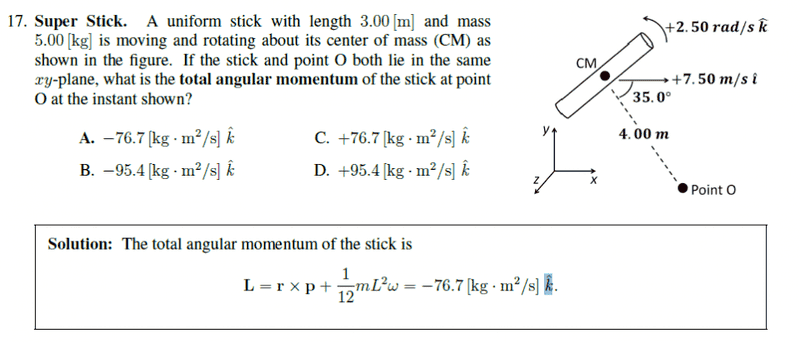
p6.png
 
Last edited by a moderator:
Physics news on Phys.org
The first term ## r \times p## comes from the definition of angular momentum of any particle (or center of mass), while the second term comes from the fact that this object has a finite extent (i.e. moment of inertia). However, technically, the formula is incorrect since the first term is a vector while the second term seems to be a scalar (this doesn't disrupt the answer since you're given the direction of the rotation, just note that the formula isn't technically correct)
 
Brian T said:
the second term seems to be a scalar
ω should be a vector. Are you saying it seems to be a scalar because it is not in bold? The value is shown in the diagram as a vector (##\hat k##).
 
Brian T said:
The first term ## r \times p## comes from the definition of angular momentum of any particle (or center of mass), while the second term comes from the fact that this object has a finite extent (i.e. moment of inertia). However, technically, the formula is incorrect since the first term is a vector while the second term seems to be a scalar (this doesn't disrupt the answer since you're given the direction of the rotation, just note that the formula isn't technically correct)
how did it yield a negative answer? What I got was letter D. my solution is: (5kg)(7.50m/s)(4m)sin(35) + 1/12(5kg)(3m)^2(2.50 rad) = 95.411
Thanks for the reply, I really need to learn this before tomorrow. Cheers :)
 
Rheegeaux said:
how did it yield a negative answer? What I got was letter D. my solution is: (5kg)(7.50m/s)(4m)sin(35) + 1/12(5kg)(3m)^2(2.50 rad) = 95.411
Thanks for the reply, I really need to learn this before tomorrow. Cheers :)
I got it already *ZOINKS* I just needed to use the right hand rule
 
The book claims the answer is that all the magnitudes are the same because "the gravitational force on the penguin is the same". I'm having trouble understanding this. I thought the buoyant force was equal to the weight of the fluid displaced. Weight depends on mass which depends on density. Therefore, due to the differing densities the buoyant force will be different in each case? Is this incorrect?

Similar threads

Replies
9
Views
2K
  • · Replies 22 ·
Replies
22
Views
3K
Replies
30
Views
3K
  • · Replies 9 ·
Replies
9
Views
3K
  • · Replies 25 ·
Replies
25
Views
11K
  • · Replies 2 ·
Replies
2
Views
3K
  • · Replies 4 ·
Replies
4
Views
2K
  • · Replies 38 ·
2
Replies
38
Views
4K
Replies
1
Views
8K
  • · Replies 3 ·
Replies
3
Views
1K