How is the binomial theorem used here?

3 replies · 2K views · last reply
shanepitts
Messages
84
Reaction score
1
The below image shows a portion of my current Analytical Mechanics textbook.

My inquiry is how is the binomial theorem used to get from eq. 3.4.5a ⇒ 3.4.5b ?

Thanks in advance
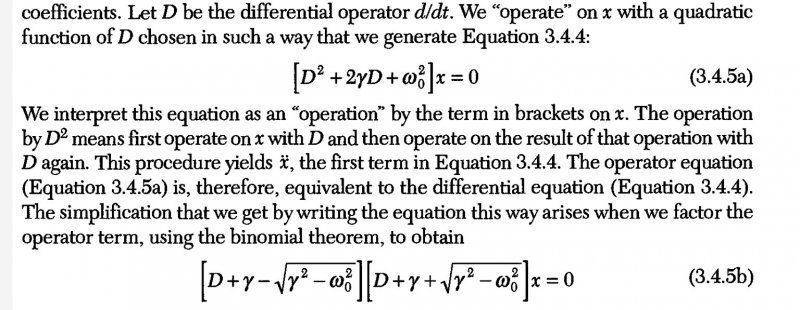
Printed textbook page showing the operator equation [D^2 + 2γD + ω0^2]x = 0 (3.4.5a), followed by its factored form [D + γ − √(γ^2 − ω0^2)][D + γ + √(γ^2 − ω0^2)]x = 0 (3.4.5b).
 
shanepitts said:
The below image shows a portion of my current Analytical Mechanics textbook.

My inquiry is how is the binomial theorem used to get from eq. 3.4.5a ⇒ 3.4.5b ?

Thanks in advance

In fact, that's simply the factorisation of a quadratic equation. You have to be careful as Operators don't always commute, but in this case, as ##\gamma## and ##\omega_0## are constants, you get the same factorisation as if ##D## were a number.

(I'm not sure I would call that the Binomial theorem. The Binomial Theorem does not apply for Operators, as they do not generally commute. I would call it the distributive law: which does apply for Operators as well as numbers.)

As an exercise, you might like to compare:

##(x + y)(x - y)## (for numbers)

and

##(X + Y)(X - Y)## (for operators).
 
Last edited:
  • Like
Likes   Reactions: shanepitts
PeroK said:
In fact, that's simply the factorisation of a quadratic equation. You have to be careful as Operators don't always commute, but in this case, as ##\gamma## and ##\omega_0## are constants, you get the same factorisation as if ##D## were a number.

(I'm not sure I would call that the Binomial theorem. The Binomial Theorem does not apply for Operators, as they do not generally commute. I would call it the distributive law: which does apply for Operators as well as numbers.)

As an exercise, you might like to compare:

##(x + y)(x - y)## (for numbers)

and

##(X + Y)(X - Y)## (for operators).
Thank you

This clarified things