How is the moment at A using the Force 1200N calculated?

  • Thread starter Thread starter Benjamin_harsh
  • Start date Start date
  • Tags Tags
    Force Moment
Click For Summary
SUMMARY

The moment at point A due to a force of 1200N is calculated using the formula: MA = - (1200 * Sin 30° * 140) + (1200 * Cos 30° * 1200), resulting in MA = 40.71 x 10³ Nm. The confusion arises from the use of moment arms and the sign convention for torque, where counterclockwise is positive and clockwise is negative. Proper identification of the moment arms for each force component is crucial for accurate calculations.

PREREQUISITES
  • Understanding of basic mechanics and torque concepts
  • Knowledge of trigonometric functions (Sine and Cosine)
  • Familiarity with moment arm calculations
  • Ability to interpret force diagrams
NEXT STEPS
  • Study the principles of torque and moment arm calculations in mechanical systems
  • Learn about sign conventions in physics, particularly for torque
  • Explore the use of free body diagrams in analyzing forces and moments
  • Review examples of calculating moments for various force applications
USEFUL FOR

Mechanical engineers, physics students, and anyone involved in structural analysis or mechanics will benefit from this discussion on calculating moments and understanding torque directionality.

Benjamin_harsh
Messages
211
Reaction score
5
Homework Statement
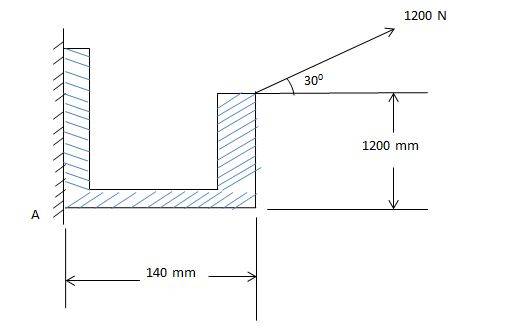
Find the moment of this Force about point A.
Relevant Equations
##M_{A} = - (1200.Sin 30^{0} X 140) + (1200.Cos 30^{0} X 140)##
A force of 1200N acts on a bracket as shown in the below figure. Find the moment of this Force about point A.
244733


Taking moments of components of 1200N force about point A.

∴ ##M_{A} = - (1200.Sin 30^{0} * 140) + (1200.Cos 30^{0} * 140)##

##M_{A} = 40.71 X 10^{3} Nm##

I am confused, because Force 1200 is far away from A and also not touching each other. How is moment at A using Force 1200 is calculated? I am also confused with negative signs.
 
Last edited:
Physics news on Phys.org
Your calculation is flawed: For some reason, you used the same moment arm (140 mm) for each component.
Benjamin_harsh said:
I am confused, because Force 1200 is far away from A and also not touching each other.
So?
Benjamin_harsh said:
How is moment at A using Force 1200 is calculated?
You can break the force into components and find the moment of each, but be sure to use the proper moment arm (which is the perpendicular distance to point A).
Benjamin_harsh said:
I am also confused with negative signs.
Generally, counterclockwise torques are positive; clockwise, negative.
 
Doc Al said:
proper moment arm (which is the perpendicular distance to point A)
show me the proper moment arm in this diagram.
 
Here's a hint: The moment arm for the vertical component will be the horizontal distance; the opposite for the horizontal component.
 
##M_{A} = - (1200.Sin 30^{0} * 140) + (1200.Cos 30^{0} * 1200)##

I got it, what about negative sign? How should I know which sign should be used?
 
Benjamin_harsh said:
what about negative sign? How should I know which sign should be used?

Doc Al said:
Generally, counterclockwise torques are positive; clockwise, negative.
 
Bracket is fixed here, Force 1200N is so far from point A. I can't able to guess the torque directions here. Please help me.
 
Benjamin_harsh said:
Bracket is fixed here, Force 1200N is so far from point A. I can't able to guess the torque directions here. Please help me.
The torque directions for each component should be easy to determine.
 
244771

See I constructed X and Y components of force 1200N. Now tell me the torque directions.
 
  • #10
Benjamin_harsh said:
See I constructed X and Y components of force 1200N. Now tell me the torque directions.
You tell me! The vertical component (if it were all that was acting) tends to make things turn in which direction?
 
  • #11
vertical component (if it were all that was acting) tends to make things turn depends on axis of rotation.
 
  • #12
Benjamin_harsh said:
vertical component (if it were all that was acting) tends to make things turn depends on axis of rotation.
You are finding moments about point A. That's where your axis is.
 
  • #13
Doc Al said:
You are finding moments about point A. That's where your axis is.
244772


So torque direction ##1200.sin{30^0}## is counter clockwise direction, It has +ve sign, but in solution it has negative sign, this is the exact point which I am struggling.
 
  • #14
Benjamin_harsh said:
So torque direction ##1200.sin{30^0}## is counter clockwise direction, It has +ve sign, but in solution it has negative sign, this is the exact point which I am struggling.
The standard sign convention is counterclockwise is positive. But perhaps your book uses a different convention. (What book are you using?)
 
  • #15
Doc Al said:
The standard sign convention is counterclockwise is positive. But perhaps your book uses a different convention. (What book are you using?)

Are you hinting my torque direction ##1200.sin{30^0}## is correct ?
 
  • #16
Benjamin_harsh said:
Are you hinting my torque direction ##1200.sin{30^0}## is correct ?
That's the correct vertical component and you've drawn the correct torque direction (counterclockwise). The corresponding torque should be +.
 
  • #17
Doc Al said:
That's the correct vertical component and you've drawn the correct torque direction (counterclockwise). The corresponding torque should be +.
Then overall moment at A will be negative, but my doubt is can a overall moment can be negative?
 
  • #18
Benjamin_harsh said:
Then overall moment at A will be negative, but my doubt is can a overall moment can be negative?
Why not? (The sign just tells you what direction the torque acts.)
 
  • #19
Doc Al said:
The sign just tells you what direction the torque acts.
So I got Moment at A is ##40.71 X 10^{3} Nm## in negative direction, so how does the final position of bracket looks like? Please sketch it.
 
  • #20
Benjamin_harsh said:
So I got Moment at A is ##40.71 X 10^{3} Nm## in negative direction, so how does the final position of bracket looks like? Please sketch it.
Show how you got that answer. (Not sure what you mean by "sketch it".)
 
  • #21
how does the final position of bracket looks like?
You are asked to find moment of this Force about point A. Don't assume the bracket is going to rotate to a new position. This would be an analysis of the twisting torque on the bracket (perhaps to see how strong the bracket needs to be considering what will be applied to it in use).

Doc Al said in post #4
Here's a hint: The moment arm for the vertical component will be the horizontal distance; the opposite for the horizontal component.
I notice something suspicious about the figure in your first post. Did you make it or was it part of the problem you were given? The reason is it seems to be seriously not to scale. The vertical position of the point that the force is applied at is shown to be 1200 mm. Could it be that should have been 120 mm? Whichever it is, that dimension should be in your Relevant Equation.
 
  • #22
sojsail said:
I notice something suspicious about the figure in your first post. Did you make it or was it part of the problem you were given? The reason is it seems to be seriously not to scale.
Agreed.
 
  • #23
Benjamin.. There is a procedure you should use for solving this type of problem.

1) You should start by making a declaration.. "I declare clockwise to be positive" or I declare anticlockwise to be positive. The decision is yours, unless it is stated (or implied) in the problem.

2) Then identify all the torques and their direction and give them the appropriate sign when you write your equation.

3) When you solve the equation the answer will be positive or negative (or zero). Now look back at your declaration to determine what that means (clockwise or anti clockwise).

If you make a different choice of declaration to that in the book _all_ the signs in the working will be opposite. However the direction of the answer (clockwise or anti clockwise) will still be the same. It "all comes out in the wash".

The procedure works no matter what you are trying to solve for. Eg it works if you are trying to find the net torque or if you are given the net and are trying to find an unknown torque.

Ideally your textbook should be consistent throughout and somewhere there should be a statement that says... "Unless stated otherwise, this book declares that (counter) clockwise torques are positive". Unfortunately it is possible your book is not consistent.
 

Similar threads

  • · Replies 7 ·
Replies
7
Views
1K
  • · Replies 6 ·
Replies
6
Views
1K
  • · Replies 24 ·
Replies
24
Views
2K
  • · Replies 6 ·
Replies
6
Views
2K
Replies
3
Views
1K
  • · Replies 4 ·
Replies
4
Views
1K
  • · Replies 10 ·
Replies
10
Views
3K
  • · Replies 16 ·
Replies
16
Views
3K
  • · Replies 40 ·
2
Replies
40
Views
6K
  • · Replies 4 ·
Replies
4
Views
2K