How Is the Right Triangle Used in Truss Force Calculations?

  • Thread starter Thread starter mohamadali
  • Start date Start date
  • Tags Tags
    Statics Trusses
Click For Summary
SUMMARY

The discussion centers on the application of right triangles in truss force calculations, specifically in the context of Statics problems. A participant seeks clarification on how to utilize the properties of a right triangle to solve a truss problem involving forces. The solution involves recognizing the 3-4-5 triangle ratio, which is essential for applying basic trigonometric principles such as sine, cosine, and tangent to compute forces accurately. Understanding these relationships is crucial for success in Statics and related engineering fields.

PREREQUISITES
  • Basic trigonometry, including sine, cosine, and tangent ratios
  • Understanding of right triangle properties, specifically the 3-4-5 triangle
  • Knowledge of truss structures and their force distribution
  • Familiarity with Statics principles and problem-solving techniques
NEXT STEPS
  • Review basic trigonometric functions and their applications in engineering
  • Study the properties of right triangles, focusing on the 3-4-5 triangle
  • Learn about force distribution in truss structures using examples
  • Practice solving Statics problems that involve trigonometric calculations
USEFUL FOR

Engineering students, particularly those studying Statics, civil engineers, and anyone involved in structural analysis and design will benefit from this discussion.

mohamadali
Messages
3
Reaction score
0
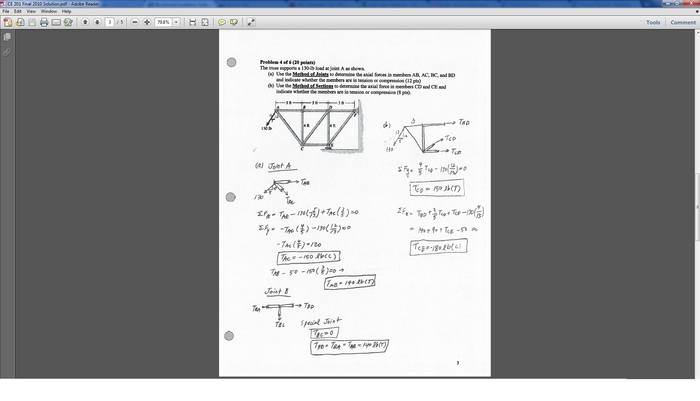
Hi, I have a, I believe simple, problem. I am studying for a Statics final and while doing problems with a Truss I came to a problem that I did not know how to solve. It is already solved for me, but I do not get how. The truss has a force coming out from the side but instead of an angle there is a right triangle. I do not understand how to use the triangle. I will upload a picture of the problem and the answer. If anyone can help me understand how the triangle is being used to compute the problem I would greatly appreciate it! Thanks in advance!

For example I do not understand where or why they get (4/5)Tcd or 130(12/13)

Direct Link:: http://i.imgur.com/ee9zP.jpg
ee9zP.jpg
 
Physics news on Phys.org
oh nvm i think i got it, 3, 4 , 5 triangle!
 
Shouldn't you be familiar with basic trigonometry in order to deal with statics? What are the relations in a right triangle?
 
I think you need to do some revision before your final. Look up the ratios of sine, cosine and tan.
 
The book claims the answer is that all the magnitudes are the same because "the gravitational force on the penguin is the same". I'm having trouble understanding this. I thought the buoyant force was equal to the weight of the fluid displaced. Weight depends on mass which depends on density. Therefore, due to the differing densities the buoyant force will be different in each case? Is this incorrect?

Similar threads

  • · Replies 2 ·
Replies
2
Views
750
  • · Replies 1 ·
Replies
1
Views
2K
Replies
3
Views
7K
Replies
3
Views
1K
Replies
19
Views
1K
Replies
2
Views
1K
  • · Replies 18 ·
Replies
18
Views
6K
  • · Replies 3 ·
Replies
3
Views
858
Replies
5
Views
6K
  • · Replies 2 ·
Replies
2
Views
2K