Undergrad How is this a representation of a 3 dimensional torus?

Click For Summary
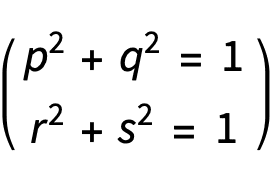
The discussion clarifies the representation of a two-dimensional torus in a four-dimensional space, specifically through the intersection of two orthogonal Euclidean planes. It explains that a torus can be visualized as a circle rotated around another circle, with each equation defining a location on these circles. The equations represent two cylinders in the product space R^4 = R^2 x R^2, where their intersection forms the torus. The intersection is defined mathematically as (S^1 x R^2) intersect (R^2 x S^1) = S^1 x S^1. This understanding enhances the visualization of the torus as a product of two sets, each representing a circle.
docnet
Messages
796
Reaction score
489
TL;DR
How is this expression of a torus?
In a differential geometry text, a torus is defined by the pair of equations:
Screen Shot 2020-10-05 at 11.08.47 AM.png


I initially thought this was somehow a torus embedded in 4 dimensions, but I do not see how we can visualize two orthogonal 2-dimensional Euclidian spaces. How is this a representation of a 2 dimensional torus embedded in 3 dimensions, with 4 presumably orthogonal coordinates?
 
Last edited:
Physics news on Phys.org
This is a two dimensional torus.
 
The idea is you can imagine a torus as a circle rotated around in a circle. The first equation defines your location on the first circle, and the second the second circle.
 
  • Like
Likes docnet
in 4 space with coords p,q,r,s, the subspaces p=q=0 and r=s=0 are two orthogonal euclidean 2 dimensional spaces. this torus meets each of them in a circle.

Alternatively, R^4 = R^2 x R^2 is the product of two orthogonal euclidean planes. your two equations define two (3 dimensional) "cylinders", one in each of these products, i.e. S^1 x R^2 and R^2 x S^1. Setting both equations equal to zero defines the intersection of these two cylinders, namely (S^1xR^2)intersect(R^2xS^1) = S^1xS^1.
 
  • Like
Likes docnet
thank you for your replies. It makes more sense now. It is a product of the sets {p^2+q^2=1} and {r^2+s^2=1}.
 
  • Like
Likes mathwonk

Similar threads

  • · Replies 8 ·
Replies
8
Views
3K
  • · Replies 15 ·
Replies
15
Views
2K
  • · Replies 22 ·
Replies
22
Views
2K
  • · Replies 13 ·
Replies
13
Views
2K
  • · Replies 27 ·
Replies
27
Views
3K
  • · Replies 19 ·
Replies
19
Views
3K
  • · Replies 1 ·
Replies
1
Views
2K
  • · Replies 5 ·
Replies
5
Views
3K
  • · Replies 5 ·
Replies
5
Views
3K
  • · Replies 22 ·
Replies
22
Views
3K