How is Torque Calculated in Equilibrium Problems?

  • Context:
  • Thread starter Thread starter Dethrone
  • Start date Start date
  • Tags Tags
    Pin Torque
Join the discussion
Ask a follow-up here, or get your own question answered by working scientists, mathematicians and engineers — people, not an autocomplete.
Real named experts · corrections over time · the nuance an AI answer skips
3 replies · 2K views
Dethrone
Messages
716
Reaction score
0
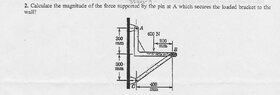
View attachment 3352
I've seen someone's solution in which they did the following:
$$600(200)-R_{AH} (600) = 0$$

How did they arrive at that conclusion by taking the moment about $A$?
 

Attachments

  • civquestion.JPG
    civquestion.JPG
    29.5 KB · Views: 120
Mathematics news on Phys.org
Rido12 said:
https://www.physicsforums.com/attachments/3352
I've seen someone's solution in which they did the following:
$$600(200)-R_{AH} (600) = 0$$

How did they arrive at that conclusion by taking the moment about $A$?

Hey Rido! (Wave)

The third equilibrium condition is that the sum of the torques must be zero.

The torque of the vertical 600 N force with respect to A is
$$+600\text{ N} \cdot \frac{400\text{ mm}}{2} = +600\text{ N} \cdot 200\text{ mm}\tag 1$$
Apparently clockwise has been chosen to be positive, so this torque is positive.

In A and C there will be vertical force components and horizontal force components.
The vertical force components have a lever-arm of zero with respect to A, so the corresponding torques are zero.
The horizontal force component at A also has a lever-arm of zero.
So that leaves only the horizontal force component at C.

Let's use the symbol $H_C$ for the horizontal force component at C, which is pointing to the right.
Then the corresponding torque is:
$$-H_C \cdot (300 \text{ mm} + 300 \text{ mm}) = -H_C \cdot 600\text{ mm} \tag 2$$
This is negative, since it would make the structure turn counter clockwise.

So the total sum of torques is (1) and (2) together:
$${}_+^\curvearrowright\sum T_A = +600\text{ N} \cdot 200\text{ mm} - H_C \cdot 600\text{ mm}$$

Btw, I don't know why the symbol $R_{AH}$ was chosen for $H_C$.
 
Thanks ILS! (Wave)

http://skule.ca/courses/exams/custom/20099/CIV102_2009__1329360871.pdf

The reason why I posted it was because the above link confused me. (See #2). I guess they used the wrong letter? (Presumably my 80yo+ prof)
 
Rido12 said:
Thanks ILS! (Wave)

http://skule.ca/courses/exams/custom/20099/CIV102_2009__1329360871.pdf

The reason why I posted it was because the above link confused me. (See #2). I guess they used the wrong letter? (Presumably my 80yo+ prof)

From your notes I can see that $R_{AH}$ is the force at $A$ that is $H$orizontal.
I'm guessing that he picked the letter $R$ for $R$eactive force.

Either way, it means the torque was calculated with respect to $C$ and not with respect to $A$. :eek:
Moreover, the direction of $R_{AH}$ has been picked to point to the left.