mheslep
Gold Member
- 376
- 714
The battery ( and/or capacitor bank) would be purchased. I don't know of a commercial high power density 2000 HP e motor source.
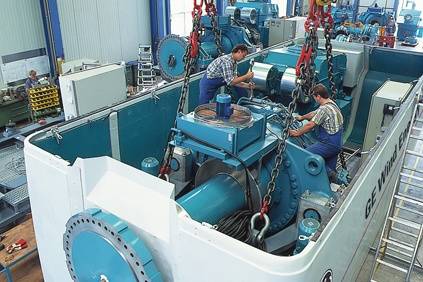
Sure, the power density is doable, but with non trivial engineering and manufacturing chops. Tesla's motors for instance are 2.5 HP/lb (4kW/kg), and even higher power density is reportedly available, though these are built in the hundreds of HP range. Challenges include mechanical loads on the windings, with 200 lb-ft race car typical torque, and heat rejection when packing a lot of power into a small space, especially for the rotor. Guys like the OP have been machining high performance IC engines from scratch for a century. E-motors at 2000 HP and 3 HP/lb? Not that I know of. Dividing the load among multiple motors at 300 mph would present other challenges, like multiple gear boxes, and stable vehicle control.Example GE 1.5 MW generator and gearbox, when high power density is not a design constraint:
Sure, the power density is doable, but with non trivial engineering and manufacturing chops. Tesla's motors for instance are 2.5 HP/lb (4kW/kg), and even higher power density is reportedly available, though these are built in the hundreds of HP range. Challenges include mechanical loads on the windings, with 200 lb-ft race car typical torque, and heat rejection when packing a lot of power into a small space, especially for the rotor. Guys like the OP have been machining high performance IC engines from scratch for a century. E-motors at 2000 HP and 3 HP/lb? Not that I know of. Dividing the load among multiple motors at 300 mph would present other challenges, like multiple gear boxes, and stable vehicle control.Example GE 1.5 MW generator and gearbox, when high power density is not a design constraint: