How Should Significant Figures Be Determined Without Numerical Data?

Click For Summary
SUMMARY

This discussion centers on determining significant figures for angles derived from geometric calculations without numerical data. The angle at point M, calculated using the law of cosines, approximates to 108.4 degrees. Participants emphasize that while exact answers are preferred in mathematics, approximations should reflect the precision of the least significant measurement used. A standard error of 5% to 10% is suggested for cases lacking clear uncertainty, particularly in experimental physics contexts.

PREREQUISITES
  • Understanding of the law of cosines
  • Familiarity with significant figures and their application
  • Basic knowledge of geometric principles involving angles
  • Experience with error analysis in experimental physics
NEXT STEPS
  • Study the law of cosines in depth for geometric applications
  • Learn about significant figures and their role in scientific reporting
  • Explore error analysis techniques in experimental physics
  • Investigate the implications of measurement precision and accuracy in lab work
USEFUL FOR

Students and professionals in mathematics and physics, particularly those involved in experimental design and data analysis, will benefit from this discussion on significant figures and their application in calculations without numerical data.

SweatingBear
Messages
119
Reaction score
0
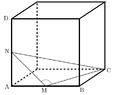
I received an excellent question about significant figures when there is no actual numerical data given. In the figure below, we have a cube circumscribing a triangle and the task is to find the angle at M. N and M are midpoints of the cube's side.

View attachment 1016

By using the Pythagorean theorem a few times and ultimately law of cosines, one can arrive at

$$\cos (\text{M}) = \frac { \frac 94 - \frac 12 - \frac 54 }{ -\sqrt{\frac 52} } \, ,$$

where one solution is $$M \approx 108.4349488^\circ$$. Here is the problem: How many significant figures ought one to have for the angle? We were not given any numerical data, so what ought one to do? Integral values seems to be a natural, conventional practice; however, in terms of significant figures, the questions becomes much more interesting.
 

Attachments
  • 2ZtKAul.png
    2ZtKAul.png
    3.7 KB · Views: 113
Last edited:
Physics news on Phys.org
Re: No data; sig figs?

Couple of questions/comments:

1. Is $M$ the midpoint of $AB$? And is $N$ the midpoint of $AD$?

2. If you can give the exact answer, that would be preferable. A decimal approximation can also be useful - I'd probably just go to the tenth decimal place for precision.
 
Re: No data; sig figs?

In this case it's up to you how many digits you use.
In mathematics you're supposed to give an exact answer.
It's extra to provide an approximation.

My answer would be $$\text{M} = \arccos \big(-\frac 1{ \sqrt{10}}\big) \approx 108.4^\circ$$.
I would include 1 digit after the decimal point only to indicate it is not exactly 108 degrees.If you're working with real measurements, as a rule of thumb, the approximation in the final answer should have the same total number of digits as the least significant measurement you used.
Note that any intermediate results should have at least 1 digit extra and preferably more.
 
Re: No data; sig figs?

Ackbach said:
Couple of questions/comments:

1. Is $M$ the midpoint of $AB$? And is $N$ the midpoint of $AD$?

2. If you can give the exact answer, that would be preferable. A decimal approximation can also be useful - I'd probably just go to the tenth decimal place for precision.

1. Yes correct. Sorry about that, I forgot to write that in my first post.

2. All right, thank you!

I like Serena said:
In this case it's up to you how many digits you use.
In mathematics you're supposed to give an exact answer.
It's extra to provide an approximation.

My answer would be $$\text{M} = \arccos \big(-\frac 1{ \sqrt{10}}\big) \approx 108.4^\circ$$.
I would include 1 digit after the decimal point only to indicate it is not exactly 108 degrees.If you're working with real measurements, as a rule of thumb, the approximation in the final answer should have the same total number of digits as the least significant measurement you used.
Note that any intermediate results should have at least 1 digit extra and preferably more.

Thanks, much appreciated.
 
Re: No data; sig figs?

sweatingbear said:
Here is the problem: How many significant figures ought one to have for the angle? We were not given any numerical data, so what ought one to do? Integral values seems to be a natural, conventional practice; however, in terms of significant figures, the questions becomes much more interesting.
As a Physicist who is known for his very, very bad lab data I usually assume a standard error of about 10%. (By comparison any competent lab student probably works at around a 5% standard error. And a professional somewhere lower than that...certainly less than 1% depending on the equipment.) Anyway if I have no idea about the uncertainty of the number I would normally guess at between 5% and 10%.

-Dan
 
Re: No data; sig figs?

topsquark said:
As a Physicist who is known for his very, very bad lab data I usually assume a standard error of about 10%. (By comparison any competent lab student probably works at around a 5% standard error. And a professional somewhere lower than that...certainly less than 1% depending on the equipment.) Anyway if I have no idea about the uncertainty of the number I would normally guess at between 5% and 10%.

-Dan

Heh.
Suppose you had to measure an angle of about 108.4 degrees in a drawing.
How accurately would you measure it, say, for lab work?
 
Last edited:
Re: No data; sig figs?

I like Serena said:
Heh.
Suppose you had to measure an angle of about 108.4 degrees in a drawing.
How accurately would you measure it, say, for lab work?
(snorts) With calipers I can get about a decimal point for accuracy. For precision on the other hand... Kablooey!

Let's put it this way. I once did the Millikan Oil Drop experiment. It's basically Physics hazing for Junior and Senior Physics lab students. (Some details on the internet.) It's an experiment to measure the charge on an electron. My answer for the charge of the electron? [math]1.6 \times 10^{19}[/math] C. I want you to look carefully at this well checked result...this is what my data told me.

Look at my result again. Let me compare it to the actual value for the charge on the electron: [math]1.6 \times 10^{-19}[/math] C. Note the difference? There is a -19 on the actual charge and a +19 on my result.

Yes, my answer was 38 orders of magnitude off. Using my result the orbit of the electron about a Hydrogen nucleus is on the order of the size of the orbit of Jupiter.

I now try to be generous about the standard error I attribute to my data.

-Dan
 

Similar threads

  • · Replies 3 ·
Replies
3
Views
3K
  • · Replies 5 ·
Replies
5
Views
7K
  • · Replies 4 ·
Replies
4
Views
6K
Replies
7
Views
2K
  • · Replies 5 ·
Replies
5
Views
2K
  • · Replies 1 ·
Replies
1
Views
3K
  • · Replies 2 ·
Replies
2
Views
3K
  • · Replies 2 ·
Replies
2
Views
4K
  • · Replies 1 ·
Replies
1
Views
3K
  • · Replies 10 ·
Replies
10
Views
5K