How the power of the voltage supply can be calculated?

Click For Summary
SUMMARY

The discussion centers on calculating the power of a voltage supply in the context of a spectrometer's velocity selector region. Participants clarify that the power required to maintain an electric field in isolation is zero, as the energy to create the electric field is drawn from the voltage source. The relevant equation for energy in a capacitor is provided as E = 1/2 CV², where C is the capacitance. The conversation emphasizes the need for clarity regarding the definitions of power and the specifics of the charged particle involved in the problem.

PREREQUISITES
  • Understanding of electric fields and capacitors
  • Familiarity with the concept of power in electrical circuits
  • Knowledge of basic physics principles regarding charged particles in magnetic fields
  • Ability to interpret equations related to electrical energy and power
NEXT STEPS
  • Study the principles of electric fields and their role in capacitors
  • Learn about the relationship between voltage, current, and power in electrical circuits
  • Research the dynamics of charged particles in magnetic and electric fields
  • Explore the design and function of spectrometers, focusing on the velocity selector region
USEFUL FOR

Students and professionals in physics, electrical engineering, and anyone involved in designing or analyzing spectrometers and their components.

requied
Messages
98
Reaction score
3
Homework Statement
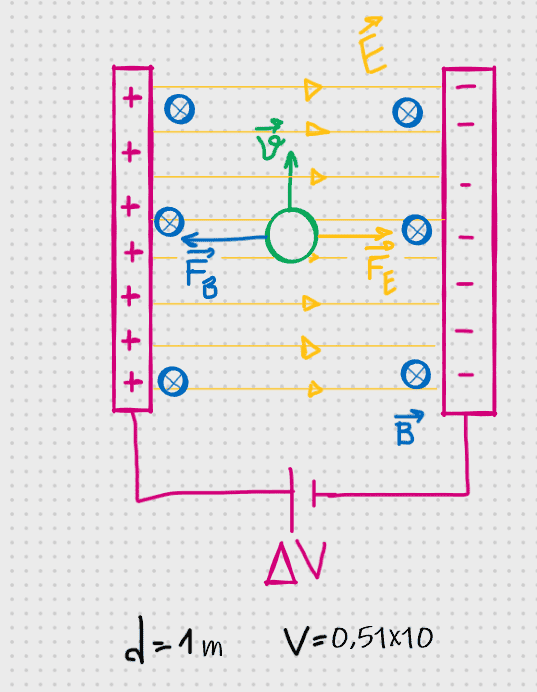
What should be the power of the voltage supply below that we use for producing electric field .
Relevant Equations
P=IV = IR^2 =V^2/R
I know only these relevant equations for power. But here there is a different situation, we have a parallel plates which we don't have to know I current. How should I think of about this? I wonder if it can be thought of a capasitor or something?

1591812435990.png

Assume that also we know E, B and velocity .
 
  • Like
Likes   Reactions: Delta2
Physics news on Phys.org
Did you give the complete statement of the problem? In your drawing you show a magnetic field and a particle moving through the E and B fields. But, the problem statement doesn't mention anything about these.

Are you supposed to find the power of the voltage supply or are you supposed to find the voltage of the power supply?
 
From what you have shown, it looks to be a simple capacitor, so no current is flowing. If I=0, then what is the power?
 
I am guessing that the OP is troubled by the following fact:
As the particle accelerates under the influence of electric field, if this accelerated movement corresponds to some sort of current, and where the energy comes from that increases the kinetic energy of the particle.

My answer to this is that though this movement is indeed a current, still this current is not drawn from the voltage source, and the energy that increases the kinetic energy of the particle does not come from the source but from the initial potential energy of the particle inside the field.

The energy to produce the E-field is drawn from the voltage source and it is $$E=\frac{1}{2}CV^2$$ where C the capacitance of the capacitor. This energy is drawn when capacitor is charged.
 
Last edited:
requied said:
Relevant Equations:: P=IV = IR^2 =V^2/R

I know only these relevant equations for power.

You might want to verify those for future use, one of them is incorrect.
 
TSny said:
Are you supposed to find the power of the voltage supply or are you supposed to find the voltage of the power supply?
I spesified it on the homework statement.
 
phyzguy said:
If I=0, then what is the power?
It's that easy really? I supposed that I would do some complex calculations :/
 
Delta2 said:
As the particle accelerates under the influence of electric field, if this accelerated movement corresponds to some sort of current, and where the energy comes from that increases the kinetic energy of the particle.
I didn't ask the question for anything about the kinetic energy of the particle. You misunderstood me . I just wondered that what is the voltage supply's power.
 
requied said:
It's that easy really? I supposed that I would do some complex calculations :/
requied said:
I didn't ask the question for anything about the kinetic energy of the particle. You misunderstood me . I just wondered that what is the voltage supply's power.
No power is required to maintain the electric field in isolation. The moving particle, which you did not mention in the problem description, must be relevant.
Would I be right in thinking there is a stream of such particles? Whatever, please post the entire question as given to you.
 
  • #10
This looks suspiciously like the sort of problem where one should calculate the potential difference between the deflection plates that will result in a linear trajectory for a given charged particle passing through a fixed magnetic field.

The OP needs to provide his definition of "power" for the voltage source, and the specifics of the particle.
 
  • #11
haruspex said:
please post the entire question as given to you.
This is a piece of a spectrometer question and this region above is the velocity selector region. The question says "What should be the power of the voltage supply that we will use in velocity selector region?".
I think it is not a problem to just take this area about the question. I assumed that we already know the values I found in other regions
1591957403298.png

gneill said:
that will result in a linear trajectory for a given charged particle passing through a fixed magnetic field.
That will occur on spectrometer
 
  • Like
Likes   Reactions: Delta2

Similar threads

  • · Replies 0 ·
Replies
0
Views
638
  • · Replies 9 ·
Replies
9
Views
2K
Replies
2
Views
921
Replies
1
Views
2K
Replies
9
Views
1K
  • · Replies 52 ·
2
Replies
52
Views
3K
  • · Replies 51 ·
2
Replies
51
Views
6K
Replies
4
Views
2K
  • · Replies 8 ·
Replies
8
Views
2K
  • · Replies 2 ·
Replies
2
Views
1K