How to add area moments of inertia for varying cross sections

Click For Summary

Discussion Overview

The discussion revolves around calculating the area moment of inertia for a shaft with varying cross sections, specifically in the context of a spindle design for a CNC machine aimed at minimizing deflection. Participants explore methods for combining moments of inertia for different diameters along the shaft overhang.

Discussion Character

  • Technical explanation
  • Debate/contested
  • Mathematical reasoning

Main Points Raised

  • One participant inquires about the correct method to calculate the area moment of inertia for a shaft overhang with varying diameters, suggesting the possibility of adding and averaging the moments of inertia for different sections.
  • Another participant emphasizes that the method of calculation depends on the intended use of the area moment of inertia, specifically for deflection calculations in a CNC machine application.
  • A suggestion is made to refer to a specific textbook for guidance on calculating deflection, noting that integration may be required, which some find complicated.
  • It is proposed that for a simplified approach, one could assume the entire shaft has the smaller diameter to estimate maximum deflection, although this may vary based on application needs.
  • A question is raised regarding the specific loads and their application points that would affect the deflection calculation.

Areas of Agreement / Disagreement

Participants express differing views on the best approach to calculate the area moment of inertia and its application in deflection calculations, indicating that multiple competing methods and considerations remain unresolved.

Contextual Notes

Participants note the complexity of integrating for deflection calculations and the potential for varying results based on assumptions about load and diameter.

friscoboya
Messages
6
Reaction score
1
Hello

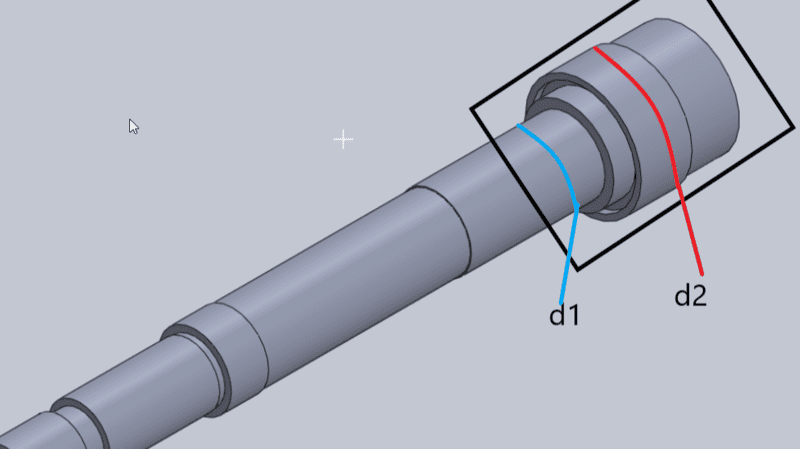
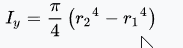
I am doing a shaft design layout for a spindle to minimize deflection and I have to calculate the area moment of inertia for a shaft overhang.The shaft overhang is the distance from a bearing to the end of the shaft. Here is a picture detailing the location of the overhang. The black square would be the shaft overhang. Would I calculate the area moment of inertia for d1 and d2, add them together and average them? Or what is the correct method to add area moment of inertias? The equation for hollow cylinder area moment of inertia is.
upload_2018-10-17_16-18-48.png

upload_2018-10-17_16-9-8.png

Thanks
 

Attachments

  • upload_2018-10-17_16-8-50.png
    upload_2018-10-17_16-8-50.png
    20.5 KB · Views: 694
  • upload_2018-10-17_16-9-8.png
    upload_2018-10-17_16-9-8.png
    23.5 KB · Views: 1,270
  • upload_2018-10-17_16-18-48.png
    upload_2018-10-17_16-18-48.png
    843 bytes · Views: 1,071
Engineering news on Phys.org
It depends what you are going to do with the area moment of inertia. How are you going to use it?
 
haruspex said:
It depends what you are going to do with the area moment of inertia. How are you going to use it?
So the shaft design would be for a CNC machine primarily used for milling. The area moment of inertia would be put into an equation I found from papers. Area moment of inertia is used for deflection calculation which is what I am focusing on. Yeah what's confusing me is the different diameters, it would be simple if the diameters were constant throughout the shaft overhang (black box).
 
If you have access to Mechanical Engineering Design by Shigley-Mischke-Budynas, it shows you how the deflection should be calculated. You have to perform some integration. I find it quite complicated.
.
However, if you want to calculate a "limiting," or maximum possible deflection, you can assume the entire shaft has diameter d1 - the smaller diameter. This is often a more practical approach, but of course it depends on your application.

Another website is-
https://www.machinedesign.com/archive/calculate-deflection-stepped-shafts-easy-way

Still not easy in my opinion.
 
  • Like
Likes   Reactions: berkeman
friscoboya said:
deflection calculation
Deflection under what load, applied where?
 

Similar threads

  • · Replies 20 ·
Replies
20
Views
12K
  • · Replies 7 ·
Replies
7
Views
3K
  • · Replies 5 ·
Replies
5
Views
5K
Replies
33
Views
5K
  • · Replies 1 ·
Replies
1
Views
6K
  • · Replies 4 ·
Replies
4
Views
3K
  • · Replies 6 ·
Replies
6
Views
4K
  • · Replies 4 ·
Replies
4
Views
33K
  • · Replies 14 ·
Replies
14
Views
5K
Replies
1
Views
4K