How to Calculate Error on Beat Frequency?

  • Thread starter Thread starter belgin fish
  • Start date Start date
  • Tags Tags
    Error Frequency
Click For Summary
SUMMARY

The discussion focuses on calculating the error on a beat frequency, specifically when the beat frequency is determined to be 1/20.0 seconds. The correct approach involves understanding that the beat frequency is the difference between two frequencies, such as 1000 Hz and 1100 Hz, resulting in a beat frequency of 100 Hz. The error in this calculation is derived from the accuracy of the individual frequencies, leading to a final result of 100 ± 20 Hz. The use of differential equations is deemed unnecessary for this straightforward case.

PREREQUISITES
  • Understanding of beat frequency and its calculation
  • Knowledge of basic frequency concepts in acoustics
  • Familiarity with error propagation in measurements
  • Basic mathematical skills for derivatives and differences
NEXT STEPS
  • Research error propagation techniques in frequency measurements
  • Learn about the relationship between frequency and beat frequency
  • Explore the application of differential equations in more complex frequency scenarios
  • Study examples of beat frequency calculations in acoustics
USEFUL FOR

Acoustic engineers, physicists, and students studying sound waves and frequency analysis will benefit from this discussion.

belgin fish
Messages
1
Reaction score
0
I'm being asked to calculate the error on a beat frequency. The beat frequency was found to be 1/20.0s


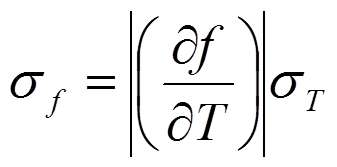
The equation given is
atlxz4.png


The thing is I am not really sure where to go from there or how to get the derivative of that, any help or pointing me in the right direction would be much appreciated.
 
Physics news on Phys.org
Welcome to PF, Belgin.

You can only use that formula if you have the formula for f as a function of T and the error in T. It actually doesn't look like the right formula to me.

The beat frequency is the difference between two frequencies. Say you have two tones at 1000 Hz and 1100 Hz mixing together in your ear. You will hear 1000, 1100, the "beat" or difference between them and perhaps the sum. You would do 1100 - 1000 = 100 to calculate the beat frequency. If the accuracy on the 1100 and the 1000 is ± 10 Hz, then the beat could be anywhere from
(1100 - 10) - (1000 + 10) = 80 Hz to (1100+10) - (1000 - 10) = 120 Hz
so you would say it is 100 ± 20 Hz. I don't think it makes sense to use the differential equation in such a simple case - save it for a situation where you have multiplying at least.
 

Similar threads

  • · Replies 3 ·
Replies
3
Views
3K
  • · Replies 13 ·
Replies
13
Views
3K
Replies
3
Views
2K
  • · Replies 19 ·
Replies
19
Views
2K
  • · Replies 43 ·
2
Replies
43
Views
7K
  • · Replies 6 ·
Replies
6
Views
5K
  • · Replies 3 ·
Replies
3
Views
4K
  • · Replies 7 ·
Replies
7
Views
8K
  • · Replies 1 ·
Replies
1
Views
2K
Replies
15
Views
2K