How to Calculate Gauss Curvature from a Mesh Surface?

Click For Summary
SUMMARY

This discussion focuses on calculating Gauss curvature from a mesh surface represented as a function S: R² -> R³. The user, Jens, seeks a numerical method to derive curvature using linearly interpolated face normals at mesh nodes. A suggested approach involves calculating curvature along six lines through each node, connecting to adjacent nodes, and multiplying the maximum and minimum values obtained. The conversation clarifies that Gauss curvature is defined at individual points rather than as a total integral.

PREREQUISITES
  • Understanding of mesh representation in 3D geometry
  • Knowledge of curvature concepts in differential geometry
  • Familiarity with numerical methods for surface analysis
  • Experience with vector calculations and interpolation techniques
NEXT STEPS
  • Research methods for calculating curvature on mesh surfaces
  • Learn about differential geometry and its applications in computer graphics
  • Explore numerical techniques for surface interpolation
  • Investigate algorithms for computing Gauss curvature specifically
USEFUL FOR

This discussion is beneficial for computer graphics developers, mathematicians specializing in geometry, and researchers working on surface analysis and mesh processing.

Omega0
Messages
215
Reaction score
52
Hi!

I would like to calculate the curvature for a surface S:R^2->R'3 numerically.
The problem: I simply have the surface as a mesh like you see in the image attached.

I calculated the linearly interpolated face normals in the nodes, too. You see the vectors.

Question: How would you calculate the Gauss curvature from this information?

Thanks!

Best wishes,
Jens
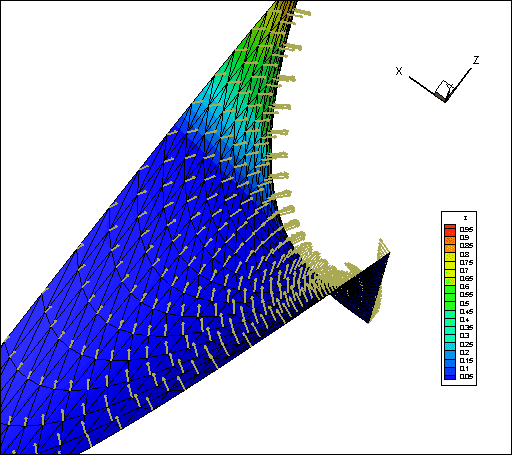
curve.png
 

Attachments

  • curve.png
    curve.png
    22.4 KB · Views: 533
Physics news on Phys.org
Since each node is at the centre of a hexagon, and surrounded by six other equally close nodes, I suggest you calculate the curvature along each of the six lines running through each point, using the line segments connecting the centre point to each of the two points either side of it along every given line. THen multiply the maximum out of the six by the minimum. It's fairly crude, but may be good enough, and I can't easily think of a better method.
 
do you mean the total (integral of the ) gauss curvature? or the curvature at some point. technically gauss curvature is taken separately at each point.
 

Similar threads

  • · Replies 2 ·
Replies
2
Views
3K
  • · Replies 6 ·
Replies
6
Views
3K
  • · Replies 1 ·
Replies
1
Views
2K
Replies
0
Views
1K
  • · Replies 1 ·
Replies
1
Views
2K
  • · Replies 8 ·
Replies
8
Views
6K
Replies
2
Views
2K
  • · Replies 2 ·
Replies
2
Views
2K
  • · Replies 30 ·
2
Replies
30
Views
3K
  • · Replies 14 ·
Replies
14
Views
4K