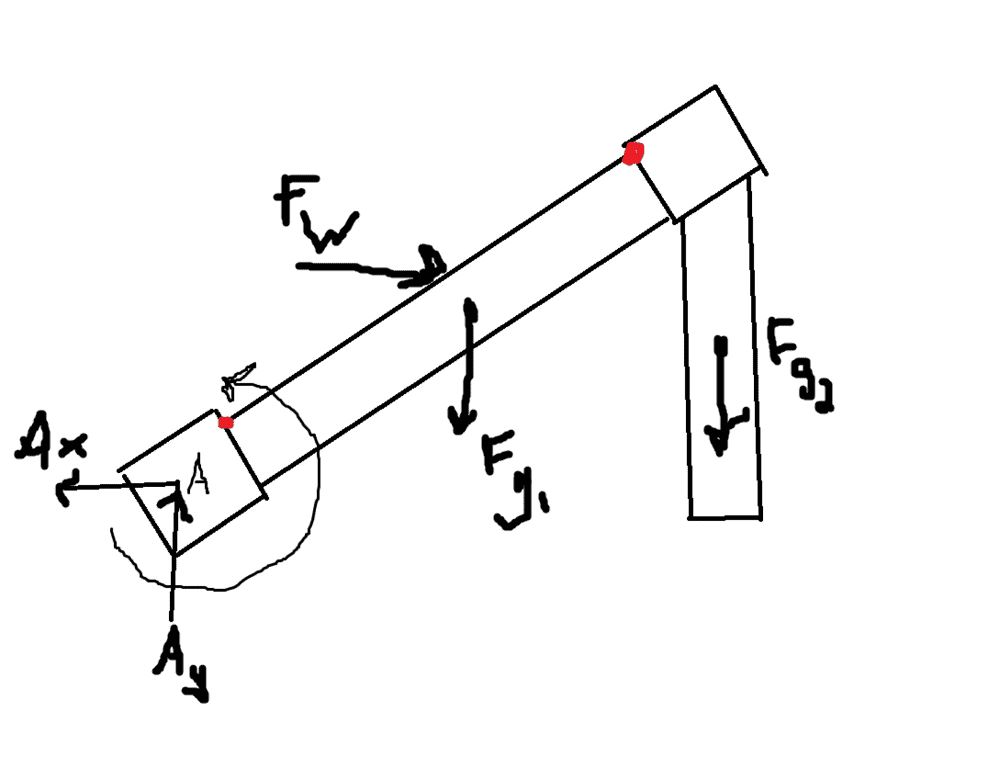
Discussion Overview
The discussion revolves around the analysis of potential failure points in a rigid body subjected to various forces, including moments and wind forces. Participants explore methods for evaluating failure, particularly in the context of bending and stress concentrations, and the applicability of Finite Element Analysis (FEA) in this scenario.
Discussion Character
- Technical explanation
- Debate/contested
- Exploratory
Main Points Raised
- One participant suggests that the assumption of rigidity may not hold when evaluating failure spots, indicating the need for FEA to assess von Mises stress and compare it with yield stress.
- Another participant agrees that while hand calculations can determine overall stress levels, they cannot account for stress concentrations around sharp corners, which require high-quality FEA for accurate predictions.
- A participant inquires whether the failure analysis would differ if the body were positioned differently, seeking clarification on the implications of the angle on calculations.
- One participant offers to perform an FEA analysis if provided with more details about the structure, including its size, material, and wind force values.
Areas of Agreement / Disagreement
Participants generally agree on the limitations of hand calculations in accounting for stress concentrations and the necessity of FEA for accurate failure analysis. However, there is no consensus on the implications of the body's angle on the failure analysis process.
Contextual Notes
The discussion highlights limitations related to assumptions of rigidity, the need for detailed structural information for FEA, and the challenges posed by stress concentrations that are not addressed by traditional hand calculations.