How to Calculate <Ly^2> Without Using Symmetry?

Click For Summary

Homework Help Overview

The discussion revolves around calculating the expectation value for a given wave function without relying on the symmetry that suggests = . The subject area pertains to quantum mechanics, specifically angular momentum operators and their properties.

Discussion Character

  • Exploratory, Assumption checking, Mathematical reasoning

Approaches and Questions Raised

  • The original poster attempts to find directly from the wave function and expresses difficulty in doing so without using symmetry arguments. Some participants suggest using ladder operators to compute the action on the state, while others question the validity of the symmetry assumption.

Discussion Status

Participants are exploring various methods to approach the problem, including the use of ladder operators and questioning the necessity of symmetry. There is no explicit consensus on the best approach, and the discussion remains open-ended with multiple perspectives being considered.

Contextual Notes

There are constraints regarding the original post's editability, which may affect the clarity of the problem presented. Additionally, the original poster expresses urgency due to an upcoming test, which may influence the depth of their inquiry.

physics1000
Messages
104
Reaction score
4
Misplaced Homework Thread
Hi, I have a question.
Let us say we have the wave function as with eigen value and base eigen value of:
##!\psi >\:=\:\frac{1}{6}\left(4!1,0,0>\:+\:3!2,1,1>\:-1!2,1,0\:+\:\sqrt{10}!2,1,-1>\right)##
I need to find <Ly^2>
the solution of the problem according to answers, is demanding that <Lx^2>=<Ly^2> ( Due to symmetry ) which I have no idea why.
If I dont want to use that symmetry ( let us say I did not know that at the test ), how do I calculate it?
I tried calculating it using formulas, it is impossible...
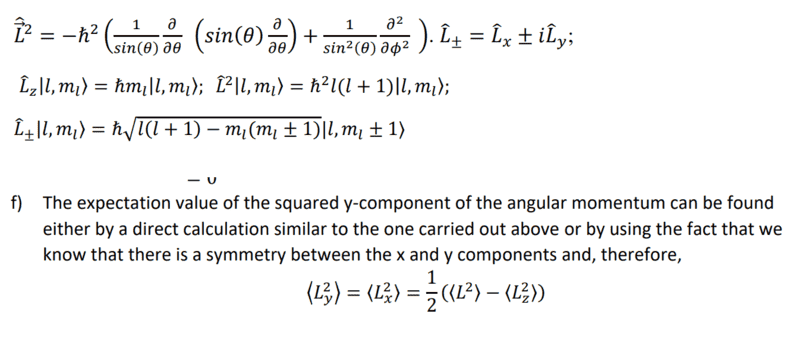
1678143314423.png


The beginning is from our formulas, f) is the solution.
How do I find it without saying <Ly^2>=<Lx^2>? ( finding <L^2> and <Lz^2> is easy )
Edit:
Of course it is easy also to find lx and ly using lower and upper operators, but doing square, is impossible...
 
Last edited:
Physics news on Phys.org
Can you write your formula in readable form, using LaTeX? Here's the LaTeX Guide (the link is directly under the input form):

https://www.physicsforums.com/help/latexhelp/

Of course, you can apply
$$\hat{L}_x=\frac{1}{2}(\hat{L}_+ + \hat{L}_-)$$
twice to the state ket to get what ##\hat{L}_x^2## does on the state. Analogously it works for ##\hat{L}_y^2##.
 
  • Like
Likes   Reactions: topsquark
vanhees71 said:
Can you write your formula in readable form, using LaTeX? Here's the LaTeX Guide (the link is directly under the input form):

https://www.physicsforums.com/help/latexhelp/

Of course, you can apply
$$\hat{L}_x=\frac{1}{2}(\hat{L}_+ + \hat{L}_-)$$
twice to the state ket to get what ##\hat{L}_x^2## does on the state. Analogously it works for ##\hat{L}_y^2##.
Hi, thanks for the answer, but sadly it doesn't answer :(
I will try to fix, it may take time.
about what you said.
I said I tried with operator above and below, it will not work.
you may try, but you see, there are calculations that with sqrt and such... ( I thought of it, as said in the edit ).
That is why I asked for another way to reach it if possible :\
If there is, I will just remember the symmetry ( although I have no idea why it is true )
 
Why cant I edit the original post?
I want to write it, but I cant edit it.

EDIT:
You can close thread.
If i need to put my answer from before question and write it here, it will take me a few hours and the test is really soon.
Thanks anyway for trying to help :)
 
Hi.

My best guess is that the formula should have looked like this:

## \vert\psi >\:=\:\frac{1}{6}\left(4|1,0,0>\:+\:3|2,1,1>\:-1|2,1,0>\:+\:\sqrt{10}|2,1,-1>\right) ##

That's a state vector written in ket notation = a superposition of eigenstates labelled with what look like principal quantum numbers.

@physics1000 you can right-click on any LaTeX formula in any post and choose to see how that was encoded as LaTeX. The above was done just using \vert to create a vertical line and/or taking the character | straight from my keyboard.

physics1000 said:
Why cant I edit the original post?
I think this forum has a policy that discourages that. Users can only edit a post for about an hour after they first posted it. If there's an important reason for editing after that you have to seek assistance from a moderator. There's some fair reasons for this, e.g. existing replies may be left looking odd or irrelevant. I am NOT staff, I don't know, that's my best knowledge and belief.

physics1000 said:
the solution of the problem according to answers, is demanding that <Lx^2>=<Ly^2> ( Due to symmetry ) which I have no idea why.
I haven't seen the full details of the original question but from what you have shown, the question really should be "why wouldn't that symmetry be there?"
You have some information that specifies an m quantum number so that would tie down the z-axis a little. However you are free to orientate the x and y axis as you wish and the information in the question would be unaffected. Maintaining a left-handed convention for the axis, you could choose to rotate around the z-axis so that the x axis becomes the y-axis and the new y-axis becomes negative (points the other way to) the old x-axis. Under that symmetry you must have
(x-axis angular momentum components) = - (components in the y-axis) .

Computing the expectation values of SQUARES of ##L_x## and ##L_y## you can ignore the sign change.

NOTE: I'm not an expert. Advice is offered only to the best of my ability. My motivation: People helped me with a question recently, seems fair to try and pass that help on.
Good luck with the test etc.
 
  • Like
Likes   Reactions: dextercioby and TSny
Well, but what's wrong with calculating how the "ladder operators" act on this state? It's not that difficult!
 
@vanhees71, I agree. From what the OP has shown of the model answers, it is clearly stated that you can solve the problem in many ways.
 

Similar threads

Replies
12
Views
12K
  • · Replies 1 ·
Replies
1
Views
2K
  • · Replies 1 ·
Replies
1
Views
2K
  • · Replies 10 ·
Replies
10
Views
3K
Replies
1
Views
6K
Replies
1
Views
3K
Replies
2
Views
3K
  • · Replies 3 ·
Replies
3
Views
3K
  • · Replies 12 ·
Replies
12
Views
28K
  • · Replies 4 ·
Replies
4
Views
2K