How to calculate self energy Feynman diagram like that

Click For Summary
SUMMARY

This discussion focuses on calculating the squared amplitude of a self-energy Feynman diagram involving a massless Dirac fermion (se), a massless right-handed neutrino (vrm), and a scalar particle (x) with mass m. The participants analyze the numerator of the process, denoted as N, which involves complex gamma matrix expressions and traces. Key points include the importance of using distinct indices for clarity in tensor notation and the necessity of integrating over loop momentum k while considering the self-energy contribution to particle mass. The discussion emphasizes the application of Feynman rules and the evaluation of the diagram to address divergences.

PREREQUISITES
  • Understanding of Feynman diagrams and self-energy calculations
  • Familiarity with gamma matrices and their properties
  • Knowledge of Dirac fermions and neutrinos in quantum field theory
  • Experience with loop integrals and dimensional regularization techniques
NEXT STEPS
  • Study the application of Feynman rules in quantum field theory
  • Learn about dimensional regularization and its role in handling divergences
  • Explore the properties and applications of gamma matrices in particle physics
  • Investigate the implications of self-energy corrections on particle masses
USEFUL FOR

Particle physicists, quantum field theorists, and graduate students studying advanced topics in theoretical physics, particularly those focusing on Feynman diagrams and self-energy calculations.

Safinaz
Messages
255
Reaction score
8
Hi all ,

I try to calculate the squared amplitude of the following self energy digram :
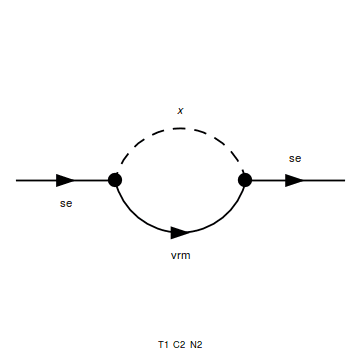
B-l.png
where se is massless Dirac fermion , and vrm is massless right handed neutrino. x is a scalar with mass m ..

I wrote the nominator of this process as:

N = ## \bar{u}(p) (1-\gamma_5) (p\!\!\!/ +k\!\!\!/ ) (1+\gamma_5) u(p) \to p\!\!\!/ (1-\gamma_5) (p\!\!\!/ +k\!\!\!/ ) (1+\gamma_5) \to p\!\!\!/ (1-\gamma_5) (p\!\!\!/ +k\!\!\!/ ) \to p_\alpha \gamma^\alpha (1-\gamma_5) (p_\alpha \gamma^\alpha + k_\beta \gamma^\beta ) \to p_\alpha p_\alpha \gamma^\alpha \gamma^\alpha +p_\alpha k_\beta\gamma^\alpha \gamma^\beta - p_\alpha \gamma^\alpha \gamma_5 p_\alpha \gamma^\alpha - p_\alpha \gamma^\alpha \gamma_5 k_\beta \gamma^\beta ##

I don't know how the first term as ## p_\alpha p_\alpha \gamma^\alpha \gamma^\alpha ## can be calculated or the third term .. also I don't know how ## P.K## which comes from the second term can be calculated from the process kinematics ? while ## P^2 =0 ## and ## K^2 = m_\chi^2##

Note that: the momentums of the particles in the Feynman diagram are se(p), vrm(p+k) and x(k)

Also the "x se vrm " vertices come from these Lagrangian terms:

## y (\bar{\nu_R^c} \chi s + \bar{s} \chi \nu_R^c ) ## (where s-> se, ##\chi ## -> x and \nu -> vrm)

Thanks ..
 
Physics news on Phys.org
For the terms you asked for: Wikipedia has a useful list of identities: https://en.wikipedia.org/wiki/Gamma_matrices#Feynman_slash_notation. I am not sure if I follow your steps though. Are there traces implied over your terms? Also, ##k^2 \neq m_\chi^2##, as ##k^\mu## is the loop momentum you are integrating over.

Edit: Also, for a self energy you would not necessarily write it between spinors, probably you could expand more on what you actually want to calculate...
 
Last edited:
Dr.AbeNikIanEdL said:
Are there traces implied over your terms

Yes, sure .. I forgot Tr [] :(

Dr.AbeNikIanEdL said:
Also, for a self energy you would not necessarily write it between spinors

Now it getting worse .. the nominator becomes:

## N = Tr [ (1-\gamma_5) (p\!\!\!/ +k\!\!\!/ ) (1+\gamma_5) \to (1-\gamma_5) (p\!\!\!/ +k\!\!\!/ ) ] \to 0 ##

since:

Trace of any product of an odd number of ## \gamma^\mu ## is zero and trace of ## \gamma^5 ## times a product of an odd number of ## \gamma^\mu ## is also zero ..
 
  • Like
Likes   Reactions: vanhees71
Why do you write same indices more than once?
 
Which indices ? I think the veritecs and momentums are all clear in the question
 
Safinaz said:
Now it getting worse ..

But you only have a trace if there are spinors. In this case all your terms just need traces (and I think you are missing a factor of two from ##(1-\gamma_5)(1-\gamma_5) = 2(1-\gamma_5)##).

Safinaz said:
Which indices ?

For example

Safinaz said:
→##p_\alpha p_\alpha\gamma^\alpha\gamma^\alpha##

would be more readable as ##p_\alpha p_\beta\gamma^\alpha\gamma^\beta##.
 
It's not only "more readable" but it's a meaningful expression. Each index can occur maximally twice, and in this case one must be an upper and one a lower index, and this implies by convention that you sum over this index from 0 to 3 (Einstein summation convention). If the same index occurs more than twice or two same upper or lower indices, than the expression is wrong.
 
Dr.AbeNikIanEdL said:
But you only have a trace if there are spinors. In this case all your terms just need traces

Dr.AbeNikIanEdL said:
Also, for a self energy you would not necessarily write it between spinors

So some thing is not clear now, do I write the spinors ? that is the right ?

Dr.AbeNikIanEdL said:
and I think you are missing a factor of two

Yap .. but forget about numbers now, actually it will be a factor of 1/2, because ##P_L = (1-\gamma^5)/2## and ##P_R = (1+\gamma^5)/2##

ChrisVer said:
Why do you write same indices more than once?

I will say why .. please look the following Feynman digram of the process

loop.png


I have in N ## p\!\!\!/ ## comes from the spinors and ## p\!\!\!/ ## appear in ## (p\!\!\!/+k\!\!\!/) ## from the fermion propagtor, so it's the same momentum or p .. I wonder if it will be meaningfull if i used different indecis for like ## p_\alpha \gamma^\alpha (1-\gamma_5) (p_\delta \gamma^\delta + k_\beta \gamma^\beta ) ## ?
 

Attachments

  • loop.png
    loop.png
    2.3 KB · Views: 674
Safinaz said:
So some thing is not clear now, do I write the spinors?

The self energy ##\Sigma(p)## is usually defined as just the 1PI blob, for which at lowest order your diagram would contribute. There are no spinors involved. You can of course write down the expression for ##\bar{u}(p)\Sigma(p)u(p)##, but I am not aware what this expression would mean. What observable do you want to calculate?
Safinaz said:
I have in N p/p/ p\!\!\!/ comes from the spinors and p/p/ p\!\!\!/ appear in (p/+k/)(p/+k/) (p\!\!\!/+k\!\!\!/) from the fermion propagtor, so it's the same momentum or p .

That is why you call it ##p## both times. But the contracted indices mean summation e.g. ##p_\alpha\gamma^\alpha = \sum_{\alpha=0}^3 p_\alpha\gamma^\alpha##. The sums in the two ##\slash{p}## expressions have their own indices.

Safinaz said:
I wonder if it will be meaningfull if i used different indecis for like pαγα(1−γ5)(pδγδ+kβγβ)pαγα(1−γ5)(pδγδ+kβγβ) p_\alpha \gamma^\alpha (1-\gamma_5) (p_\delta \gamma^\delta + k_\beta \gamma^\beta ) ?

That would be the expression.
 
  • #10
So now "P.K" or ##p_\mu k^\mu## what does it equal ? 'd we use CMF kinematics here ? but I wonder how ..
 
  • #11
Well , ##k^\mu## is the loop momentum you are integrating over, so you need to calculate something like ##p_\mu \int \frac{d^4k}{(2\pi)^4} \frac{k^\mu}{D}##, where ##D## means the denominator corresponding to your diagram.
 
  • #12
Dr.AbeNikIanEdL said:
but I am not aware what this expression would mean. What observable do you want to calculate?

I want to calculate the mass of a particle ## s ## on the loop level ..
 
  • #13
so you indeed just need the self energy
 
  • Like
Likes   Reactions: Safinaz
  • #14
What's you interaction? I can only guess from your a bit strange posting #1 that it might be the coupling
$$\mathcal{L}_{\text{int}}=g \overline{\psi} \mathrm{i} \gamma^5 \psi \phi,$$
where ##\psi## is a Dirac spinor and ##\phi## a (pseudo-)scalar field. The corresponding Feynman rule is that the three-point vertex is ##-g \gamma^5##. The propagator lines are
$$G(p)=\frac{\gamma_{\mu} p^{\mu}+m}{p^2-m^2+\mathrm{i} 0^+}, \quad D(p)=\frac{1}{p^2-M^2+\mathrm{i} 0^+},$$
for the fermion and boson respectively.

Now apply the Feynman rules. The self-energy is truncated, i.e., the external legs are not considered. They just tell you that you have a self-energy. Now you have to read the diagram against the direction of the spinor legs. Then taking into account the symmetry factor you get
$$\sigma(p)=-g^2 \int \mathrm{d}^4 l \frac{1}{(2 \pi)^4} \gamma^5 \mathrm{i} G(l+p) \gamma^5 \mathrm{i} D(l).$$
Now you can use standard formulae (e.g., regularizing with dimensional regularization) and evaluate the diagram, which is linearly divergent, i.e., you need a wave-function and a mass counter term to make the diagram finite, as expected.
 
  • Like
Likes   Reactions: Safinaz and Dr.AbeNikIanEdL

Similar threads

  • · Replies 6 ·
Replies
6
Views
4K
  • · Replies 15 ·
Replies
15
Views
3K
  • · Replies 13 ·
Replies
13
Views
5K
  • · Replies 2 ·
Replies
2
Views
2K
  • · Replies 1 ·
Replies
1
Views
2K
  • · Replies 2 ·
Replies
2
Views
2K
  • · Replies 6 ·
Replies
6
Views
2K
  • · Replies 3 ·
Replies
3
Views
2K
  • · Replies 1 ·
Replies
1
Views
2K
  • · Replies 5 ·
Replies
5
Views
3K