Discussion Overview
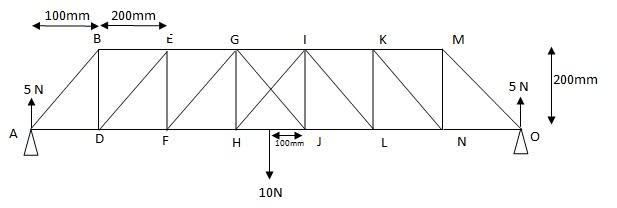
The discussion revolves around calculating tension and compression forces in a truss bridge, particularly when a load is applied at the midpoint between two joints. Participants explore methods for analyzing the forces in the truss members, including the challenges posed by the configuration of the load and the presence of "X" trusses in the middle section.
Discussion Character
- Technical explanation
- Mathematical reasoning
- Debate/contested
Main Points Raised
- One participant notes that forces like load and reaction force act on joints, questioning how to find forces on members when the load is centrally located.
- Another participant suggests splitting the central force into two equal forces at the ends of the spar.
- A participant expresses difficulty in calculating the forces in the middle section with "X" trusses and seeks assistance in determining the tension or compression in those members.
- One contributor mentions that it is possible to assume a member is in tension or compression, indicating that a negative value would suggest an incorrect assumption.
- Another participant advises against using the method of sections for the center load, recommending the method of joints instead and treating the load as a moment on the joint being analyzed.
Areas of Agreement / Disagreement
Participants do not reach a consensus on the best method to analyze the forces in the truss members, with differing opinions on whether to use the method of sections or the method of joints. The discussion remains unresolved regarding the specific calculations and approaches to take.
Contextual Notes
Some participants express confusion about the calculations, particularly in relation to the middle section of the truss and the application of loads. There is also mention of potential assumptions that may affect the analysis.