What do the numbers in the method of joints analysis for trusses represent?

Click For Summary

Discussion Overview

The discussion revolves around the analysis of a truss using the method of joints, specifically focusing on understanding the forces in the truss members and their implications for tension and compression. Participants are examining calculations related to specific joints and the interpretation of force values derived from free body diagrams.

Discussion Character

  • Technical explanation
  • Debate/contested
  • Mathematical reasoning

Main Points Raised

  • One participant seeks clarification on whether the calculated forces in members AB and AC indicate that AB is in compression and AC is in tension, based on their numerical values.
  • Another participant confirms that the values represent the forces in the members and explains the nature of tension and compression forces in relation to their direction at the joints.
  • A later reply addresses confusion regarding a negative value for a force at joint C, suggesting that the negative sign indicates an incorrect assumption about the direction of the force rather than its nature as tension or compression.
  • Participants discuss the implications of negative values in force calculations and how they relate to the assumed directions of forces in free body diagrams.

Areas of Agreement / Disagreement

Participants generally agree on the basic principles of tension and compression forces, but there is some confusion regarding the interpretation of negative values in force calculations, indicating that the discussion remains unresolved on this point.

Contextual Notes

There are unresolved issues regarding the assumptions made in free body diagrams and the implications of negative force values, which may depend on the specific context of the calculations and the chosen directions for forces.

tomtomtom1
Messages
160
Reaction score
8
TL;DR
Trusses - Method Of Joints
Hello all

I am trying to analyse a truss using the method of joint process i.e I am trying to determine whether each member is in tension or compression.

I have the following truss that I want to analyse using the method of sections.
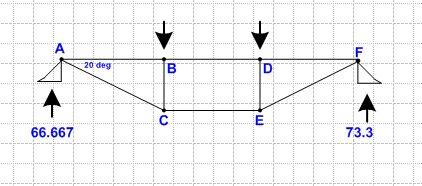
aone.JPG


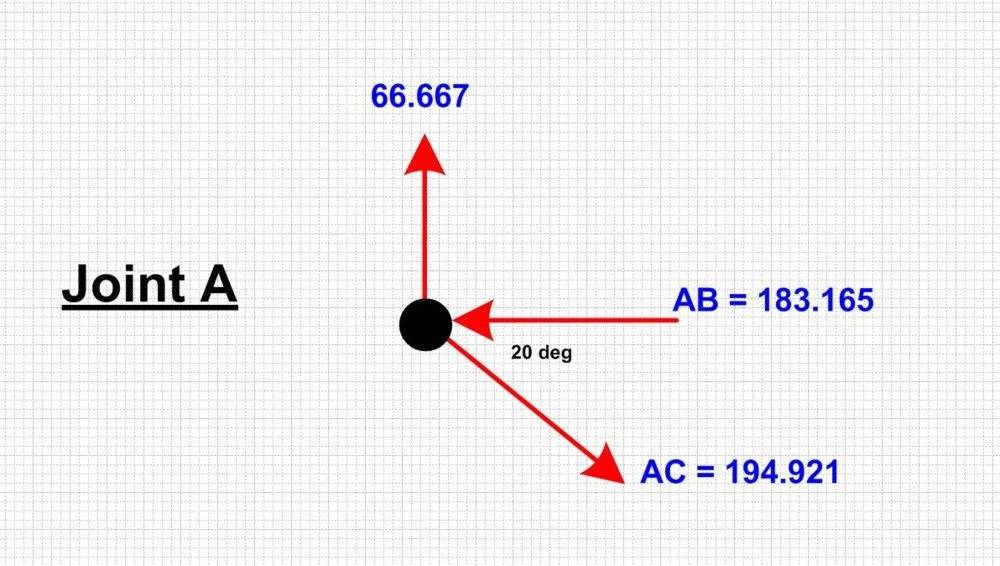
Just focusing on joint A, I have created a FDB and calculated all the forces:-
fbddddd.JPG


I know this is correct but I wanted to ask about the values of AB (183.165) & AC (194.921) - would I be correct in saying that the member AB is in compression and the compressive force through that member is 183.165kN, similarly would I be correct in saying that the member AC is in tension and the tensile forces through the member is 194.921kN?

I am trying to understand what the numbers mean?

Thoughts?

Thank you.
 
Engineering news on Phys.org
Yes that is correct. With a correct free body diagram it is easy to determine whether a member is in compression or tension. Compression forces in members are pushing forces and always act toward the joint. Tension forces in members are pulling forces and always act away from the joint. When using the method of sections, compression forces act toward the member and tension forces pull away from the member.
You asked what the numbers mean? These are the forces in the members used for member design. Compression forces subject members to buckling and are often more critical for equal size members .
 
PhanthomJay said:
Yes that is correct. With a correct free body diagram it is easy to determine whether a member is in compression or tension. Compression forces in members are pushing forces and always act toward the joint. Tension forces in members are pulling forces and always act away from the joint. When using the method of sections, compression forces act toward the member and tension forces pull away from the member.
You asked what the numbers mean? These are the forces in the members used for member design. Compression forces subject members to buckling and are often more critical for equal size members .

Phanthomjay

Thanks for clearing up my doubt.

I have the same question shown below:-

question 1.JPG
Focusing on just joints A & C the calculations are :-

q2222.JPG


I was wondering if you knew why 194.93 was Negative I am really struggling to figure out why it would be a negative value when checking for compression/tension at joint C when at Joint A it was a positive Tension?

Can you help?

Thanks
 
Oh the darn minus sign is always cause for confusion, so it’s perhaps not as easy as I mentioned.
First off, look at joint A. In your first post, you chose the correct direction of the forces. But in your second post, at joint A, you assumed the wrong direction for Force AB, and got a negative number for force AB. That negative number means you assumed the wrong direction for ForceAB, that is, it actually acts towards the joint as in your first post, not away from the joint which you assumed. The negative sign here means you assumed that he wrong direction for that force. I does not mean the force is a compression force. So immediately change your free body diagram to show F-AB acting toward the joint to the left, making it a compressive force because it acts toward the joint.
Now move to joint C. You know that Force AC is a tension force. So at Joint C it must pull away from the joint, as you have shown. Then when you sum forces in the x direction, it is a minus number for the x component because it acts left, but that doesn’t stop it from being a tension force. Note that you got a negative number for force BC. What does that mean? Tough question.
 

Similar threads

  • · Replies 1 ·
Replies
1
Views
2K
  • · Replies 2 ·
Replies
2
Views
4K
  • · Replies 18 ·
Replies
18
Views
7K
  • · Replies 2 ·
Replies
2
Views
2K
  • · Replies 12 ·
Replies
12
Views
5K
  • · Replies 1 ·
Replies
1
Views
4K
  • · Replies 1 ·
Replies
1
Views
2K
Replies
2
Views
2K
  • · Replies 4 ·
Replies
4
Views
2K
Replies
1
Views
2K