How to Calculate the Force Required to Lift an Arm

  • Thread starter Thread starter kgp43
  • Start date Start date
  • Tags Tags
    Arm Force Lift
Click For Summary
SUMMARY

The discussion focuses on calculating the force required to lift an arm using principles of mechanics. Key variables include the length of the arm (Lac), distances from the anchor point to the actuator (Lab and Lad), and angles (Da, Db, Dd). Participants recommend creating a free body diagram to visualize forces and torques, ensuring that both are balanced to prevent acceleration or rotation. An introductory textbook on mechanics is suggested for foundational concepts such as torque and levers.

PREREQUISITES
  • Understanding of basic mechanics principles, including forces and torques.
  • Familiarity with free body diagrams and their applications.
  • Knowledge of lever systems and their calculations.
  • Ability to interpret and apply mathematical formulas related to force and motion.
NEXT STEPS
  • Study the concept of torque and its calculations in mechanical systems.
  • Learn how to create and analyze free body diagrams effectively.
  • Research lever mechanics and the equations governing their operation.
  • Explore introductory textbooks on mechanics for a comprehensive understanding of the subject.
USEFUL FOR

Engineers, physics students, and anyone involved in mechanical design or analysis who seeks to understand the calculations necessary for lifting mechanisms.

kgp43
Messages
1
Reaction score
0
Hi,

Hope one of you might be able to help me with some calculations :)
I'm trying to calculate the amount of force required to lift an arm, based on weight, distances and angles.

I made a sketch to illustrate my problem.
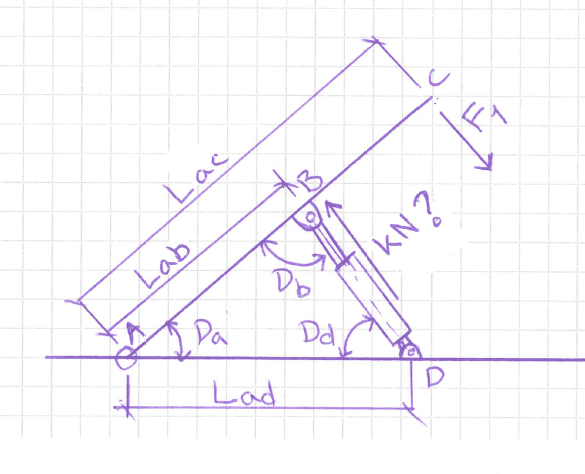
beregningsmodel 1.png


where:

Lac = Length of arm
Lab = Distance from "anker-point" to mounting point for cylinder/aktuator.
Lad = Distance from "anker-point" to mounting point for cylinder/aktuator.
F1 = Force in Kg.
Da = Angle #1
Db = angle #2
Dd = Angle #3

Is there a formula to calculate the force required to lift the arm? Not sure where to look.Thanks,

Kenneth

 
Engineering news on Phys.org
Hello kgp, :welcome: !

You can write balances for the forces and for the torques. Both should be zero (otherwise the lot will start to accelerate or to rotate). Be sure to include ALL the forces and torques.

You will also want to make some sensible approximations in order to get started: you have drawn the cylinder in great detail, but the arm is a single line. Is it massless ?

##F_1## is unclear to me. What does it represent ?

kgp43 said:
Not sure where to look
Seems to me an introductory textbook on mechanics should be helpful. Look under torque, lever and such things.
 
The first step is to make a free body diagram (search the term) from your sketch. The second step is to use the free body diagram to calculate the sum of moments about the pivot. Search that term also, but only AFTER you have a complete and correct free body diagram.
 

Similar threads

  • · Replies 9 ·
Replies
9
Views
2K
  • · Replies 9 ·
Replies
9
Views
2K
  • · Replies 2 ·
Replies
2
Views
4K
Replies
4
Views
2K
  • · Replies 3 ·
Replies
3
Views
2K
  • · Replies 28 ·
Replies
28
Views
2K
Replies
1
Views
2K
Replies
5
Views
2K
  • · Replies 1 ·
Replies
1
Views
2K
Replies
1
Views
1K