How to calculate the potential energy of a spring?

Click For Summary

Homework Help Overview

The discussion revolves around calculating the potential energy of a spring system, particularly in relation to a mass and its motion influenced by gravitational and spring forces. Participants are attempting to derive an equation for potential energy as a function of displacement.

Discussion Character

  • Exploratory, Conceptual clarification, Mathematical reasoning, Problem interpretation

Approaches and Questions Raised

  • Participants are exploring the relationship between gravitational potential energy and the potential energy stored in the springs. There are attempts to formulate equations that incorporate both types of energy, with some questioning the validity of their approaches and the role of velocity in the equations.

Discussion Status

There is ongoing dialogue about the correct formulation of the potential energy equation, with some participants providing guidance on how to consider the contributions from both gravitational and spring forces. Multiple interpretations of the problem are being explored, particularly regarding the components of forces and energy.

Contextual Notes

Some participants express uncertainty about the assumptions made regarding the system, such as the effects of the springs and the nature of the forces involved. There is also mention of the need for a free body diagram to clarify the forces acting on the mass.

ramialsaiad
Messages
24
Reaction score
0
Hi
I want to calculate the potential energy of the following figure in function of x
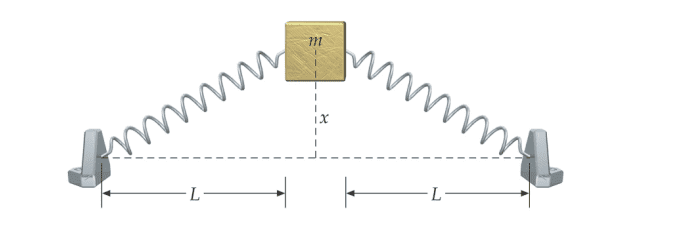
upload_2016-4-25_18-49-26.png


Here is my attempt :

mgx + 1/2*k*(sqrt(x^2+L^2)-L)=1/2*m*v^2

Is that correct ?

thanks
 
Last edited by a moderator:
Physics news on Phys.org
I really suck at physics, but I think that the forces exerted by the two springs should cancel each other out. So, the only thing which comes into play is gravitational potential energy. Someone please correct me if I'm wrong.

Edit: I think have taken only the mass m into account.
 
ramialsaiad said:
Hi
I want to calculate the potential energy of the following figure in function of x

View attachment 99738

Here is my attempt :

mgx + 1/2*k*(sqrt(x^2+L^2)-L)=1/2*m*v^2

Is that correct ?

thanks
Welcome to the PF.

Not quite right. Please do not deleted the Homework Help Template that you are provided when starting a schoolwork thread here. It helps to organize your thoughts, especially showing the Relevant Equations.

Your "equation" does not make sense in the context of the question you posed. The potential energy does not depend on velocity (why is that on the righthand side of the equation?)

Can you list the Relevant Equations for this problem? If you want to find the PE(x), you will add the gravitational PE to the PE of the stretching springs. Please draw a FBD of the mass in the middle, showing all of the forces on it.
atom jana said:
I really suck at physics, but I think that the forces exerted by the two springs should cancel each other out. So, the only thing which comes into play is gravitational potential energy. Someone please correct me if I'm wrong.

Edit: I think have taken only the mass m into account.
No, you are incorrect.
 
berkeman said:
Welcome to the PF.

Not quite right. Please do not deleted the Homework Help Template that you are provided when starting a schoolwork thread here. It helps to organize your thoughts, especially showing the Relevant Equations.

Your "equation" does not make sense in the context of the question you posed. The potential energy does not depend on velocity (why is that on the righthand side of the equation?)

Can you list the Relevant Equations for this problem? If you want to find the PE(x), you will add the gravitational PE to the PE of the stretching springs. Please draw a FBD of the mass in the middle, showing all of the forces on it.

No, you are incorrect.
here is my draw :

upload_2016-4-25_21-41-21.png


Is it correct?
thanks
 
Closer :smile:

You have the gravitational PE correct at mgx.

The PE from the stretched springs has to do with the force in the vertical direction, not in the directions of the springs. Take the vertical component of the spring force(s) to get the PE contribution from the stretched springs.
 
  • Like
Likes   Reactions: ramialsaiad
berkeman said:
Closer :smile:

You have the gravitational PE correct at mgx.

The PE from the stretched springs has to do with the force in the vertical direction, not in the directions of the springs. Take the vertical component of the spring force(s) to get the PE contribution from the stretched springs.
mgx = 1/2*k*(x/sin(a) - L)^2 + 1/2*k*(x/sin(a) - L)^2

upload_2016-4-25_22-1-33.png


Is it correct?
thanks
 
ramialsaiad said:
mgx = 1/2*k*(x/sin(a) - L)^2 + 1/2*k*(x/sin(a) - L)^2

View attachment 99745

Is it correct?
thanks
Closer still, but you should be adding mgx to those spring terms. You want an equation for PE(x) = ____________________

I'm also not real clear why you are dividing by the sine of the angle a...
 
berkeman said:
Closer still, but you should be adding mgx to those spring terms. You want an equation for PE(x) = ____________________

I'm also not real clear why you are dividing by the sine of the angle a...
PE(x) = mgx -1/2*k*(x/sin(a) - L)^2 - 1/2*k*(x/sin(a) - L)^2
(x/sin(a) - L) means that the distance of the stretched spring ... So x/sin(a) is total new distance and L is old distance .. So the difference x/sin(a)-L is the distance of the stretched spring ..
upload_2016-4-25_22-42-49.png


thanks
 
Ah, I get the distance thing now with the x/sin(a)-L. But that just gives you the PE from the force of the spring in the direction of the spring, not in the vertical direction. The horizontal forces of the two springs on the mass cancel out.
 
  • #10
berkeman said:
Ah, I get the distance thing now with the x/sin(a)-L. But that just gives you the PE from the force of the spring in the direction of the spring, not in the vertical direction. The horizontal forces of the two springs on the mass cancel out.
I do not know how to do ?
 
  • #11
berkeman said:
The PE from the stretched springs has to do with the force in the vertical direction, not in the directions of the springs. Take the vertical component of the spring force(s) to get the PE contribution from the stretched springs.
No, energy is a scalar. The PE in the springs relates to their extensions. It does not have components.
 
  • Like
Likes   Reactions: ramialsaiad
  • #12
haruspex said:
No, energy is a scalar. The PE in the springs relates to their extensions. It does not have components.
Do you have any idea how to build the equation of the potential energy for the system
thanks
 
  • #13
ramialsaiad said:
PE(x) = mgx -1/2*k*(x/sin(a) - L)^2 - 1/2*k*(x/sin(a) - L)^2
Nearly right, but in my experience stretching a spring increases its potential energy.
 
  • Like
Likes   Reactions: ramialsaiad
  • #14
haruspex said:
Nearly right, but in my experience stretching a spring increases its potential energy.
Can you correct my formula ?
thanks
 
  • #15
ramialsaiad said:
Can you correct my formula ?
thanks
I can, but you are going to. The equation you wrote would have the springs' contribution to the total PE decreasing when the springs are stretched. What do you think must be wrong?
 
  • Like
Likes   Reactions: ramialsaiad
  • #16
haruspex said:
I can, but you are going to. The equation you wrote would have the springs' contribution to the total PE decreasing when the springs are stretched. What do you think must be wrong?
is it the signs ?
PE(x) = mgx +1/2*k*(x/sin(a) - L)^2 + 1/2*k*(x/sin(a) - L)^2
 
  • #17
ramialsaiad said:
is it the signs ?
PE(x) = mgx +1/2*k*(x/sin(a) - L)^2 + 1/2*k*(x/sin(a) - L)^2
Yes.
 
  • Like
Likes   Reactions: ramialsaiad
  • #18
haruspex said:
Yes.
So now it is correct formula ?
 
  • #19
haruspex said:
Yes.
thank you very much
 
  • #20
ramialsaiad said:
here is my draw :

View attachment 99744

Is it correct?
thanks
It strikes me that from that figure, the block may be moving on a horizontal surface.
 
  • #21
SammyS said:
It strikes me that from that figure, the block may be moving on a horizontal surface.
Is that the force of the block in function of x is : F(x) = k*(x/sin(a) - L) + k*(x/sin(a) - L)
and the kinetic energy in function of x is : KE(x)= 1/2*m*v^2 + 1/2*m*v^2 (I cannot express it in x)
Is that correct ?
thanks
 
  • #22
ramialsaiad said:
Is that the force of the block in function of x is : F(x) = k*(x/sin(a) - L) + k*(x/sin(a) - L)
and the kinetic energy in function of x is : KE(x)= 1/2*m*v^2 + 1/2*m*v^2 (I cannot express it in x)
Is that correct ?
thanks
Why the two 1\2 mv2 terms?
You probably need to express it in terms of dx/dt.
 
  • #23
haruspex said:
Why the two 1\2 mv2 terms?
You probably need to express it in terms of dx/dt.
So you mean that this F(x) = k*(x/sin(a) - L) + k*(x/sin(a) - L) is correct !
and KE(x)= 1/2*m*v^2 + 1/2*m*v^2 = KE(x)= 1/2*m*(dx/dt)^2 + 1/2*m*(dx/dt)^2
Is it like that?
thank you very much
 
  • #24
Why didn't you use vectors if you want the net force on the object?

I think he means, Why do you have two 0.5 m v^2? What does the second one represent?

I guess I know what the mentor meant by getting its components.. Because the vertical is doing positive work and the horizontal should have a work of 0 J because it doesn't move horizontally( Springs forces cancel each other if they have the same spring constant).

So If you use the vertical component but you have a variable that changes over time which is theta but both ways should yield in the same result right?
 
Last edited:
  • #25
Biker said:
Why didn't you use vectors if you want the net force on the object?

I think he means, Why do you have two 0.5 m v^2? What does the second one represent?
We have two springs so the kinetic energy should be double as much ,, is not that?
thanks
 
  • #26
ramialsaiad said:
We have two springs so the kinetic energy should be double as much ,, is not that?
thanks
Eh...?
From what I know we use f = kd only if the springs are mass-less... So you they don't actually have kinetic energy.

What you should substitute there is the mass of the object not the springs
 
  • #27
Biker said:
Eh...?
From what I know we use f = kd only if the springs are mass-less... So you they don't actually have kinetic energy.

What you should substitute there is the mass of the object not the springs
Can you write the kinetic energy equation here?
 
  • #28
ramialsaiad said:
We have two springs so the kinetic energy should be double as much ,, is not that?
thanks
The kinetic energy is possessed by the mass m, and there is only one of those. The springs are considered massless. The mass does not care how it gets its KE, whether from one spring or two.
 
  • #29
haruspex said:
The kinetic energy is possessed by the mass m, and there is only one of those. The springs are considered massless. The mass does not care how it gets its KE, whether from one spring or two.
can you write the equation here ?
thanks
 
  • #30
ramialsaiad said:
can you write the equation here ?
thanks
No, that's your job.
To recap:
In post #16 you had the right expression for the potential energy in the springs.

Unless you have some good reason to suppose it is in the vertical plane, go with Sammy's suggestion that is is horizontal, so discard any gravitational term.

In post #21 your force equation is quite wrong. You cannot add forces acting in different directions as though they are scalars. If you want the net force from the springs then you need to consider the x and y components of the forces. (This is the path berkeman was going down, but he wrongly tried to apply that to the PE of the springs instead of to their tensions.). But I don't think you need to worry about forces anyway, just concentrate on energy.

In post #21, your KE expression had two copies of 1/2 mv2. There is one mass m moving at speed v, not two.

From all that, see if you can put together the correct expression for the total energy.
 

Similar threads

Replies
29
Views
3K
Replies
24
Views
4K
  • · Replies 21 ·
Replies
21
Views
2K
  • · Replies 15 ·
Replies
15
Views
2K
  • · Replies 20 ·
Replies
20
Views
4K
  • · Replies 2 ·
Replies
2
Views
1K
Replies
7
Views
1K
  • · Replies 3 ·
Replies
3
Views
2K
Replies
6
Views
2K
  • · Replies 13 ·
Replies
13
Views
1K