How to Calculate the Pseudoinverse Using the SVD?

Join the discussion
Registration is free. Ask a follow-up in this thread, or start your own.
6 replies · 2K views
nao113
Messages
68
Reaction score
13
Homework Statement
Hello, I have question related to SVD. Can anyone give me hints about what should I do to solve this question. I provided the question and my answer on the picture below. I have found the eigenvalues and eigenvector but I m not sure whether it is correct not and then whether this answer already cover the question. Thank you
Relevant Equations
𝐀=𝐔Σ𝐕∗
Screen Shot 2022-05-21 at 16.05.23.png


My Answer:
I am still beginner in this area so it s quite hard for me to understand this one. I am not sure what the output that this question asked me. I thought it might be asked about the value of x1, x2, x3, and x4
WhatsApp Image 2022-05-22 at 4.32.31 PM.jpeg
 
  • Like
Likes   Reactions: Delta2
Physics news on Phys.org
Recheck that determinant for ##~\mathbf{H^T H - I} \it \lambda ## .
 
  • Like
Likes   Reactions: Mark44
SammyS said:
Recheck that determinant for ##~\mathbf{H^T H - I} \it \lambda ## .
Hello, thank you the respond, actually, I have correct my mistakes here. I already got the answer from this. But still, can you help me to understand what is U means? and how to get the matrix for it as well as Vt?
 

Attachments

  • Screen Shot 2022-06-08 at 17.07.42.png
    Screen Shot 2022-06-08 at 17.07.42.png
    15.2 KB · Views: 163
nao113 said:
Hello, thank you the respond, actually, I have correct my mistakes here. I already got the answer from this. But still, can you help me to understand what is U means? and how to get the matrix for it as well as Vt?
U is one of the parts of the SVD, which is given by U Σ VT.
See: https://en.wikipedia.org/wiki/Singular_value_decomposition
Sometimes the letter S is used in place of Σ, which is the case in the image you've linked to.

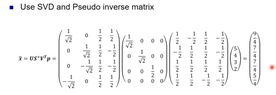
The image you linked is trying to show how to calculate the pseudoinverse using the SVD: https://en.wikipedia.org/wiki/Moore–Penrose_inverse. See the heading about 2/3 of the way down the page: "Singular value decomposition (SVD)"

but they have made a mistake. They show the pseudoinverse as: US+VT, but it should be VS+UT

The numeric values they show are correct.
 
The Electrician said:
U is one of the parts of the SVD, which is given by U Σ VT.
See: https://en.wikipedia.org/wiki/Singular_value_decomposition
Sometimes the letter S is used in place of Σ, which is the case in the image you've linked to.

The image you linked is trying to show how to calculate the pseudoinverse using the SVD: https://en.wikipedia.org/wiki/Moore–Penrose_inverse. See the heading about 2/3 of the way down the page: "Singular value decomposition (SVD)"

but they have made a mistake. They show the pseudoinverse as: US+VT, but it should be VS+UT

The numeric values they show are correct.
do you know how to change S to S+?
 
nao113 said:
do you know how to change S to S+?
Re-read the section I linked to:

The image you linked is trying to show how to calculate the pseudoinverse using the SVD: https://en.wikipedia.org/wiki/Moore–Penrose_inverse. See the heading about 2/3 of the way down the page: "Singular value decomposition (SVD)"

"For a rectangular diagonal matrix such as S, we get the pseudoinverse by taking the reciprocal of each non-zero element on the diagonal, leaving the zeros in place, and then transposing the matrix. In numerical computation, only elements larger than some small tolerance are taken to be nonzero, and the others are replaced by zeros." Any of the elements that are very small (comparable to to the value of epsilon in the arithmetic of the math system you're using) are replaced by zero, not reciprocated."
 
  • Informative
Likes   Reactions: Delta2