How to calculate the Torque for a Set screw

  • Thread starter Thread starter psugumaran
  • Start date Start date
  • Tags Tags
    Screw Set Torque
Click For Summary
SUMMARY

This discussion focuses on calculating the required torque for tightening set screws in a mechanical assembly involving O-rings and an aluminum sleeve. The set screws, specifically M3 size, are used to compress Viton O-rings against the sleeve, which is rotated by hand. The maximum torque applied by a human hand is noted as 9000 N-mm. The conversation highlights the importance of material selection for O-rings and the engineering challenges of achieving precise compression without individual adjustments to the screws.

PREREQUISITES
  • Understanding of torque calculations in mechanical assemblies
  • Familiarity with O-ring materials and their properties, specifically Viton
  • Knowledge of aluminum alloys, particularly Aluminum 6061-T6
  • Basic principles of mechanical engineering design and assembly techniques
NEXT STEPS
  • Research the coefficient of friction for Viton and alternative O-ring materials like Buna N
  • Learn about proper torque specifications and their implications in mechanical design
  • Investigate methods for measuring O-ring compression and gap dimensions in assemblies
  • Explore best practices for designing adjustable mechanical components without compromising performance
USEFUL FOR

Mechanical engineers, product designers, and anyone involved in the design and assembly of mechanical systems requiring precise torque application and material selection.

psugumaran
Messages
3
Reaction score
0
Hi,
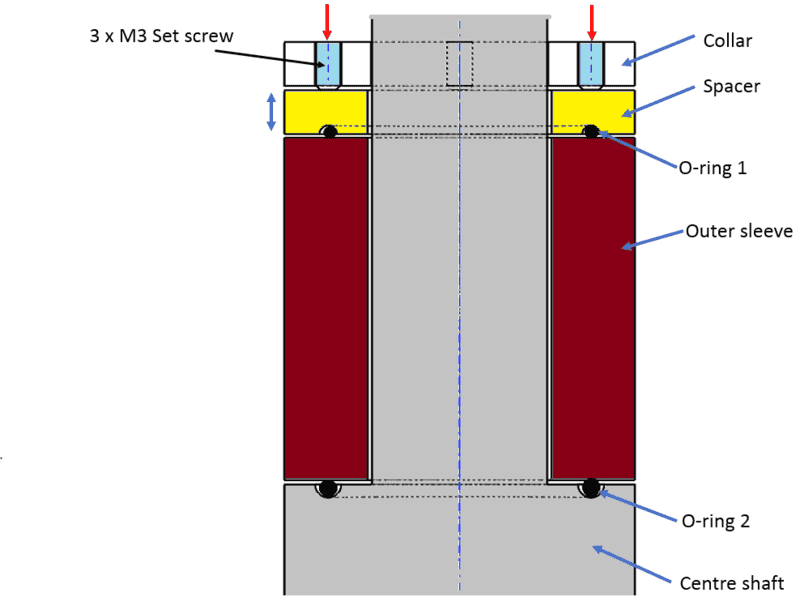
I am working on a problem where I have to find the tightening torque required for rotating the outer sleeve. The Outer sleeve is rotated by human hand ( One hand operation) hence the sleeve torque feel is determined by the set screw.

Problem statement: Please refer the image. O-ring 1 at the spacer will compress the Outer sleeve against O-ring 2 by means of tightening the set screws in the collar. The spacer is movable (floating position) and collar is fastened with shaft (fixed position). When the set screw is tighten, the spacer moves and compress the O-ring (1) against outer sleeve.

I have to calculate, How much torque is required for set screw to tighten so that sleeve will be rotated against the O-rings (1&2). Consider it is a dry condition
Set screw = 3 nos (M3)
O-ring material = Viton
Sleeve material = Aluminum 6061-T6
Maximum Torque applied by human hand (One hand) = 9000 N-mm

Thanks in advance.
upload_2017-7-7_10-11-20.png
 

Attachments

  • upload_2017-7-7_9-39-7.png
    upload_2017-7-7_9-39-7.png
    13.3 KB · Views: 830
Engineering news on Phys.org
psugumaran said:
Maximum Torque applied by human hand (One hand) = 9000 N-mm
Where does the figure 9000 N⋅mm come from?
 
A bit off point, but, if these o-rings are for providing mechanical friction only, unless there is a chemical resistance issue, Viton is poor material for that type of application. A 60 or 90 Duro NPR (Buna N) would be a better choice for contact surface durability.
 
I doubt any calculation will be very accurate but will need the diameter of the O-rings and the coefficient of friction which seems hard to find.
 
Last edited:
  • Like
Likes Nidum
Rubber materials have a coefficient of friction that is highly dependent on water or oil as lubricant. If the surfaces are dry, rotation of the sleeve will damage the O-rings. You need a surface with a predictable coefficient of friction that can slide without damage. I expect that when the O-ring is dry, the spacer will slide on the steel set-screw ends rather than the O-ring slide on the sleeve.

What is the purpose of the O-rings? Why do you need to rotate the sleeve by hand?
 
  • Like
Likes CWatters
@psugumaran : Sorry but use of three separate and non locked screws adjusted individually to position an essentially floating collar to compress an O ring by an unspecified amount is not good engineering .

Use of torque values on the adjusting screws to set up the assembly even approximately correctly is in any case going to be problematic .

In this kind of assembly the proper quantities to specify are the dimensions which control the compression of the O ring .

In components which nominally touch then the compression is controlled by the ring groove dimensions .

In components which have some separation then compression is additionally controlled by the separation distance .

Ideally the components are dimensioned so that they can just be put together and then the O ring compression gets set correctly without any adjustment at all .

If it is absolutely necessary to have adjustment then a gap dimension between components can be given and set to correct value during assembly using feeler gauges .
 
Last edited:
Purely as a matter of interest the Bristol Siddeley/Rolls Royce Olympus engines of series 101 , 201 , 301 and early 593 all had a designed in gap in the outer casing . With so many component dimensions involved the stack up dimensions of inner and outer assemblies could not be guaranteed to match exactly . So a deliberate gap was left in the casing which was measured and then a precision ring specially manufactured to close the gap .
 

Similar threads

  • · Replies 8 ·
Replies
8
Views
4K
  • · Replies 9 ·
Replies
9
Views
3K
  • · Replies 9 ·
Replies
9
Views
1K
  • · Replies 2 ·
Replies
2
Views
1K
Replies
13
Views
7K
  • · Replies 1 ·
Replies
1
Views
5K
  • · Replies 21 ·
Replies
21
Views
5K
Replies
3
Views
2K
  • · Replies 9 ·
Replies
9
Views
4K
  • · Replies 264 ·
9
Replies
264
Views
32K