How to calculate time with delta-v and velocity?

  • Context: High School 
  • Thread starter Thread starter alberto91
  • Start date Start date
  • Tags Tags
    Delta-v Time Velocity
Click For Summary

Discussion Overview

The discussion revolves around calculating time using delta-v and velocity, focusing on the relationships between these variables under different conditions, particularly in the context of acceleration. Participants explore dimensional analysis and the proper use of units in equations related to motion.

Discussion Character

  • Technical explanation
  • Mathematical reasoning
  • Debate/contested

Main Points Raised

  • Some participants question the correctness of the time calculation, noting that the time appears to be expressed in minutes instead of seconds.
  • There are claims that dimensional analysis shows the variable for time has no units, suggesting a potential error in the formulation.
  • One participant suggests using the equation t = d/v, emphasizing that distance must be correctly defined in the context of the calculation.
  • Another participant proposes using the relationship between velocity and time through acceleration, providing a method to derive time based on constant acceleration.
  • There is a request for clarification on whether constant acceleration is assumed, with a specific value suggested for consideration.

Areas of Agreement / Disagreement

Participants express differing views on the correctness of the time calculation and the appropriate use of units. There is no consensus on the proper approach or assumptions regarding acceleration.

Contextual Notes

Limitations include missing assumptions about acceleration and the specific context of the problem, as well as unresolved issues regarding the units used in the calculations.

alberto91
Messages
15
Reaction score
19
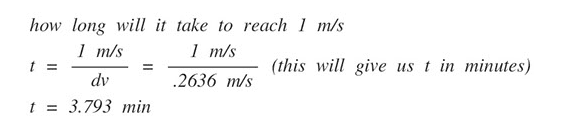
Is this correct?

Sin título.png


Why the time is minutes instead of seconds?

Thanks!
 
  • Like
Likes   Reactions: Delta2
Mathematics news on Phys.org
By dimensional analysis your t has no units.
 
WWGD said:
By dimensional analysis your t has no units.

And how can I calculate that equation?
 
What I mean is you're dividing two expressions with m/s as units, which cancel out. This tells you you're doing something wrong somewhere. I guess you want to use t=d/v? Then d is given in meters ( or another unit of distance) . In your case you used 1 m/s , which is not a measure of distance.
 
WWGD said:
What I mean is you're dividing two expressions with m/s as units, which cancel out. This tells you you're doing something wrong somewhere. I guess you want to use t=d/v? Then d is given in meters ( or another unit of distance) . In your case you used 1 m/s , which is not a measure of distance.

Thanks for your answer.

I want to use delta-vee (dv)
 
To find the time you need a relationship between velocity and time such as the definition of acceleration:

##\frac{dv}{dt}=a##

Then separate and integrate:

##dv=adt \rightarrow \int_{0}^{v_{needed}} dv = \int_{0}^{t_{needed}}a dt##

This gives

##v_{needed} = at_{needed}##

So to find the time needed to get to the needed velocity, simply divide.

##t_{needed} = v_{needed}/a##

Note that this assumes constant acceleration from zero. So it seems the solution you showed has the wrong units for acceleration.
 
Last edited:
There is context missing. Do you have a constant acceleration? If yes, what is its value? Maybe 0.2636 m/(s*min)?
 

Similar threads

  • · Replies 23 ·
Replies
23
Views
3K
  • · Replies 41 ·
2
Replies
41
Views
3K
  • · Replies 33 ·
2
Replies
33
Views
4K
  • · Replies 35 ·
2
Replies
35
Views
3K
  • · Replies 10 ·
Replies
10
Views
3K
  • · Replies 2 ·
Replies
2
Views
2K
  • · Replies 7 ·
Replies
7
Views
3K
  • · Replies 21 ·
Replies
21
Views
5K
  • · Replies 5 ·
Replies
5
Views
2K
  • · Replies 6 ·
Replies
6
Views
3K